

By Chris Forrester
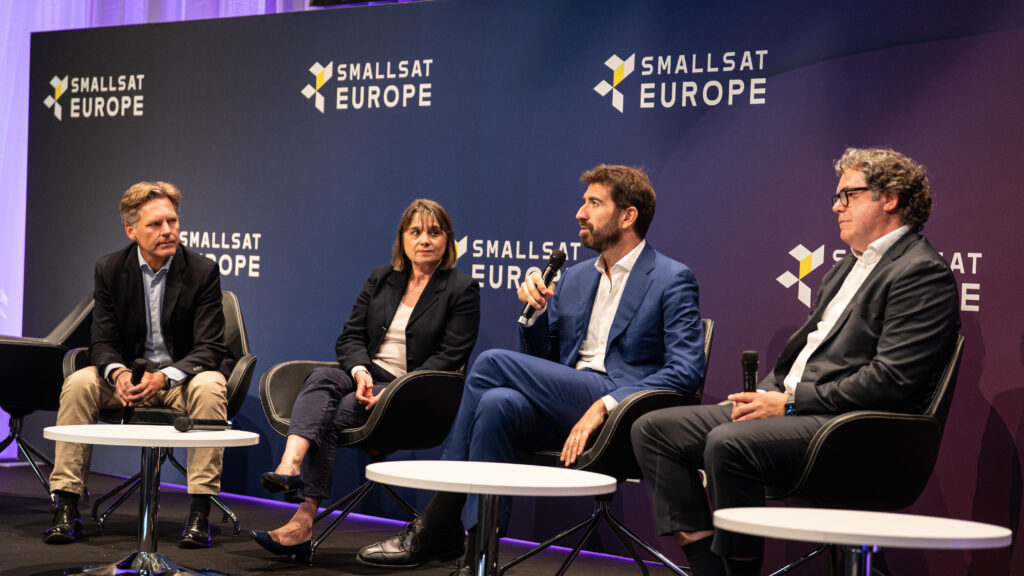
Dara Penahy (Partner, Millbank LLP) moderated this fascinating panel. He told delegates that – at Q1 – the sector was about 10% up on private equity raising compared with 2024. But it seems everything has changed in the past couple of months, and the Trump administration seems to have helped the cash flow towards Europe and away from the US. This is generating a significant amount of interest in European activity, he said.
Sandrine Bedat (Deputy Head of the Defense, Shipping, Space, Telecom Unit, BPI France) said her bank supported the export prospects of a business especially if a conventional commercial bank was reluctant to embrace long-term financing. Her portfolio has included the space sector for 22 years and most of the related French export credits supported over the period whatever the financing structure. BPI could handle financing of up to 15 years.
Wim Steenbakkers (Managing Director, ING Wholesale Banking) said that little has changed in terms of the usual due diligence, but when commercial banks suffer and retreat we have seen funding take precedence over satellite building or launching. And the technology is changing fast, but this gives opportunities especially in Earth observation. He has more than 25 years global satellite finance and advisory experience ranging from corporate to structured project (export) finance and start-ups to mature corporates
Dr. Gianluigi Baldesi (Head of Ventures and Financing Office, European Space Agency) said that in 35 years the ESA financial model had changed. Initially it was innovation and R&D but nowadays the sector was increasingly vibrant, and ESA was supporting market growth in terms of new business. The latest initiative is the European Launcher Challenge. It is important to attract new ideas and concepts, and Space is at the top of every government’s agenda and at the Prime Ministerial level. ESA is present to help them.
Anders Bohlin (Lead Economist – Digital Infrastructure, European Investment Bank) said the EIB took a long-term view of the market. Today, we look at small ticket items, say €10-€20 million. Mr Bohlin has also contributed in defining new financial instruments for digital infrastructure jointly with the European Commission, national promotional banks and the private sector. There were recent changes and today the EIB can also help fund projects where the end client is military, for example. However, there’s a problem in market fragmentation. We see these new players but they are often too small. They are good companies but they need to merge. The rule even applies to us. We are the biggest financial player in our sector Europe but there should be more of us! EIB can help with defence-related projects, except where weapons are involved.
The panel discussed IRIS2. Steenbakkers said that first there needed to be solid contracts in place. There will be a detailed technical due diligence for the project. Key to the financing dilemma would be the ultimate cashflows.
Sandrine Bedat agreed, and said nobody knew anything about IRIS2, but did not doubt that lenders would be present once the project’s details were known. The earlier those details were known was better, and the length of the terms of the loans needed.
