



Blue Origin successfully completed its 29th New Shepard flight and 14th payload mission today from Launch Site One in West Texas. The payloads experienced roughly two minutes of lunar gravity forces. The New Shepard crew capsule used its reaction control system to spin up to approximately 11 revolutions per minute, simulating one-sixth Earth gravity at the midpoint of the crew capsule lockers. Photos by Satnews.
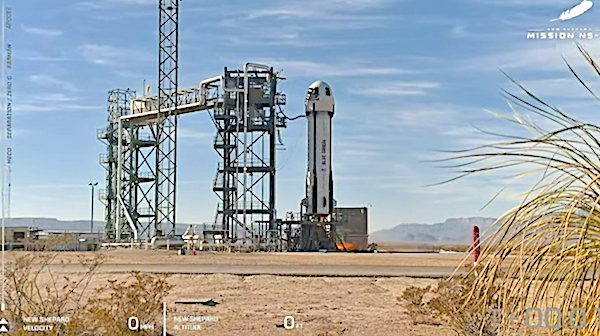
The NS-29 mission, scheduled to launch a week earlier, was scrubbed after an extended countdown hold, in which both weather conditions and a technical issue were the culprits. It was explained that the previous scrub was caused by an avionics issue that kept the vehicle from verifying commands.

The flight carried 30 payloads from NASA, research institutions, and commercial companies, bringing the number of payloads flown on New Shepard to more than 175. Club for the Future, Blue Origin’s nonprofit, flew thousands of postcards as part of its Postcards to Space program. Each postcard will be returned to its creator stamped “Flown to Space.” The Club has a digital method to create and send postcards, which can be found here.

Key Mission Statistics
- Official Launch Time: 10:00:00 AM CST / 16:00:00 UTC
- Booster Apogee: 341,700 ft AGL / 345,347 ft MSL (104 km AGL / 105 km MSL)
- Crew Capsule Apogee: 341,944 ft AGL / 345,591 ft MSL (104 km AGL / 105 km MSL)
- Crew Capsule Landing Time: 10:10:06 AM CST / 16:10:06 UTC
- Mission Elapsed Time: 10 minutes, 6 seconds
“New Shepard’s ability to provide a lunar gravity environment is an extremely unique and valuable capability as researchers set their sights on a return to the Moon,” said Phil Joyce, SVP, New Shepard. “This enables researchers to test lunar technologies at a fraction of the cost, rapidly iterate, and test again in a significantly compressed timeframe.”
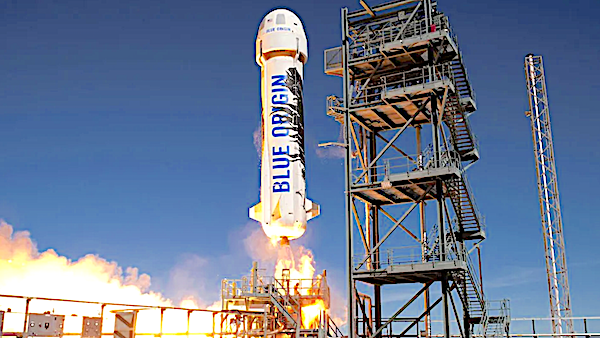
Another launch day has been announced by Blue Origin regarding the much delayed and scrubbed New Shepard NS-29 mission. The new date is now Tuesday, February 4 at 7:30 am – 3:30 pm PST from from West Texas Suborbital Launch Site/ Corn Ranch. Photo credit Blue Origin.
This site launched 28 rockets, including 0 orbital launch attempts. This mission will simulate the Moon’s gravity and fly 30 payloads, all but one of which is focused on testing lunar-related technologies.
NS-29 will simulate the Moon’s gravity and fly 30 payloads, all but one of which is focused on testing lunar-related technologies.
The payloads will experience at least two minutes of lunar gravity forces, a first for New Shepard and made possible in part through support from NASA. The flight will test six broad lunar technology areas: In-situ resource utilization, dust mitigation, advanced habitation systems, sensors and instrumentation, small spacecraft technologies, and entry descent and landing. Proving out these technologies at lower cost is another step toward Blue Origin’s mission to lower the cost of access to space for the benefit of Earth. It also enables NASA and other lunar surface technology providers to test innovations critical to achieving Artemis program goals and exploring the Moon’s surface.
The New Shepard crew capsule is using its Reaction Control System (RCS) to spin up to approximately 11 revolutions per minute. This spin rate simulates one-sixth Earth gravity at the midpoint of the crew capsule lockers. In simulated lunar gravity, customers can accelerate their learning and technology readiness for lunar payloads at much lower cost.
Blue Origin scrubs Tuesday’s launch of New Shepard’s NS-29 and plans for Thursday
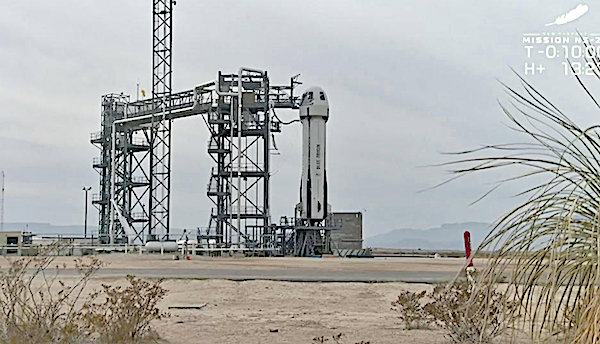
“We are scrubbing today’s launch. In addition to thick clouds we’ve been tracking all morning, we also encountered an issue related to the booster’s avionics. New launch target forthcoming,” Blue Origin announced via X today.
“The payloads will experience at least two minutes of forces, a first for New Shepard and made possible in part through support from NASA,” Blue Origin wrote in a mission description. “The flight will test six broad lunar technology areas: in-situ resource utilization, dust mitigation, advanced habitation systems, sensors and instrumentation, small spacecraft technologies, and entry, descent and landing.”
.Proving out these technologies at lower cost is another step toward Blue Origin’s mission to lower the cost of access to space for the benefit of Earth. It also enables NASA and other lunar surface technology providers to test innovations critical to achieving Artemis program goals and exploring the Moon’s surface.
Blue Origin says Go! to New Shepard’s NS-29 Tuesday mission
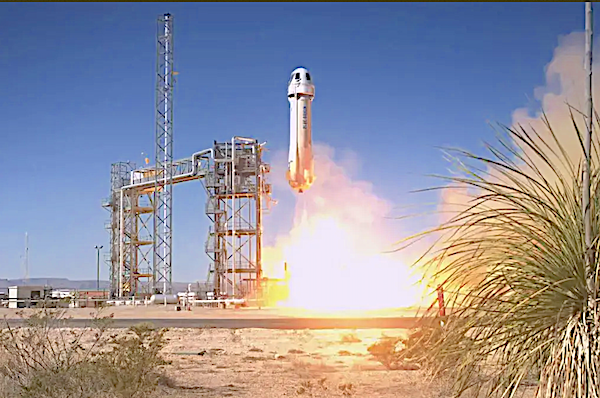
So far, so good, for tomorrow’s New Shepard NS-29 launch from West Texas Suborbital Launch Site/ Corn Ranch.
The forecast calls for a temperature of 41°F, overcast clouds, 100% cloud cover and a wind speed of 3mph.
The payloads will experience at least two minutes of lunar gravity forces, a first for New Shepard and made possible in part through support from NASA. The flight will test six broad lunar technology areas: In-situ resource utilization, dust mitigation, advanced habitation systems, sensors and instrumentation, small spacecraft technologies, and entry descent and landing.
Blue Origin’s mission NS-29 to experience two minutes of lunar gravity forces, a first for New Shepard

On Tuesday, January 28 with a window from 8:00 AM – 3:30 PM PST Blue Origin’s New Shepard NS-29 will launch from West Texas Suborbital Launch Site/ Corn Ranch. This site launched 28 rockets, including 0 orbital launch attempts. This mission will simulate the Moon’s gravity and fly 30 payloads, all but one of which is focused on testing lunar-related technologies.
The payloads will experience at least two minutes of lunar gravity forces, a first for New Shepard and made possible in part through support from NASA. The flight will test six broad lunar technology areas: In-situ resource utilization, dust mitigation, advanced habitation systems, sensors and instrumentation, small spacecraft technologies, and entry descent and landing. Proving out these technologies at lower cost is another step toward Blue Origin’s mission to lower the cost of access to space for the benefit of Earth. It also enables NASA and other lunar surface technology providers to test innovations critical to achieving Artemis program goals and exploring the Moon’s surface.
The New Shepard crew capsule is using its Reaction Control System (RCS) to spin up to approximately 11 revolutions per minute. This spin rate simulates one-sixth Earth gravity at the midpoint of the crew capsule lockers. In simulated lunar gravity, customers can accelerate their learning and technology readiness for lunar payloads at much lower cost.

New Shepard’s 29th flight brings the total number of commercial payloads flown on New Shepard to more than 175. Of the mission’s 30 payloads, 29 will fly inside the crew capsule and one will fly on the booster with exposure to the ambient space environment. More than half are supported by NASA’s Flight Opportunities program, which is managed by the agency’s Space Technology Mission Directorate. Four of the payloads are from Honeybee Robotics, a division within Blue Origin’s In-Space Systems business. Honeybee’s experiments will test technologies focused on penetrating, excavating, and processing lunar regolith.
This mission will fly our dedicated payloads capsule paired with our recently-debuted booster, demonstrating the compatibility between the boosters and capsules in our fleet and increasing launch availability for our customers. We now have three capsules and two boosters in service to better address sales demand for payloads and astronauts.
The mission will also carry thousands of postcards on behalf of Club for the Future, Blue Origin’s STEAM-focused nonprofit whose mission is to inspire and mobilize future generations to pursue careers in science, technology, engineering, arts, and math. The organization has engaged more than 44 million people globally since its founding in 2019. Students can submit digital postcards here.
NS-29 Manifest Highlights
- Electrostatic Dust Lofting (EDL), NASA Kennedy Space Center: EDL is a project studying how Moon dust gets electrically charged and lifted up when exposed to ultraviolet light. Insights from this study will help future lunar missions address dust problems. The project was created by NASA’s Kennedy Space Center in Florida along with the University of Central Florida and the University of Colorado, Boulder.
- Fluidic Operations in Reduced Gravity Experiment (FORGE), NASA Jet Propulsion Laboratory (JPL): FORGE will test how to manage liquids and gases in space. This technology is critical for instruments that may monitor water quality for astronauts or search for evidence of life on ocean worlds in our solar system.
- Honey Bubble Excitation Experiment (H-BEE), Honeybee Robotics: H-BEE is a tool evaluating how bubbles behave in thick liquids on the Moon. The insights will help better predict how oxygen bubbles will act in melted Moon rock during a process called molten regolith electrolysis.
- Soil Properties Assessment Resistance and Thermal Analysis (SPARTA), JPL:SPARTA is a toolkit designed for geomechanical testing below the lunar surface. The test aims to understand how lunar gravity affects its performance. SPARTA was created by JPL in Southern California and developed by Honeybee Robotics.
- Lunar-g Combustion Investigation (LUCI), NASA Glenn Research Center: LUCI is an experiment to study how materials catch fire in the Moon’s gravity compared to Earth’s. The findings will help NASA and its partners create safer living and working habitats for people on the Moon. This project is developed by NASA’s Glenn Research Center in Cleveland, Ohio, together with Voyager Technologies.
- Film Evaporation MEMS Tunable Array Micropropulsion System (FEMTA), Purdue University: FEMTA is a water-based micro-propulsion system in development by researchers at Purdue. This small thruster helps precisely control the direction and positioning of small satellites. The experiments are measuring how well FEMTA and its passive propellant delivery system work in the low-gravity environment of space. The experiment will be flown on the New Shepard booster.
