

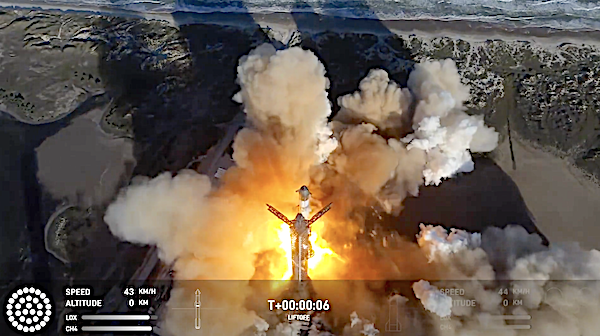
All began smoothly as SpaceX’s Starship tore through the skies from Boca Chica, Texas with 33 out of 33 engines working to send it on it’s seventh flight test. All photos provided by Satnews.
As the journey continued ground control lost its live stream and all communications with Starship. Word continued informing all that several engines had been lost and telemetry, and that the ship had been lost. A new rocket was used on this mission. As a result the plan to deploy 10 Starlink satellite simulators for the first time was scrubbed.
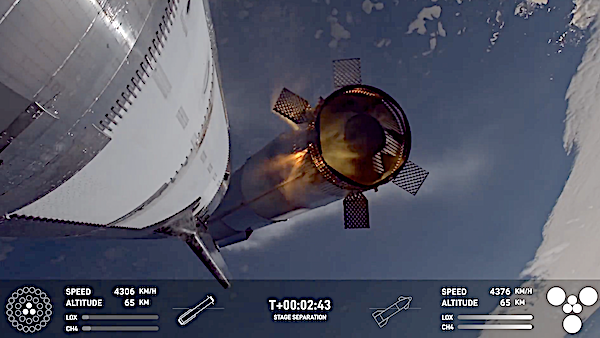
SpaceX issued this statement: Starship experienced a rapid unscheduled disassembly during its ascent burn. Teams will continue to review data from today’s flight test to better understand root cause. With a test like this, success comes from what we learn, and today’s flight will help us improve Starship’s reliability.
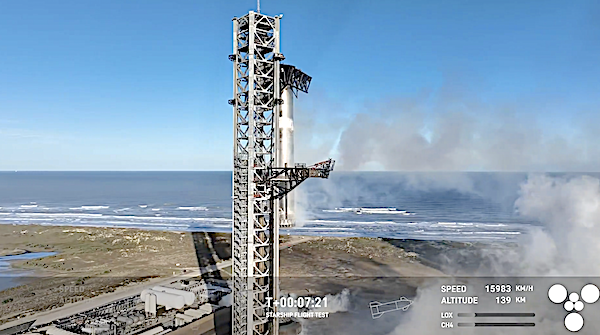
Despite the loss of Starship, the enormous first-stage booster successfully conducted a controlled descent returning to the launch tower as the launch robotic arms caught the engine making it the second such catch for SpaceX.
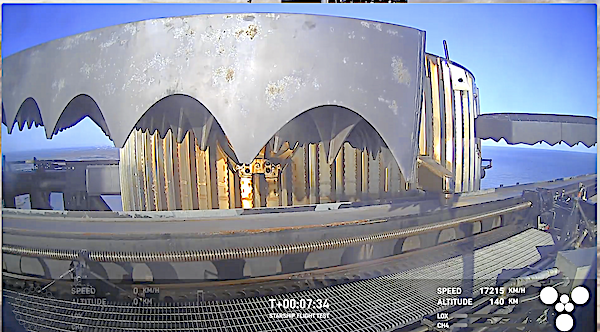
This was the second successful catch as Starship’s previous capture was on the fifth launch test. During Starship’s sixth launch test in November, the spacecraft splashed down in the Indian Ocean but an attempted catch of its Super Heavy booster was skipped.
SpaceX’s Starship flight test seven now on Thursday

The seventh flight test of Starship is preparing to launch Thursday, January 16. The 60-minute launch window will open at 4:00 p.m. CT.
SpaceX was scheduled to launch Starship from Boca Chica, Texas, at around 5 p.m. EST, but announced around 10 a.m. Wednesday they were now targeting Thursday for the launch due to weather.
The seven-day forecast from the nearest National Wather Service station showed it was 55 degrees with fog and mist around the scheduled time of the launch Wednesday, and the forecast for Thursday said it would be cloudy in the mid morning before clearing in the afternoon.
Starship’s Super Heavy booster will reuse one of its 33 engines for the first time and if conditions are optimal, SpaceX will attempt to catch the booster with two mechanical arms much like the successful catch of Starship’s fifth launch test. During Starship’s sixth launch test in November, the spacecraft splashed down in the Indian Ocean but an attempted catch of its Super Heavy booster was skipped.
SpaceX has requested approval from the FAA to increase the maximum number of annual Starship launches from five to 25. The FAA is expected to rule on the proposal after a public comment period ends on Jan. 17.
SpaceX now plans launch of Starship’s seventh test flight on Wednesday
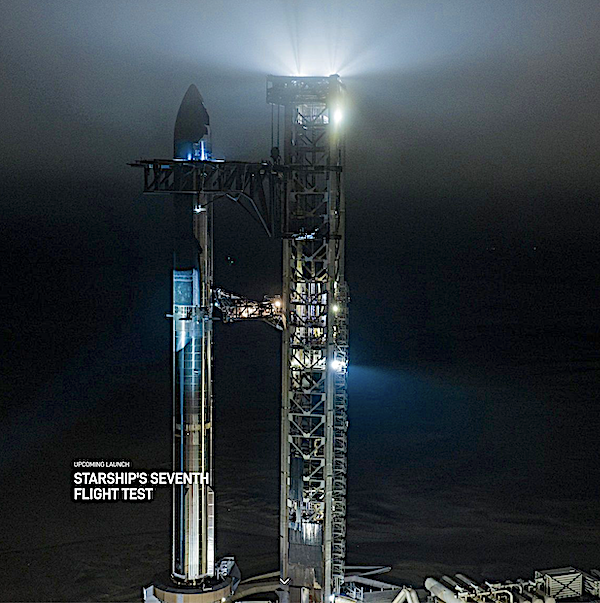
The seventh flight test of Starship is preparing to launch as soon as Wednesday, January 15, from Starbase in South Texas.
A live webcast of the flight test will begin about 35 minutes before liftoff on X @SpaceX. You can also watch the webcast on the new X TV app. The launch window will open at 4:00 p.m. CT. As is the case with all developmental testing, the schedule is dynamic and likely to change, so be sure to check in here and stay tuned to our X account for updates.
SpaceX plans Monday launch of Starship’s seventh test flight
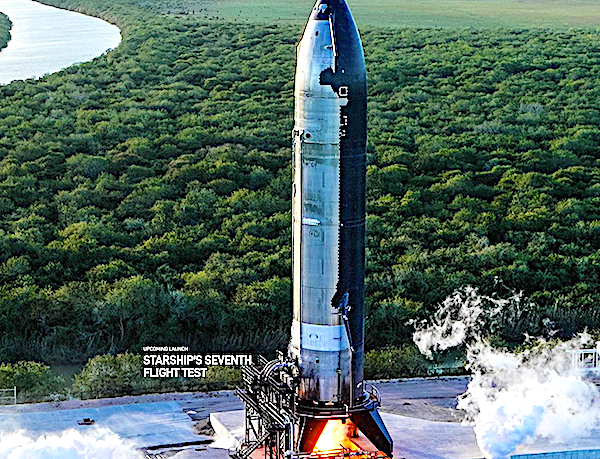
The seventh flight test of SpaceX’s Starship is preparing to launch as soon as Monday, January 13, at 2:00 PM – 3:38 PM PST from Starbase in South Texas.
A live webcast of the flight test will begin about 35 minutes before liftoff, which you can watch on X @SpaceX. You can also watch the webcast on the new X TV app. The launch window will open at 4:00 p.m. CT. As is the case with all developmental testing, the schedule is dynamic and likely to change, so be sure to check in here and stay tuned to our X account for updates.
SpaceX announced today (January 8) that it’s targeting Monday (January 13) for Flight 7 of Starship, the 400-foot-tall (122 meters), fully reusable megarocket designed to help humanity settle the Moon and Mars.
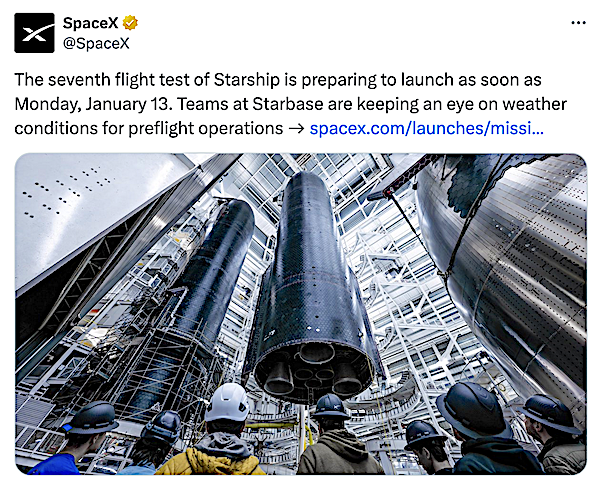
Starship is scheduled to lift off Monday at 5 p.m. EST (2200 GMT) from Starbase, SpaceX‘s manufacturing and launch site in South Texas. Orbital Launch Mount A has witnessed the launch of 6 rockets, including 0 orbital launch attempts, while SpaceX Starbase, TX, USA, has been the site for 15 rocket launches.
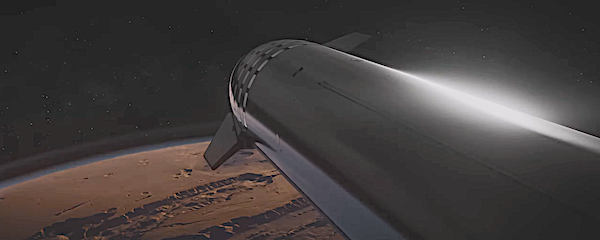
For the first time, Starship will attempt to deploy payloads in space consisting of 10 mock satellites, “similar in size and weight to next-generation Starlink satellites as the first exercise of a satellite deploy mission,” SpaceX wrote in a Flight 7 mission description.
SpaceX gets ready for Starship’s seventh flight test as soon as Friday
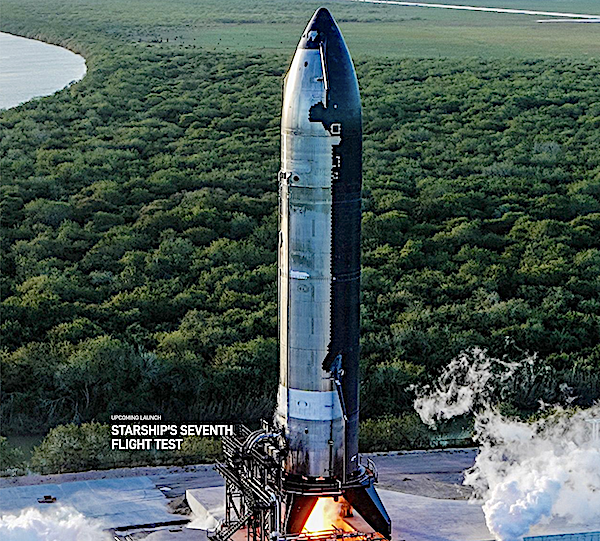
SpaceX has great plans for 2025 with as many as 25 launches this year. On January 10 SpaceX is preparing to launch the seventh flight test of Starship. For the first time Starship will launch the first deployable payload, and plans to fly 10 so-called “Starlink simulators,” which it said are “similar in size and weight to next-generation Starlink satellites.”
In its “Progress 2024” report on Starlink, SpaceX wrote that the Starlink V3 satellites will have 160 Gbps of uplink capacity and 1 Tbps of downlink speed, “which is more than 10x the downlink and 24x the uplink capacity of the V2 Mini Starlink satellites.”

In a response to a user on X, formerly Twitter, SpaceX Founder Elon Musk said that SpaceX was aiming for January 10. The Federal Aviation Administration approved a launch license modification on December 17, which paved the way for SpaceX to proceed with the mission’s launch.
“The FAA continues to increase efficiencies in our licensing determination activities to meet the needs of the commercial space transportation industry,” said the Associate Administrator for Commercial Space Transportation Kelvin Coleman, in a statement. “This license modification that we are issuing is well ahead of the Starship Flight 7 launch date and is another example of the FAA’s commitment to enable safe space transportation.”
The upcoming flight test will launch a new generation ship with significant upgrades, attempt Starship’s first payload deployment test, fly multiple reentry experiments geared towards ship catch and reuse, and launch and return the Super Heavy booster.
SpaceX said it did this in order to reduce the flaps’ “exposure to reentry heating while simplifying the underlying mechanisms and protective tiling.”
“Redesigns to the propulsion system, including a 25 percent increase in propellant volume, the vacuum jacketing of feedlines, a new fuel feedline system for the vehicle’s Raptor vacuum engines, and an improved propulsion avionics module controlling vehicle valves and reading sensors, all add additional vehicle performance and the ability to fly longer missions,” SpaceX wrote.
A block of planned upgrades to the Starship upper stage will debut on this flight test, bringing major improvements to reliability and performance. The vehicle’s forward flaps have been reduced in size and shifted towards the vehicle tip and away from the heat shield, significantly reducing their exposure to reentry heating while simplifying the underlying mechanisms and protective tiling. The ship’s heat shield will also use the latest generation tiles and includes a backup layer to protect from missing or damaged tiles.
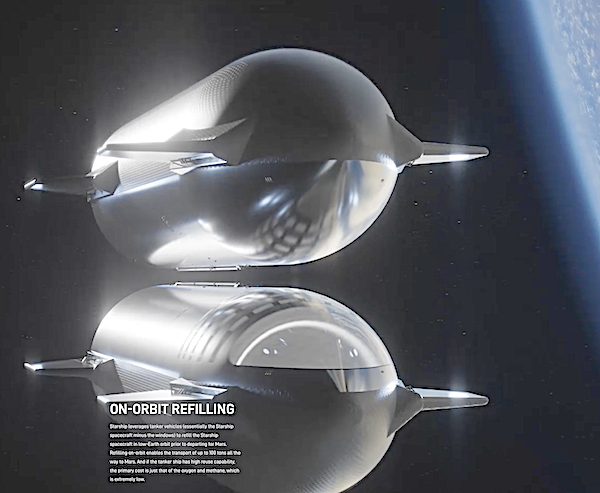
The vehicle’s avionics underwent a complete redesign, adding additional capability and redundancy for increasingly complex missions like propellant transfer and ship return to launch site. Avionics upgrades include a more powerful flight computer, integrated antennas which combine Starlink, GNSS, and backup RF communication functions into each unit, redesigned inertial navigation and star tracking sensors, integrated smart batteries and power units that distribute data and 2.7MW of power across the ship to 24 high-voltage actuators, and an increase to more than 30 vehicle cameras giving engineers insight into hardware performance across the vehicle during flight. With Starlink, the vehicle is capable of streaming more than 120 Mbps of real-time high-definition video and telemetry in every phase of flight, providing invaluable engineering data to rapidly iterate across all systems.
While in space, Starship will deploy 10 Starlink simulators, similar in size and weight to next-generation Starlink satellites as the first exercise of a satellite deploy mission. The Starlink simulators will be on the same suborbital trajectory as Starship, with splashdown targeted in the Indian Ocean. A relight of a single Raptor engine while in space is also planned.
The flight test will include several experiments focused on ship return to launch site and catch. On Starship’s upper stage, a significant number of tiles will be removed to stress-test vulnerable areas across the vehicle. Multiple metallic tile options, including one with active cooling, will test alternative materials for protecting Starship during reentry. On the sides of the vehicle, non-structural versions of ship catch fittings are installed to test the fittings’ thermal performance, along with a smoothed and tapered edge of the tile line to address hot spots observed during reentry on Starship’s sixth flight test. The ship’s reentry profile is being designed to intentionally stress the structural limits of the flaps while at the point of maximum entry dynamic pressure. Finally, several radar sensors will be tested on the tower chopsticks with the goal of increasing the accuracy when measuring distances between the chopsticks and a returning vehicle during catch.
The Super Heavy booster will utilize flight proven hardware for the first time, reusing a Raptor engine from the booster launched and returned on Starship’s fifth flight test. Hardware upgrades to the launch and catch tower will increase reliability for booster catch, including protections to the sensors on the tower chopsticks that were damaged at launch and resulted in the booster offshore divert on Starship’s previous flight test.
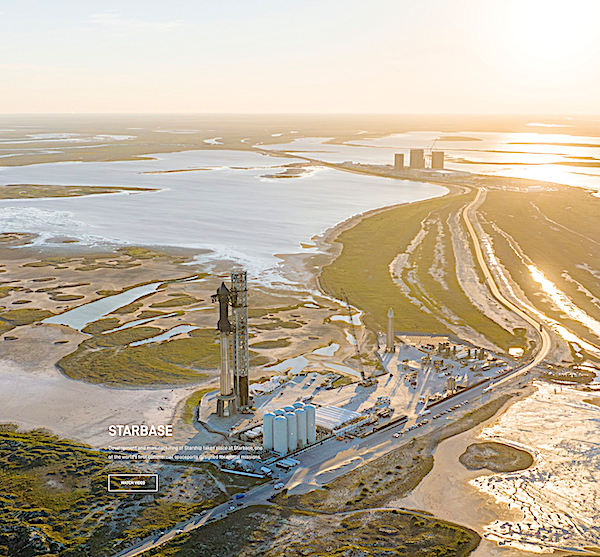
Distinct vehicle and pad criteria must be met prior to a return and catch of the Super Heavy booster, requiring healthy systems on the booster and tower and a final manual command from the mission’s Flight Director. If this command is not sent prior to the completion of the boostback burn, or if automated health checks show unacceptable conditions with Super Heavy or the tower, the booster will default to a trajectory that takes it to a landing burn and soft splashdown in the Gulf of Mexico. We accept no compromises when it comes to ensuring the safety of the public and our team, and the return will only take place if conditions are right.
The returning booster will slow down from supersonic speeds, resulting in audible sonic booms in the area around the landing zone. Generally, the only impact to those in the surrounding area of a sonic boom is the brief thunder-like noise with variables like weather and distance from the return site determining the magnitude experienced by observers.
This new year will be transformational for Starship, with the goal of bringing reuse of the entire system online and flying increasingly ambitious missions as we iterate towards being able to send humans and cargo to Earth orbit, the Moon, and Mars.
