


• Skip to primary navigation
  • Skip to main content
  • Skip to primary sidebar
  • Skip to secondary sidebar
  • Skip to footer
  • NEWS:
  • SatNews
  • SatMagazine
  • MilSatMagazine
  • SmallSat News
  • |     EVENTS:
  • SmallSat Symposium
  • Satellite Innovation
  • MilSat Symposium
  • SmallSat Europe

SatNews

Satellite Industry Intelligence Since 1983

Subscribe
  • LATEST
  • SatNews Events
  • Magazines
  • Calendar
  • Subscribe
  • Missions & Constellations
    • Exploration & Science Missions
    • In-Orbit Servicing & Orbital Operations
    • LEO Constellations
    • Mission Autonomy & Onboard Systems
    • Mission Deployments & Manifests
    • Navigation & PNT
    • SmallSat
    • Spacecraft & Payload Technology
    View All in Missions & Constellations →
    Viasat Completes ViaSat-3 Constellation with Successful Flight 3 LaunchViasat Completes ViaSat-3 Constellation with Successful Flight 3 Launch
    GMV to Lead Mission Planning for ESA’s Next-Generation Copernicus ExpansionGMV to Lead Mission Planning for ESA’s Next-Generation Copernicus Expansion
    Canada Tightens Re-entry Regulations as SpaceX Starlink Constellations DescendCanada Tightens Re-entry Regulations as SpaceX Starlink Constellations Descend
    The waiver was the policy. Thursday is the paperwork.The waiver was the policy. Thursday is the paperwork.
  • Business
    • Contracts & Commercial Deals
    • Earnings & Financial Reporting
    • Events & Conferences
    • Funding & Venture Capital
    • Market Forecasts
    • Mergers & Acquisitions
    • Personnel Moves & Appointments
    View All in Business & Finance →
    SmallSat Europe Speaker Focus: Koen Willems, ST Engineering iDirect EuropeSmallSat Europe Speaker Focus: Koen Willems, ST Engineering iDirect Europe
    U.S. Commercial Service to Host “Future in Orbit” Networking Event at SpaceBR 2026U.S. Commercial Service to Host “Future in Orbit” Networking Event at SpaceBR 2026
    SmallSat Europe Speaker Focus: Dr. Jakob Stöber, McKinsey & CompanySmallSat Europe Speaker Focus: Dr. Jakob Stöber, McKinsey & Company
    Bright Ascension Finalizes Leadership Transition with John Baughn as CEOBright Ascension Finalizes Leadership Transition with John Baughn as CEO
  • Defense
    • Counterspace & ASAT
    • Defense Budgets & Procurement
    • ISR & Reconnaissance
    • MILSATCOM
    • Missile Warning & Defense
    • National Security Programs
    • Space Domain Awareness
    View All in Military & Defense →
    BAE Systems Enters Production for NavGuide M-Code GPS ReceiverBAE Systems Enters Production for NavGuide M-Code GPS Receiver
    Space Force Awards $3.2 Billion in Golden Dome Contracts for Orbital Interceptor ConstellationSpace Force Awards $3.2 Billion in Golden Dome Contracts for Orbital Interceptor Constellation
    USSF Finalizes GPS III Constellation with Successful SV-10 DeploymentUSSF Finalizes GPS III Constellation with Successful SV-10 Deployment
    Meink: Space Force Programs Ready to Execute Once FY27 Budget LandsMeink: Space Force Programs Ready to Execute Once FY27 Budget Lands
  • Gov
    • Export Controls & Compliance
    • International Space Agreements
    • National Space Policy
    • Space Law & Treaties
    • Space Sustainability & Debris Policy
    • Space Traffic Management / Debris Removal
    View All in Government & Regulation →
    SmallSat Europe Speaker Focus: Tanja Masson-Zwaan, Leiden UniversitySmallSat Europe Speaker Focus: Tanja Masson-Zwaan, Leiden University
    How CubeSat Proliferation is Redefining Sovereignty and Diplomatic Leverage at the United NationsHow CubeSat Proliferation is Redefining Sovereignty and Diplomatic Leverage at the United Nations
    FCC Modernization of Spectrum Rules Unlocks Sevenfold Gain in Satellite CapacityFCC Modernization of Spectrum Rules Unlocks Sevenfold Gain in Satellite Capacity
    The Smartest Money in the Room Is Looking UpThe Smartest Money in the Room Is Looking Up
  • Launch
    • Launch Providers
    • Launch Schedule & Calendars
    • Launch Sites & Infrastructure
    • Rocket Technology & Vehicles
    View All in Launch →
    FAA Grounds Blue Origin Following New Glenn Upper Stage Failure and Facility AnomalyFAA Grounds Blue Origin Following New Glenn Upper Stage Failure and Facility Anomaly
    NanoAvionics to Launch Trio of Milestone Payloads on SpaceX CAS500-2 MissionNanoAvionics to Launch Trio of Milestone Payloads on SpaceX CAS500-2 Mission
    Astrobotic Achieves Record 300-Second Burn with New Detonation EngineAstrobotic Achieves Record 300-Second Burn with New Detonation Engine
    Bad news, but good news followedBad news, but good news followed
  • Software
    • Autonomous Ground Operations
    • Data Processing & AI/ML
    • Digital Twins & Modeling
    • Ground Segment & Teleports
    • Mission Planning & Simulation
    • Space Systems Software Engineering
    • Spectrum & Licensing
    View All in Software Automation & Ground Systems →
    Global Invacom Secures Exclusive Worldwide Distribution for Prodelin Antenna RangeGlobal Invacom Secures Exclusive Worldwide Distribution for Prodelin Antenna Range
    SmallSat Europe Speaker Focus: Giovanni Pandolfi Bortoletto, Leaf SpaceSmallSat Europe Speaker Focus: Giovanni Pandolfi Bortoletto, Leaf Space
    SpinLaunch Selects Equinix to Deploy Global Ground Infrastructure for Meridian Space ConstellationSpinLaunch Selects Equinix to Deploy Global Ground Infrastructure for Meridian Space Constellation
    RF-Design Launches FiberLink CompactLine FCLR1811S4 for Ground Segment OptimizationRF-Design Launches FiberLink CompactLine FCLR1811S4 for Ground Segment Optimization
  • Services & Apps
    • Climate & Environmental Monitoring
    • Disaster Response & Security Mapping
    • Earth Observation & Imaging
    • Maritime & Aviation Satcom
    • Satellite Communications
    View All in Services & Applications →
    Solstar Confirms Successful On-Orbit Operation of Deke Space Communicator Following Launch on SpaceX Transporter-16 MissionSolstar Confirms Successful On-Orbit Operation of Deke Space Communicator Following Launch on SpaceX Transporter-16 Mission
    IEC Telecom Unveils Voucher-Based Connectivity Solution at Singapore Maritime Week 2026IEC Telecom Unveils Voucher-Based Connectivity Solution at Singapore Maritime Week 2026
    GomSpace and STETMAN Establish UASAT Joint Venture for Ukrainian Sovereign CommunicationsGomSpace and STETMAN Establish UASAT Joint Venture for Ukrainian Sovereign Communications
    Market Dynamics and Non-Terrestrial Network (NTN) ChipsetsMarket Dynamics and Non-Terrestrial Network (NTN) Chipsets

NASA’s PACE, US-European SWOT satellites offer combined look at Ocean

December 10, 2024


Once in orbit, the SWOT mission will regularly monitor not only mighty rivers like Oregon’s Willamette, pictured, but also smaller waterways that are at least 330 feet (100 meters) across.
Credit: U.S. Department of Energy

The ocean is an engine that drives Earth’s weather patterns and climate and sustains a substantial portion of life on the planet. A new animation based on data from two recently launched missions — NASA’s Plankton, Aerosol, Cloud, ocean Ecosystem (PACE) and the international Surface Water and Ocean Topography (SWOT) satellites — gives a peek into the heart of that engine.

Physical processes, including localized swirling water masses called eddies and the vertical movement of water, can drive nutrient availability in the ocean. In turn, those nutrients determine the location and concentration of tiny floating organisms known as phytoplankton that photosynthesize, converting sunlight into food. These organisms have not only contributed roughly half of Earth’s oxygen since the planet formed, but also support economically important fisheries and help draw carbon out of the atmosphere, locking it away in the deep sea.

“We see great opportunity to dramatically accelerate our scientific understanding of our oceans and the significant role they play in our Earth system,” said Karen St. Germain, director of the Earth Science Division at NASA Headquarters in Washington. “This visualization illustrates the potential we have when we begin to integrate measurements from our separate SWOT and PACE ocean missions. Each of those missions is significant on its own. But bringing their data together — the physics from SWOT and the biology from PACE — gives us an even better view of what’s happening in our oceans, how they are changing, and why.”

A collaboration between NASA and the French space agency CNES (Centre National d’Études Spatiales), the SWOT’ satellite launched in December 2022 to measure the height of nearly all water on Earth’s surface. It is providing one of the most detailed, comprehensive views yet of the planet’s ocean and its freshwater lakes, reservoirs, and rivers.
Launched in February 2024, NASA’s PACE satellite detects and measures the distribution of phytoplankton communities in the ocean. It also provides data on the size, amount, and type of tiny particles called aerosols in Earth’s atmosphere, as well as the height, thickness, and opacity of clouds.

“Integrating information across NASA’s Earth System Observatory and its pathfinder missions SWOT and PACE is an exciting new frontier in Earth science,” said Nadya Vinogradova Shiffer, program scientist for SWOT and the Integrated Earth System Observatory at NASA Headquarters.

Where Physics and Biology Meet
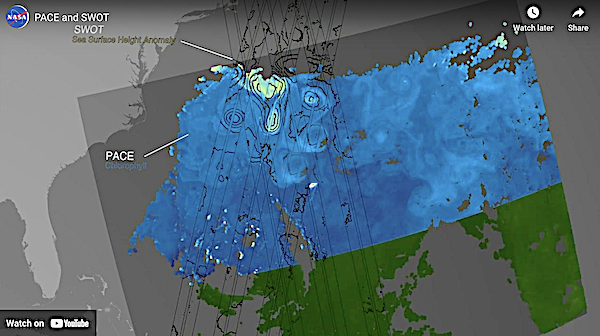
One Earth satellite can see plankton that photosynthesize. The other measures water surface height. Together, their data reveals how sea life and the ocean are intertwined.

The animation above access here, starts by depicting the orbits of SWOT (orange) and PACE (light blue), then zooms into the North Atlantic Ocean. The first data to appear was acquired by PACE on Aug. 8. It reveals concentrations of chlorophyll-a, a vital pigment for photosynthesis in plants and phytoplankton. Light green and yellow indicate higher concentrations of chlorophyll-a, while blue signals lower concentrations.

Next is sea surface height data from SWOT, taken during several passes over the same region between Aug. 7 and 8. Dark blue represents heights that are lower than the mean sea surface height, while dark orange and red represent heights higher than the mean. The contour lines that remain once the color fades from the SWOT data indicate areas of the ocean with the same height, much like the lines on a topographic map indicate areas with the same elevation.

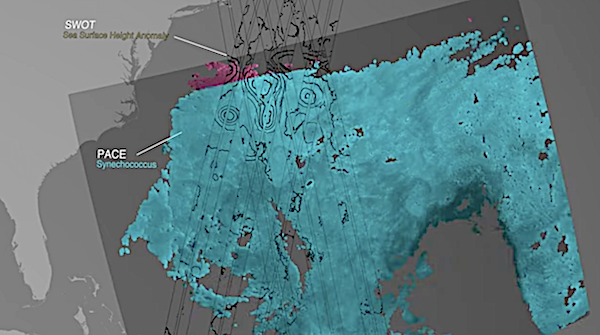
The underlying PACE data then cycles through several groups of phytoplankton, starting with picoeukaryotes. Lighter green indicates greater concentrations of this group. The final two groups are cyanobacteria — some of the smallest and most abundant phytoplankton in the ocean — called Prochlorococcus and Synechococcus. For Prochlorococcus, lighter raspberry colors represent higher concentrations. Lighter teal colors for Synechococcus signal greater amounts of the cyanobacteria.

The animation shows that higher phytoplankton concentrations on Aug. 8 tended to coincide with areas of lower water height. Eddies that spin counterclockwise in the Northern Hemisphere tend to draw water away from their center. This results in relatively lower sea surface heights in the center that draw up cooler, nutrient-rich water from the deep ocean. These nutrients act like fertilizer, which can boost phytoplankton growth in sunlit waters at the surface.

Overlapping SWOT and PACE data enables a better understanding of the connections between ocean dynamics and aquatic ecosystems, which can help improve the management of resources such as fisheries, since phytoplankton form the base of most food chains in the sea. Integrating these kinds of datasets also helps to improve calculations of how much carbon is exchanged between the atmosphere and the ocean. This, in turn, can indicate whether regions of the ocean that absorb excess atmospheric carbon are changing.

Filed Under: Exploration & Science Missions

Primary Sidebar

Coverage

  • Missions & Constellations
  • Business & Finance
  • Military & Defense
  • Launch
  • Software Automation & Ground Systems
  • Government & Regulation
  • Services & Applications

Most Read Stories

  • Planet Labs Imposes Indefinite Blackout on Iran Satellite Imagery at U.S. Request
  • Amazon in Reported Talks to Acquire Globalstar in $9 Billion Move to Challenge Starlink
  • What the SpaceX IPO Changes for Every Satellite Operator
  • Russia Replaces Starlink With European-Built Satellites
  • The Downlink Deficit: The Pentagon's Optical Mesh Network and the Terrestrial Bottleneck

Secondary Sidebar

Footer


Satnews is a leading provider of satellite news, events, publications, research and other satellite industry information in both commercial and military enterprises worldwide.

Stories By Category

  • Business & Finance
  • Government & Regulation
  • Launch
  • Military & Defense
  • Missions & Constellations
  • Services & Applications
  • Software Automation & Ground Systems
  • Spectrum & Licensing
  • Startups & NewSpace Business

About Us

  • Leadership & Editorial Team
  • SatNews History
  • Free Satnews Subscription
  • SatNews Events
  • Magazines

Navigation

  • Latest Stories
  • Magazines
  • Events
  • Contact
  • Cookie & Privacy Policy for Satnews

We use cookies to ensure that we give you the best experience on our website. If you continue to use this site we will assume that you are happy with it.
x
Sign up Now (For Free)
Access daily or weekly satellite news updates covering all aspects of the commercial and military satellite industry.
Invalid email address
Notify Me Regarding ( At least one ):
We value your privacy and will not sell or share your email or other information with any other company. You may also unsubscribe at anytime.

Click Here to see our full privacy policy.
Thanks for subscribing!