

• Skip to primary navigation
  • Skip to main content
  • Skip to primary sidebar
  • Skip to secondary sidebar
  • Skip to footer
  • NEWS:
  • SatNews
  • SatMagazine
  • MilSatMagazine
  • SmallSat News
  • |     EVENTS:
  • SmallSat Symposium
  • Satellite Innovation
  • MilSat Symposium
  • SmallSat Europe

SatNews

Satellite Industry Intelligence Since 1983

Subscribe
  • LATEST
  • SatNews Events
  • Magazines
  • Calendar
  • Subscribe
  • Missions & Constellations
    • Exploration & Science Missions
    • In-Orbit Servicing & Orbital Operations
    • LEO Constellations
    • Mission Autonomy & Onboard Systems
    • Mission Deployments & Manifests
    • Navigation & PNT
    • SmallSat
    • Spacecraft & Payload Technology
    View All in Missions & Constellations →
    Astroscale Launches Industry Initiative to Study Atmospheric Impact of Spacecraft ReentryAstroscale Launches Industry Initiative to Study Atmospheric Impact of Spacecraft Reentry
    Three LEO Operators Bet 2026 on a Supply Chain Built for 2027Three LEO Operators Bet 2026 on a Supply Chain Built for 2027
    The Astronaut Wears Prada. Axiom Space and the Inner Layer of Next-Generation Lunar SpacesuitThe Astronaut Wears Prada. Axiom Space and the Inner Layer of Next-Generation Lunar Spacesuit
    Analyst Projects Massive Subscription Growth for Starlink Ahead of Imminent SpaceX IPOAnalyst Projects Massive Subscription Growth for Starlink Ahead of Imminent SpaceX IPO
  • Business
    • Contracts & Commercial Deals
    • Earnings & Financial Reporting
    • Events & Conferences
    • Funding & Venture Capital
    • Market Forecasts
    • Mergers & Acquisitions
    • Personnel Moves & Appointments
    View All in Business & Finance →
    Investor Scrutiny Mounts for York Space Systems Following Pentagon Contract TurmoilInvestor Scrutiny Mounts for York Space Systems Following Pentagon Contract Turmoil
    IEC Telecom Establishes Local Indonesian Entity to Address Archipelago’s Expanding Satellite Connectivity DemandsIEC Telecom Establishes Local Indonesian Entity to Address Archipelago’s Expanding Satellite Connectivity Demands
    Viasat Launches Space for Good India Challenge 2026 to Cultivate Next-Generation Space InnovationViasat Launches Space for Good India Challenge 2026 to Cultivate Next-Generation Space Innovation
    Eutelsat and Voimatel Partner to Expand LEO Satellite Connectivity Across FinlandEutelsat and Voimatel Partner to Expand LEO Satellite Connectivity Across Finland
  • Defense
    • Counterspace & ASAT
    • Defense Budgets & Procurement
    • ISR & Reconnaissance
    • MILSATCOM
    • Missile Warning & Defense
    • National Security Programs
    • Space Domain Awareness
    View All in Military & Defense →
    Qorvo Unveils Compact X-Band Radar Module to Enhance Defense System PerformanceQorvo Unveils Compact X-Band Radar Module to Enhance Defense System Performance
    Energration and Atombeam Partner on DARPA Proposal to Revolutionize Tactical Data Movement at the Defense EdgeEnergration and Atombeam Partner on DARPA Proposal to Revolutionize Tactical Data Movement at the Defense Edge
    American military space closed around one company in seven daysAmerican military space closed around one company in seven days
    MDA Space Selected by BAE Systems for U.S. Space Force Missile Warning ConstellationMDA Space Selected by BAE Systems for U.S. Space Force Missile Warning Constellation
  • Gov
    • Export Controls & Compliance
    • International Space Agreements
    • National Space Policy
    • Space Law & Treaties
    • Space Sustainability & Debris Policy
    • Space Traffic Management / Debris Removal
    View All in Government & Regulation →
    Major opportunities for 2 GHz over EuropeMajor opportunities for 2 GHz over Europe
    “Dual-use” is the funding word. It’s also the label operators want off.“Dual-use” is the funding word. It’s also the label operators want off.
    Sovereignty got an answer on Day 3. Two answers, actually, and a commercial veto.Sovereignty got an answer on Day 3. Two answers, actually, and a commercial veto.
    Dependency killed the old debate. Sovereignty is the new one, and Europe hasn’t agreed what it means.Dependency killed the old debate. Sovereignty is the new one, and Europe hasn’t agreed what it means.
  • Launch
    • Launch Providers
    • Launch Schedule & Calendars
    • Launch Sites & Infrastructure
    • Rocket Technology & Vehicles
    View All in Launch →
    Twelve Scientific Payloads Experience Microgravity Aboard SubOrbital Express-5Twelve Scientific Payloads Experience Microgravity Aboard SubOrbital Express-5
    Amazon Leo Constellation Surpasses 330 Satellites Following Latest Atlas V LaunchAmazon Leo Constellation Surpasses 330 Satellites Following Latest Atlas V Launch
    If You Thought Space Was Hard Try to Get Your Satellite On a RocketIf You Thought Space Was Hard Try to Get Your Satellite On a Rocket
    Blue Origin Suffers Major Setback as New Glenn Rocket Explodes During Static Fire TestBlue Origin Suffers Major Setback as New Glenn Rocket Explodes During Static Fire Test
  • Software
    • Autonomous Ground Operations
    • Data Processing & AI/ML
    • Digital Twins & Modeling
    • Ground Segment & Teleports
    • Mission Planning & Simulation
    • Space Systems Software Engineering
    • Spectrum & Licensing
    View All in Software Automation & Ground Systems →
    NASA Advances Interoperable Space Networks with Successful PExT DemonstrationNASA Advances Interoperable Space Networks with Successful PExT Demonstration
    KSAT and iQPS Expand Strategic Alliance to Accelerate High-Frequency SAR ConstellationKSAT and iQPS Expand Strategic Alliance to Accelerate High-Frequency SAR Constellation
    KSAT and Axelspace Expand Strategic Partnership to Accelerate Earth ObservationKSAT and Axelspace Expand Strategic Partnership to Accelerate Earth Observation
    Europe has ships. SmallSat Europe said it doesn’t have ports.Europe has ships. SmallSat Europe said it doesn’t have ports.
  • Services & Apps
    • Climate & Environmental Monitoring
    • Disaster Response & Security Mapping
    • Earth Observation & Imaging
    • Maritime & Aviation Satcom
    • Satellite Communications
    View All in Services & Applications →
    Eutelsat and Tototheo Global Forge Partnership to Deliver LEO Connectivity Across Maritime and Government SectorsEutelsat and Tototheo Global Forge Partnership to Deliver LEO Connectivity Across Maritime and Government Sectors
    Marlink Equips Groupama-FDJ Cycling Team with Hybrid Starlink and LTE NetworkMarlink Equips Groupama-FDJ Cycling Team with Hybrid Starlink and LTE Network
    Viasat Secures Lockheed Martin Contract for NOAA’s Next-Generation AircraftViasat Secures Lockheed Martin Contract for NOAA’s Next-Generation Aircraft
    SES Partners with Viva to Launch Multi-Orbit In-Flight ConnectivitySES Partners with Viva to Launch Multi-Orbit In-Flight Connectivity

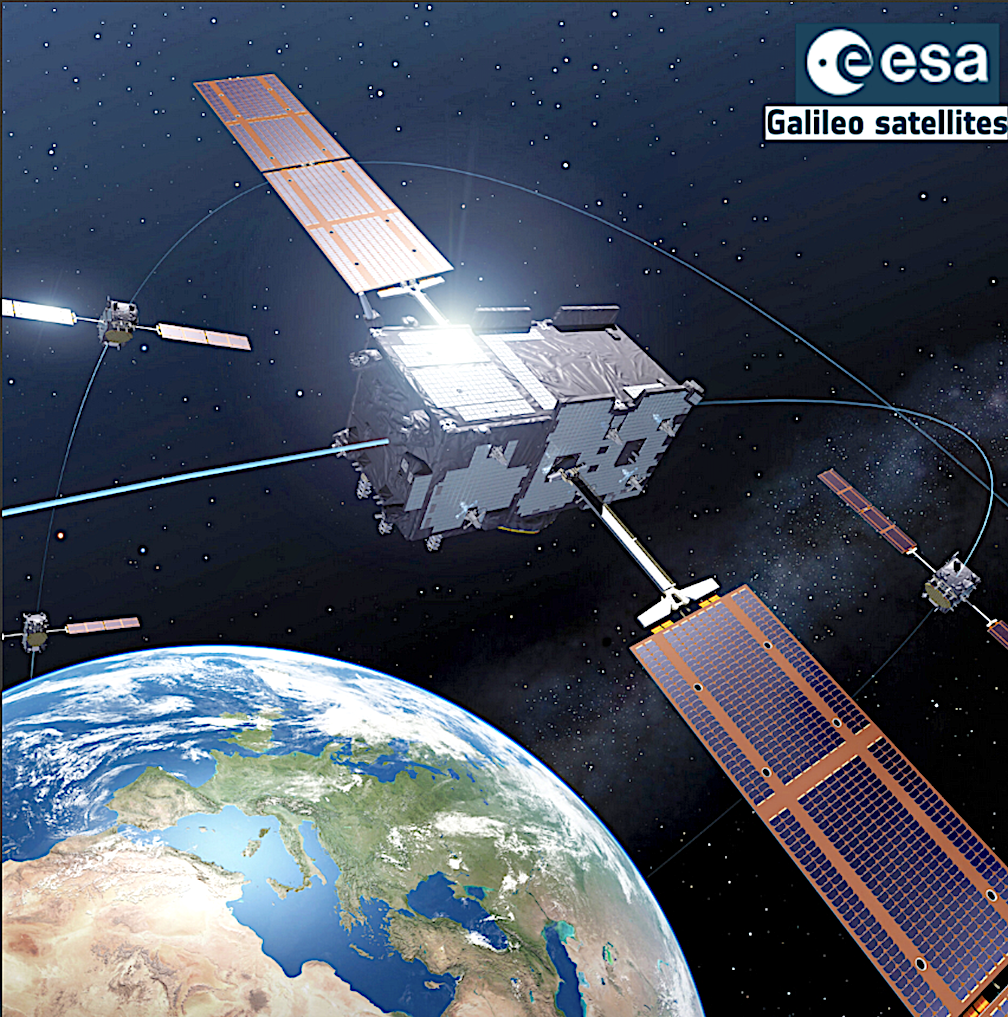
SpaceX’s Galileo L13 set for Tuesday launch weather permitting at the Cape

September 16, 2024

Plans still remain for SpaceX to launch Galileo L13 (FOC FM26 & FM32) to Medium Earth Orbit, on Tuesday, September 17th, at 3:51 PM – 4:24 PM PDT from Space Launch Complex 40, Cape Canaveral, Florida, weather permitting. Forecasts report potential thunderstorms in the afternoon.

“Additionally, expect west coast seabreeze convection to make its way across Florida nearing the
spaceport Tuesday afternoon further enhancing possibilities for showers and thunderstorms.”
(see below)

The launch is of two satellites for Europe’s Galileo navigation system. Originally planned for launch on Soyuz-ST and then Ariane 6 but both were unavailable.

Galileo provides Europe with an alternative to the American GPS and Russian GLONASS constellations, but will be interoperable with both systems.

SpaceX ready for Galileo L13 launch on Tuesday
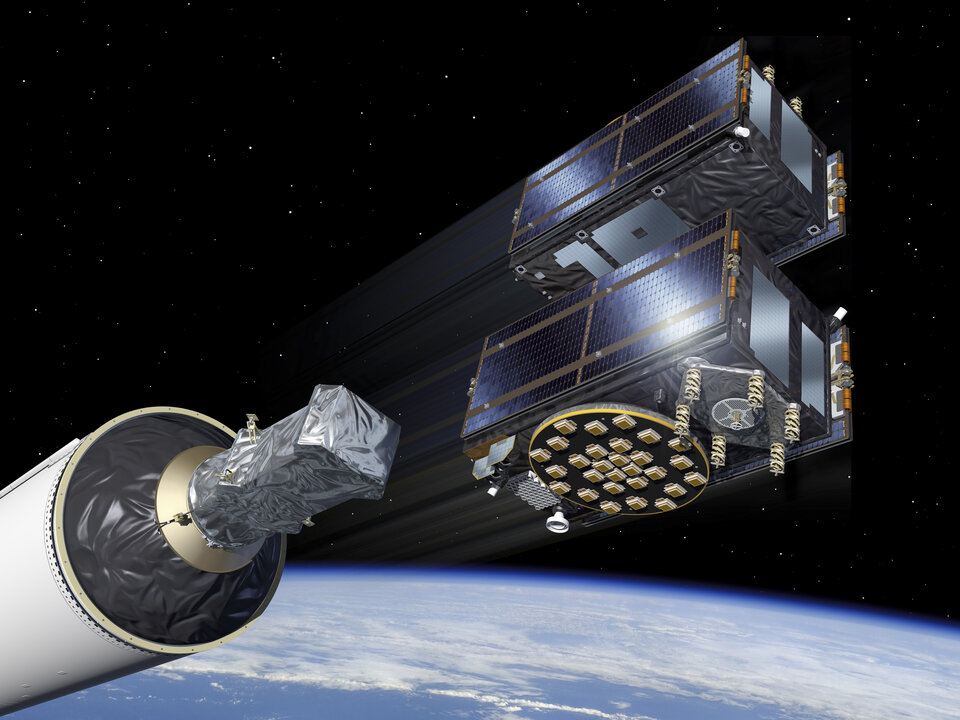
Galileo launch L12

SpaceX is now scheduled to launch Galileo L13 (FOC FM26 & FM32) to Medium Earth Orbit, on Tuesday, September 17th, at 3:51 PM – 4:24 PM PDT from Space Launch Complex 40, Cape Canaveral, Florida.

The launch is of two satellites for Europe’s Galileo navigation system. Originally planned for launch on Soyuz-ST and then Ariane 6 but both were unavailable.

Galileo provides Europe with an alternative to the American GPS and Russian GLONASS constellations, but will be interoperable with both systems.

SpaceX to launch ESA’s Galileo L13, two more satellites for Europe’s alternative to American GPS

SpaceX is scheduled to launch Galileo L13 (FOC FM26 & FM32) to Medium Earth Orbit, on Sunday, September 15th, at 3:57 PM – 4:39 PM PDT from Space Launch Complex 40, Cape Canaveral, Florida.

Three months after their launch from Cape Canaveral, Galileo satellites 29 and 30 have reached their target positions at an altitude of 23 222 km, where they have been fully tested and declared operational.

Galileo is Europe’s own global navigation satellite system, providing a highly accurate, guaranteed global positioning service under civilian control. Currently providing Initial Services, Galileo is interoperable with GPS and Glonass, the US and Russian global satellite navigation systems. By offering dual frequencies as standard, Galileo can deliver real-time positioning accuracy down to the metre range.

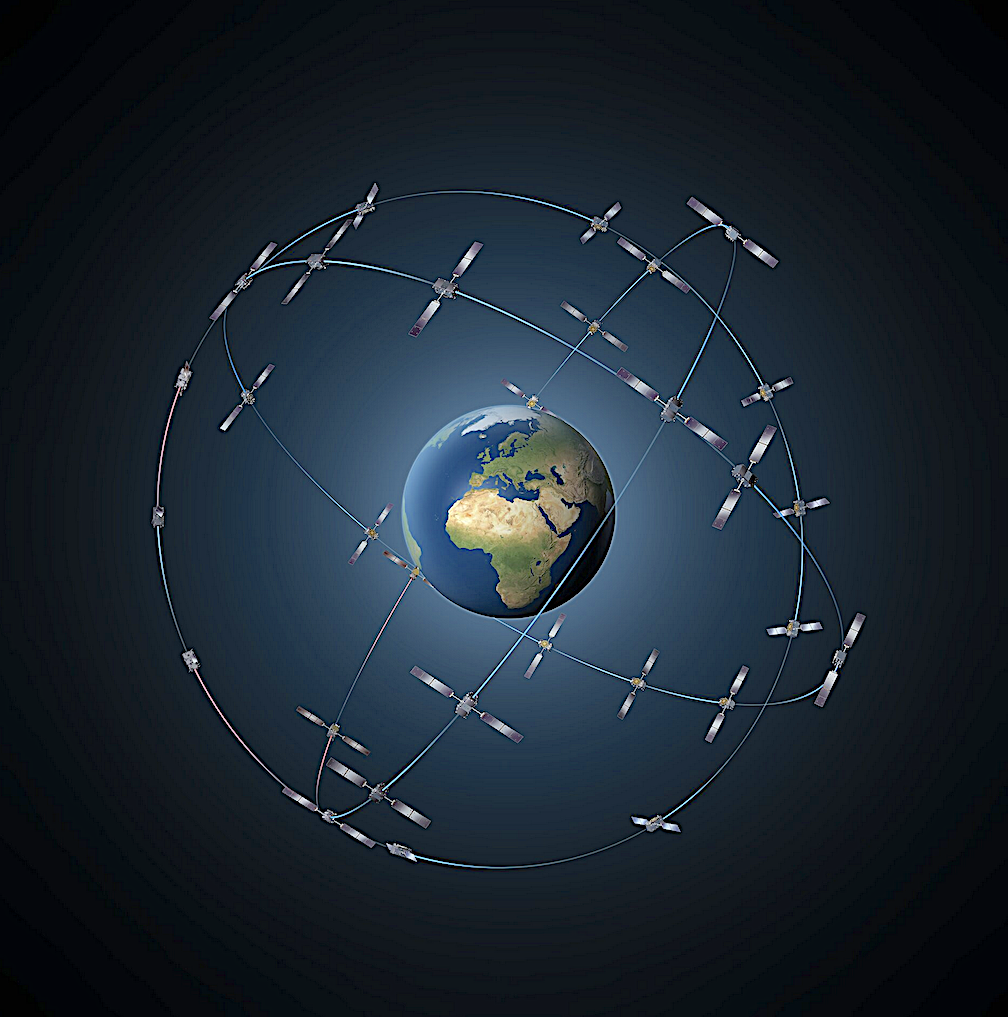
Galileo services The current Galileo system consists of 28 satellites in all. All but two of these are positioned in three circular Medium Earth Orbit (MEO) planes at 23 222 km altitude above the Earth, and at an inclination of the orbital planes of 56 degrees to the equator. The remaining pair were placed in incorrect orbits by a Soyuz launcher error, and are currently employed for search and rescue but not as operational members of the constellation.

Initial services became available on 15 December 2016. Then as the constellation is built-up beyond that, new services will be tested and made available.

Galileo navigation signals provide good coverage even at latitudes up to 75 degrees north, which corresponds to Norway’s North Cape – the most northerly tip of Europe – and beyond. The large number of satellites together with the carefully-optimised constellation design, plus the planned availability of three active spare satellites per orbital plane, should ensure that the loss of one satellite should have no discernible effect on the user.

Ground infrastructure Two Galileo Control Centres (GCCs) have been implemented on European ground to provide for the control of the satellites and to perform the navigation mission management. The data provided by a global network of Galileo Sensor Stations (GSSs) are sent to the Galileo Control Centres through a redundant communications network. The GCCs use the data from the Sensor Stations to compute the integrity information and to synchronise the time signal of all satellites with the ground station clocks. The exchange of the data between the Control Centres and the satellites is performed through up-link stations.

As a further feature, Galileo is providing a global Search and Rescue (SAR) function, based on the operational Cospas-Sarsat system. Satellites are therefore equipped with a transponder, which is able to transfer the distress signals from the user transmitters to regional rescue co-ordination centres, which will then initiate the rescue operation.

At the same time, the system will send a response signal to the user, informing him that his situation has been detected and that help is on the way. This latter feature is new and is considered a major upgrade compared to the existing system, which does not provide user feedback.

SpaceX to launch Galileo L13, Europe’s alternative to American GPS
This image has an empty alt attribute; its file name is Screen-Shot-2024-09-10-at-12.43.47-PM.png
ESA’s Galileo planned constellation

SpaceX is scheduled to launch Galileo L13 (FOC FM26 & FM32) to Medium Earth Orbit, on Sunday, September 15th, at 3:57 PM – 4:39 PM PDT from Space Launch Complex 40, Cape Canaveral, Florida.

The launch is of two satellites for Europe’s Galileo navigation system. Originally planned for launch on Soyuz-ST and then Ariane 6 but both were unavailable.

Galileo provides Europe with an alternative to the American GPS and Russian GLONASS constellations, but will be interoperable with both systems.

New Galileo satellites operational after successful on-orbit testing

This image has an empty alt attribute; its file name is ESA-Galileo-on-orbit-b-L.jpg

Galileo satellites on-orbit, image courtesy of ESA.

The two new Galileo satellites launched in April have entered service, completing the second of three constellation planes.

With every addition to the constellation, the precision, availability and robustness of the Galileo signal is improved. The next launch is planned in the coming weeks and the remaining six Galileo First Generation satellites will join the constellation in the next years.

Three months after their launch from Cape Canaveral, Galileo satellites 29 and 30 have reached their target positions at an altitude of 23 222 km, where they have been fully tested and declared operational.

Both satellites have been deployed on the same orbital plane, one of the three that make up the Galileo constellation. Now two of the three Galileo orbital planes are fully populated, bringing the constellation one launch away from completion. The next couple of Galileo satellites are planned to launch in the coming weeks from the Kennedy Space Center in Florida onboard a Falcon 9.

The two new satellites are active and providing navigation signals to users. Their addition to the constellation slightly increases the accuracy of the system and further guarantees the availability and robustness of Galileo signals.

To know more about the Galileo constellation status, consult the European GNSS Service Center.

Galileo launch L12

Galileo launch L12

The satellites were launched on April 28  by SpaceX under contract with ESA. A Falcon 9 rocket injected the Galileo satellites into MEO, not far from their final position. During the first hours after launch, the Mission Control Team made sure that the satellites had successfully completed the initialization sequence, that the solar arrays were correctly deployed and able to generate power and that the network of ground stations could track and control them correctly.

Early operations were executed by the Galileo Service Operator, supported by a team of around 30 satellite experts from ESA and satellite manufacturer OHB on site at the Galileo Control Centre in Oberpfaffenhofen, Germany, under the responsibility of EUSPA.

The drift phase then started, with teams on ground guiding manoeuvres to bring the satellites to their final positions, reached on 24 June.

Over the last months, every component on the satellites has been tested to make sure nothing was damaged by the severe launch conditions. Both platform and payload, including antennas and clocks, have been examined.

On August 21st, ESA, OHB and payload manufacturer SSTL assessed the on-orbit test results and concluded that the satellites had not suffered any degradation during launch. ESA, in collaboration with EUSPA, validated the satellites’ performance at system level. In light of these results, the Security Accreditation Board has given the green light for both satellites to begin nominal operations.

This success is a result of the joint efforts of ESA, EUSPA, the European Commission, manufacturer OHB, payload manufacturer SSTL teams at Galileo Control Centers and the Security Accreditation Board.

Galileo is currently the world’s most precise satellite navigation system, serving over four billion smartphone users around the globe since entering Open Service in 2017. All smartphones sold in the European Single Market are now guaranteed Galileo-enabled. In addition, Galileo is making a difference across the fields of rail, maritime, agriculture, financial timing services and rescue operations.

A flagship program of the European Union (EU), Galileo is managed and funded by the European Commission. Since its inception, ESA, as system development prime and design authority, leads the design, development and qualification of the space and ground systems, and procures launch services. ESA is also entrusted with research and development activities for the future of Galileo within the EU programme Horizon Europe.

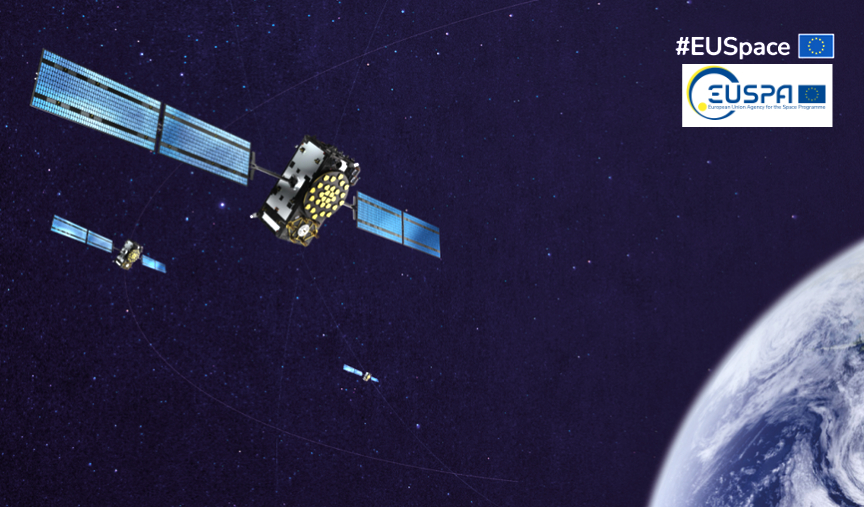
The EU Agency for the Space Programme (EUSPA) acts as the system prime for the operational system provider, ensuring exploitation and safe and secure delivery of services while overseeing market demands and application needs.
This image has an empty alt attribute; its file name is EUSPA-Galileo-b-L.jpg

For more info about Galileo, access this direct link…

Filed Under: International Space Agreements, Launch Providers

Primary Sidebar

Coverage

  • Missions & Constellations
  • Business & Finance
  • Military & Defense
  • Launch
  • Software Automation & Ground Systems
  • Government & Regulation
  • Services & Applications

Most Read Stories

  • SmallSat Europe Speaker Focus: Frank M. Salzgeber, Nadir Space Venture
  • SpaceX Debuts Starship V3: Redefining Heavy-Lift Launch Capability
  • SpaceX Is Worth $1.75 Trillion. Only 7% of That Is Real.
  • FCC Approves Landmark Spectrum Sharing and Direct-to-Device Frameworks
  • SpaceX: 10,000 Launches Annually

Secondary Sidebar

Footer


Satnews is a leading provider of satellite news, events, publications, research and other satellite industry information in both commercial and military enterprises worldwide.

Stories By Category

  • Business & Finance
  • Government & Regulation
  • Launch
  • Military & Defense
  • Missions & Constellations
  • Services & Applications
  • Software Automation & Ground Systems
  • Spectrum & Licensing
  • Startups & NewSpace Business

About Us

  • Leadership & Editorial Team
  • SatNews History
  • Free Satnews Subscription
  • SatNews Events
  • Magazines

Navigation

  • Latest Stories
  • Magazines
  • Events
  • Contact
  • Cookie & Privacy Policy for Satnews

We use cookies to ensure that we give you the best experience on our website. If you continue to use this site we will assume that you are happy with it.
x
Sign up Now (For Free)
Access daily or weekly satellite news updates covering all aspects of the commercial and military satellite industry.
Invalid email address
Notify Me Regarding ( At least one ):
We value your privacy and will not sell or share your email or other information with any other company. You may also unsubscribe at anytime.

Click Here to see our full privacy policy.
Thanks for subscribing!