

• Skip to primary navigation
  • Skip to main content
  • Skip to primary sidebar
  • Skip to secondary sidebar
  • Skip to footer
  • NEWS:
  • SatNews
  • SatMagazine
  • MilSatMagazine
  • SmallSat News
  • |     EVENTS:
  • SmallSat Symposium
  • Satellite Innovation
  • MilSat Symposium
  • SmallSat Europe

SatNews

Satellite Industry Intelligence Since 1983

Subscribe
  • LATEST
  • SatNews Events
  • Magazines
  • Calendar
  • Subscribe
  • Missions & Constellations
    • Exploration & Science Missions
    • In-Orbit Servicing & Orbital Operations
    • LEO Constellations
    • Mission Autonomy & Onboard Systems
    • Mission Deployments & Manifests
    • Navigation & PNT
    • SmallSat
    • Spacecraft & Payload Technology
    View All in Missions & Constellations →
    SDA and DIU Award Deorbit Vehicle Contracts to Firefly, D-Orbit, Katalyst, and Starfish SpaceSDA and DIU Award Deorbit Vehicle Contracts to Firefly, D-Orbit, Katalyst, and Starfish Space
    Rocket Lab Challenges NASA’s $700M Mars Orbiter Award to Blue Origin While Scaling Vertical Integration via $8B Iridium AcquisitionRocket Lab Challenges NASA’s $700M Mars Orbiter Award to Blue Origin While Scaling Vertical Integration via $8B Iridium Acquisition
    U.S. and Japan Formally Designate AST SpaceMobile and Rakuten LEO Infrastructure Under Bilateral Technology Prosperity DealU.S. and Japan Formally Designate AST SpaceMobile and Rakuten LEO Infrastructure Under Bilateral Technology Prosperity Deal
    FCC Grants SpaceX Approval for 15,000-Satellite Very Low Earth Orbit Direct-to-Device ConstellationFCC Grants SpaceX Approval for 15,000-Satellite Very Low Earth Orbit Direct-to-Device Constellation
  • Business
    • Contracts & Commercial Deals
    • Earnings & Financial Reporting
    • Events & Conferences
    • Funding & Venture Capital
    • Market Forecasts
    • Mergers & Acquisitions
    • Personnel Moves & Appointments
    View All in Business & Finance →
    Silicon Valley Space Week Speaker Focus: Dr. Tim Farrar, TMF AssociatesSilicon Valley Space Week Speaker Focus: Dr. Tim Farrar, TMF Associates
    GlobalData Forecasts Fiber Dominance Across APAC Communications Through 2031 as SatComms and Direct-to-Device Address Regional Coverage GapsGlobalData Forecasts Fiber Dominance Across APAC Communications Through 2031 as SatComms and Direct-to-Device Address Regional Coverage Gaps
    EchoStar’s DISH DBS Exits Chapter 11 Reorganization Following $4.35 Billion Debt ReductionEchoStar’s DISH DBS Exits Chapter 11 Reorganization Following $4.35 Billion Debt Reduction
    Silicon Valley Space Week Speaker Focus: Curt Blake, Wilson SonsiniSilicon Valley Space Week Speaker Focus: Curt Blake, Wilson Sonsini
  • Defense
    • Counterspace & ASAT
    • Defense Budgets & Procurement
    • ISR & Reconnaissance
    • MILSATCOM
    • Missile Warning & Defense
    • National Security Programs
    • Space Domain Awareness
    View All in Military & Defense →
    U.S. Department of Defense Awards Contract to Upgrade Kymeta Osprey u8 Terminal into Multi-Mission Edge PlatformU.S. Department of Defense Awards Contract to Upgrade Kymeta Osprey u8 Terminal into Multi-Mission Edge Platform
    HawkEye 360 Adapts Commercial Satellite RF Sensors for Space Domain Awareness Under AFRL ContractHawkEye 360 Adapts Commercial Satellite RF Sensors for Space Domain Awareness Under AFRL Contract
    Northrop Grumman Selects ThinKom ThinAir SATCOM Antennas for U.S. Navy E-130J Phoenix II TACAMO FleetNorthrop Grumman Selects ThinKom ThinAir SATCOM Antennas for U.S. Navy E-130J Phoenix II TACAMO Fleet
    BAE Systems Awarded $16 Million Collins Aerospace Contract to Deliver M-Code GPS for U.S. Navy Carrier LandingsBAE Systems Awarded $16 Million Collins Aerospace Contract to Deliver M-Code GPS for U.S. Navy Carrier Landings
  • Gov
    • Export Controls & Compliance
    • International Space Agreements
    • National Space Policy
    • Space Law & Treaties
    • Space Sustainability & Debris Policy
    • Space Traffic Management / Debris Removal
    View All in Government & Regulation →
    Open Cosmos Seeks One-Year ITU Regulatory Extension After Missing Constellation Deployment MilestonesOpen Cosmos Seeks One-Year ITU Regulatory Extension After Missing Constellation Deployment Milestones
    SSPI Explores US-China Space Law, Export Controls, and Cross-Border Regulatory FrameworksSSPI Explores US-China Space Law, Export Controls, and Cross-Border Regulatory Frameworks
    FCC Votes to Exempt Satellite Licensing from NEPA Environmental Reviews and Opens 1,000 MHz of SpectrumFCC Votes to Exempt Satellite Licensing from NEPA Environmental Reviews and Opens 1,000 MHz of Spectrum
    Taylor Jordan Puts a $2.35 Billion Price on NOAA’s New Commercial Data Vehicle.Taylor Jordan Puts a $2.35 Billion Price on NOAA’s New Commercial Data Vehicle.
  • Launch
    • Launch Providers
    • Launch Schedule & Calendars
    • Launch Sites & Infrastructure
    • Rocket Technology & Vehicles
    View All in Launch →
    FAA Licensed Launches Decline in FY2026 as Bottlenecks Drive High-Density Satellite Design AlternativesFAA Licensed Launches Decline in FY2026 as Bottlenecks Drive High-Density Satellite Design Alternatives
    TELUS and AST SpaceMobile Complete In-Orbit Network Integration Testing for Canadian Direct-to-Smartphone BroadbandTELUS and AST SpaceMobile Complete In-Orbit Network Integration Testing for Canadian Direct-to-Smartphone Broadband
    GomSpace Prepares 8U CubeSat GOMX-5 for SpaceX Transporter-18 Launch to Demonstrate Satellite Communications TechnologyGomSpace Prepares 8U CubeSat GOMX-5 for SpaceX Transporter-18 Launch to Demonstrate Satellite Communications Technology
    Sateliot Launches Five Alén Space-Built CubeSats for Draconis 5G NTN IoT MissionSateliot Launches Five Alén Space-Built CubeSats for Draconis 5G NTN IoT Mission
  • Software
    • Autonomous Ground Operations
    • Data Processing & AI/ML
    • Digital Twins & Modeling
    • Ground Segment & Teleports
    • Mission Planning & Simulation
    • Space Systems Software Engineering
    • Spectrum & Licensing
    View All in Software Automation & Ground Systems →
    SES and Sky Extend Direct-to-Home Satellite Capacity Agreement Across UK and IrelandSES and Sky Extend Direct-to-Home Satellite Capacity Agreement Across UK and Ireland
    Arqiva Proposes Managed 2044 Digital Terrestrial Television Switch-Off in UK Government Green PaperArqiva Proposes Managed 2044 Digital Terrestrial Television Switch-Off in UK Government Green Paper
    Everyone at WSBW Described a Bottleneck. In Every Case It Was Someone Else’s Business.Everyone at WSBW Described a Bottleneck. In Every Case It Was Someone Else’s Business.
    Space Development Agency Issues $369 Million Solicitation for Global Missile Tracking Ground Entry PointsSpace Development Agency Issues $369 Million Solicitation for Global Missile Tracking Ground Entry Points
  • Services & Apps
    • Climate & Environmental Monitoring
    • Disaster Response & Security Mapping
    • Earth Observation & Imaging
    • Maritime & Aviation Satcom
    • Satellite Communications
    View All in Services & Applications →
    Azercosmos Launches Platerra AI Platform for Automated Geospatial and Satellite Imagery AnalysisAzercosmos Launches Platerra AI Platform for Automated Geospatial and Satellite Imagery Analysis
    x721 Unveils Heliblade Stratospheric Drone Platform and Establishes French Operations at Bordeaux UAV Showx721 Unveils Heliblade Stratospheric Drone Platform and Establishes French Operations at Bordeaux UAV Show
    AT&T, T-Mobile, and Verizon Form Joint Venture to Standardize Satellite Direct-to-Device ConnectivityAT&T, T-Mobile, and Verizon Form Joint Venture to Standardize Satellite Direct-to-Device Connectivity
    Qorvo Unveils Integrated X-Band RF Front-End Solution for AESA Radar SystemsQorvo Unveils Integrated X-Band RF Front-End Solution for AESA Radar Systems

NASA’s vivid portrait of interacting galaxies marks Webb’s second anniversary

July 14, 2024

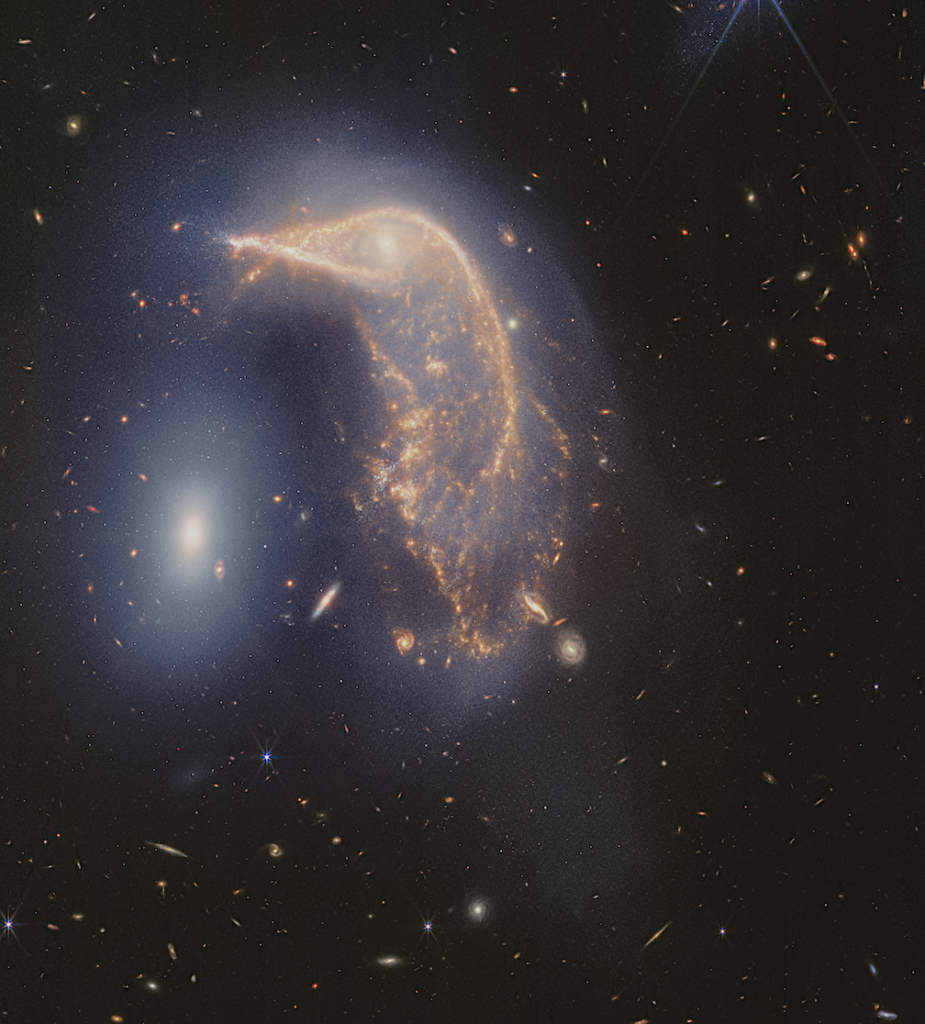
Interacting Galaxies Arp 142 (NIRCam and MIRI) The distorted spiral galaxy at center, the Penguin, and the compact elliptical at left, the Egg, are locked in an active embrace. This near- and mid-infrared image combines data from NASA’s James Webb Space Telescope’s NIRCam (Near-Infrared Camera) and MIRI (Mid-Infrared Instrument), and marks the telescope’s second year of science. Webb’s view shows that their interaction is marked by a glow of scattered stars represented in blue. Known jointly as Arp 142, the galaxies made their first pass by one another between 25 and 75 million years ago, causing “fireworks,” or new star formation, in the Penguin. The galaxies are approximately the same mass, which is why one hasn’t consumed the other.
NASA, ESA, CSA, STScI

Two for two! A duo of interacting galaxies commemorates the second science anniversary of NASA’s James Webb Space Telescope, which takes constant observations, including images and highly detailed data known as spectra. Its operations have led to a “parade” of discoveries by astronomers around the world.

“Since President Biden and Vice President Harris unveiled the first image from the James Webb Space Telescope two years ago, Webb has continued to unlock the mysteries of the universe,” said NASA Administrator Bill Nelson. “With remarkable images from the corners of the cosmos, going back nearly to the beginning of time, Webb’s capabilities are shedding new light on our celestial surroundings and inspiring future generations of scientists, astronomers, and explorers.”

“In just two years, Webb has transformed our view of the universe, enabling the kind of world-class science that drove NASA to make this mission a reality,” said Mark Clampin, director of the Astrophysics Division at NASA Headquarters in Washington. “Webb is providing insights into longstanding mysteries about the early universe and ushering in a new era of studying distant worlds, while returning images that inspire people around the world and posing exciting new questions to answer. It has never been more possible to explore every facet of the universe.”

The telescope’s specialization in capturing infrared light — which is beyond what our own eyes can detect — shows these galaxies, collectively known as Arp 142, locked in a slow cosmic dance. Webb’s observations, which combine near- and mid-infrared light from Webb’s NIRCam (Near-Infrared Camera) and MIRI (Mid-Infrared Instrument), respectively, clearly show that they are joined by a haze represented in blue that is a mix of stars and gas, a result of their mingling.

Their ongoing interaction was set in motion between 25 and 75 million years ago, when the Penguin (individually cataloged as NGC 2936) and the Egg (NGC 2937) completed their first pass. They will go on to shimmy and sway, completing several additional loops before merging into a single galaxy hundreds of millions of years from now.

Let’s Dance!

Before their first approach, the Penguin held the shape of a spiral. Today, its galactic center gleams like an eye, its unwound arms now shaping a beak, head, backbone, and fanned-out tail.

Like all spiral galaxies, the Penguin is still very rich in gas and dust. The galaxies’ “dance” gravitationally pulled on the Penguin’s thinner areas of gas and dust, causing them to crash in waves and form stars. Look for those areas in two places: what looks like a fish in its “beak” and the “feathers” in its “tail.”

Surrounding these newer stars is smoke-like material that includes carbon-containing molecules, known as polycyclic aromatic hydrocarbons, which Webb is exceptional at detecting. Dust, seen as fainter, deeper orange arcs also swoops from its beak to tail feathers.

In contrast, the Egg’s compact shape remains largely unchanged. As an elliptical galaxy, it is filled with aging stars, and has a lot less gas and dust that can be pulled away to form new stars. If both were spiral galaxies, each would end the first “twist” with new star formation and twirling curls, known as tidal tails.
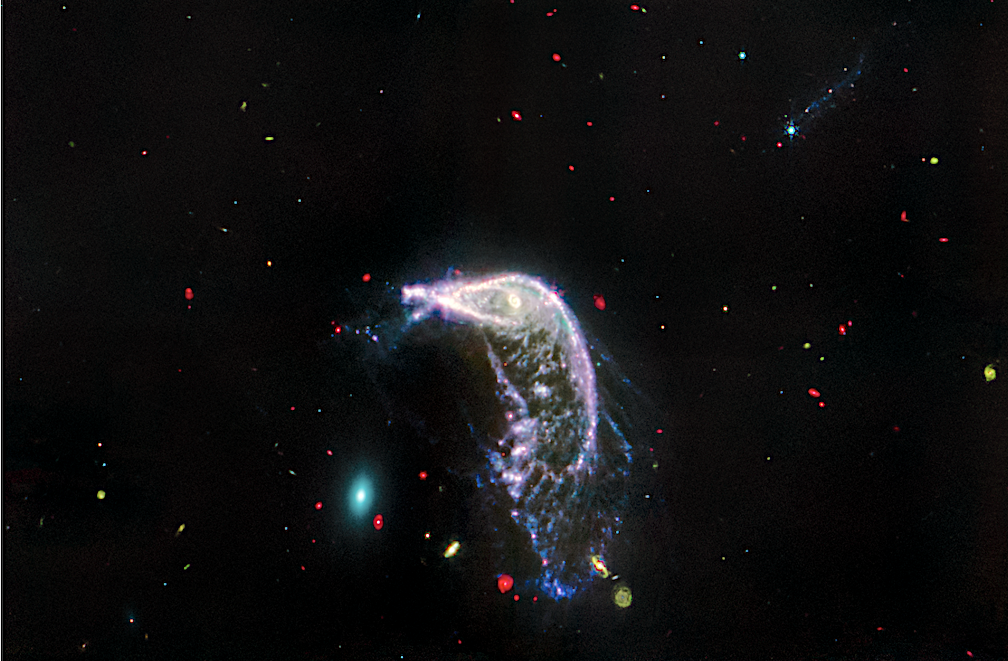
Interacting Galaxies Arp 142 (MIRI Only) NASA’s James Webb Space Telescope’s mid-infrared view of interacting galaxies Arp 142 seems to sing in primary colors. The Egg shows up as a tiny, teal-colored oval, because it is made up of old stars and has lost or used up most of its gas and dust. At right, the Penguin’s star-forming regions are represented in pink and purple, and contain smoke-like material known as polycyclic aromatic hydrocarbons.
NASA, ESA, CSA, STScI

Another reason for the Egg’s undisturbed appearance: These galaxies have approximately the same mass or heft, which is why the smaller-looking elliptical wasn’t consumed or distorted by the Penguin.

It is estimated that the Penguin and the Egg are about 100,000 light-years apart — quite close in astronomical terms. For context, the Milky Way galaxy and our nearest neighbor, the Andromeda Galaxy, are about 2.5 million light-years apart. They too will interact, but not for about 4 billion years.

Now, look to the top right to spot a galaxy that is not at this party. This edge-on galaxy, cataloged PGC 1237172, is 100 million light-years closer to Earth. It’s also quite young, teeming with new, blue stars.

Want one more party trick? Switch to Webb’s mid-infrared-only image to see PGC 1237172 practically disappear. Mid-infrared light largely captures cooler, older stars and an incredible amount of dust. Since the galaxy’s stellar population is so young, it “vanishes” in mid-infrared light.

Also take a moment to scan the background. Webb’s image is overflowing with distant galaxies. Some take spiral and oval shapes, like those threaded throughout the Penguin’s “tail feathers,” while others scattered throughout are shapeless dots. This is a testament to the sensitivity and resolution of the telescope’s infrared instruments. (Compare Webb’s view to the 2018 observation that combines infrared light from NASA’s retired Spitzer Space Telescope and near-infrared and visible light from NASA’s Hubble Space Telescope.) Even though these observations only took a few hours, Webb revealed far more distant, redder, and dustier galaxies than previous telescopes – one more reason to expect Webb to continue to expand our understanding of everything in the universe.

Want more? Take a tour to the image, “fly through” it in a visualization, and compare Webb’s image to the Hubble Space Telescope’s.

Arp 142 lies 326 million light-years from Earth in the constellation Hydra.

Filed Under: Government & Regulation

Primary Sidebar

Coverage

  • Missions & Constellations
  • Business & Finance
  • Military & Defense
  • Launch
  • Software Automation & Ground Systems
  • Government & Regulation
  • Services & Applications

Most Read Stories

  • The FCC Asked Cowboy Space How Big Its Satellites Are
  • Rocket Lab Files GAO Bid Protest Over NASA’s $700M Mars Orbiter Award to Blue Origin
  • Loft Orbital and Marlan Space Award $1 Billion Contract for 50 AI-Equipped LEO Satellites
  • Arianespace Secures Contract for 10 Ariane 64 Launch Vehicles, Allocating Six Missions to Amazon Leo
  • Ariane 6 Turbopump Anomaly Delays Launch Cadence, Capping 2026 Flight Operations at Six Missions

Secondary Sidebar

Footer


Satnews is a leading provider of satellite news, events, publications, research and other satellite industry information in both commercial and military enterprises worldwide.

Stories By Category

  • Business & Finance
  • Government & Regulation
  • Launch
  • Military & Defense
  • Missions & Constellations
  • Services & Applications
  • Software Automation & Ground Systems
  • Spectrum & Licensing
  • Startups & NewSpace Business

About Us

  • Leadership & Editorial Team
  • SatNews History
  • Free Satnews Subscription
  • SatNews Events
  • Magazines

Navigation

  • Latest Stories
  • Magazines
  • Events
  • Contact
  • Cookie & Privacy Policy for Satnews

We use cookies to ensure that we give you the best experience on our website. If you continue to use this site we will assume that you are happy with it.
x
Sign up Now (For Free)
Access daily or weekly satellite news updates covering all aspects of the commercial and military satellite industry.
Invalid email address
Notify Me Regarding ( At least one ):
We value your privacy and will not sell or share your email or other information with any other company. You may also unsubscribe at anytime.

Click Here to see our full privacy policy.
Thanks for subscribing!