

• Skip to primary navigation
  • Skip to main content
  • Skip to primary sidebar
  • Skip to secondary sidebar
  • Skip to footer
  • NEWS:
  • SatNews
  • SatMagazine
  • MilSatMagazine
  • SmallSat News
  • |     EVENTS:
  • SmallSat Symposium
  • Satellite Innovation
  • MilSat Symposium
  • SmallSat Europe

SatNews

Satellite Industry Intelligence Since 1983

Subscribe
  • LATEST
  • Missions & Constellations
    • Exploration & Science Missions
    • In-Orbit Servicing & Orbital Operations
    • LEO Constellations
    • Mission Autonomy & Onboard Systems
    • Mission Deployments & Manifests
    • Navigation & PNT
    • SmallSat
    • Spacecraft & Payload Technology
    View All in Missions & Constellations →
    CAS Space Successfully Launches Kinetica-2, Aiming for Global Cost LeadershipCAS Space Successfully Launches Kinetica-2, Aiming for Global Cost Leadership
    Can SMEs Compete in Starlink-Dominated Space?Can SMEs Compete in Starlink-Dominated Space?
    Liftoff: NASA Successfully Launches Artemis II to the MoonLiftoff: NASA Successfully Launches Artemis II to the Moon
    Spire Global Successfully Deploys Satellite for NGA MagQuest Geomagnetic ChallengeSpire Global Successfully Deploys Satellite for NGA MagQuest Geomagnetic Challenge
  • Business
    • Contracts & Commercial Deals
    • Earnings & Financial Reporting
    • Events & Conferences
    • Funding & Venture Capital
    • Market Forecasts
    • Mergers & Acquisitions
    • Personnel Moves & Appointments
    View All in Business & Finance →
    PMGC Holdings Launches NorthStrive Defense Tech to Capture Drone and Autonomous Systems MarketPMGC Holdings Launches NorthStrive Defense Tech to Capture Drone and Autonomous Systems Market
    Space42 and Viasat: Contract close for 2800 satellitesSpace42 and Viasat: Contract close for 2800 satellites
    L3Harris Taps Mercury Systems for High-Capacity Data Storage on SDA Tranche 3 SatellitesL3Harris Taps Mercury Systems for High-Capacity Data Storage on SDA Tranche 3 Satellites
    Antaris Secures $28M Series A to Advance AI-Powered Satellite Mission PlatformAntaris Secures $28M Series A to Advance AI-Powered Satellite Mission Platform
  • Defense
    • Counterspace & ASAT
    • Defense Budgets & Procurement
    • ISR & Reconnaissance
    • MILSATCOM
    • Missile Warning & Defense
    • National Security Programs
    • Space Domain Awareness
    View All in Military & Defense →
    The Downlink Deficit: The Pentagon’s Optical Mesh Network and the Terrestrial BottleneckThe Downlink Deficit: The Pentagon’s Optical Mesh Network and the Terrestrial Bottleneck
    Declassified National Reconnaissance Office Documents Reveal Early Tensions with Space Shuttle ProgramDeclassified National Reconnaissance Office Documents Reveal Early Tensions with Space Shuttle Program
    SPARC AI Appoints On-Ground Referral Agent in Ukraine to Accelerate Defense EngagementSPARC AI Appoints On-Ground Referral Agent in Ukraine to Accelerate Defense Engagement
    Indra Showcases Sovereign Space and Defense Technologies at FIDAE 2026Indra Showcases Sovereign Space and Defense Technologies at FIDAE 2026
  • Gov
    • Export Controls & Compliance
    • International Space Agreements
    • National Space Policy
    • Space Law & Treaties
    • Space Sustainability & Debris Policy
    • Space Traffic Management / Debris Removal
    View All in Government & Regulation →
    FCC Seeks Comment on Expanding Spectrum Access for “Weird Space Stuff”FCC Seeks Comment on Expanding Spectrum Access for “Weird Space Stuff”
    The FCC Must Choose: Enforce the Rules or Preserve LEO CompetitionThe FCC Must Choose: Enforce the Rules or Preserve LEO Competition
    Space Force Reassigns Final GPS III Mission to SpaceX Following Vulcan AnomalySpace Force Reassigns Final GPS III Mission to SpaceX Following Vulcan Anomaly
    NASA Realignment ‘Ignition’ Accelerates Shift Toward Commercial Lunar EconomyNASA Realignment ‘Ignition’ Accelerates Shift Toward Commercial Lunar Economy
  • Launch
    • Launch Providers
    • Launch Schedule & Calendars
    • Launch Sites & Infrastructure
    • Rocket Technology & Vehicles
    View All in Launch →
    CAS Space Successfully Launches Kinetica-2, Aiming for Global Cost LeadershipCAS Space Successfully Launches Kinetica-2, Aiming for Global Cost Leadership
    Liftoff: NASA Successfully Launches Artemis II to the MoonLiftoff: NASA Successfully Launches Artemis II to the Moon
    AAC Clyde Space Expands Orbital Presence with Transporter-16 LaunchAAC Clyde Space Expands Orbital Presence with Transporter-16 Launch
    Built by Thales Alenia Space for ESA’s Celeste mission, IOD-2 Satellite lifts off today from New ZealandBuilt by Thales Alenia Space for ESA’s Celeste mission, IOD-2 Satellite lifts off today from New Zealand
  • Software
    • Autonomous Ground Operations
    • Data Processing & AI/ML
    • Digital Twins & Modeling
    • Ground Segment & Teleports
    • Mission Planning & Simulation
    • Space Systems Software Engineering
    • Spectrum & Licensing
    View All in Software Automation & Ground Systems →
    The Downlink Deficit: The Pentagon’s Optical Mesh Network and the Terrestrial BottleneckThe Downlink Deficit: The Pentagon’s Optical Mesh Network and the Terrestrial Bottleneck
    NexSat Space Systems Debuts with ACE ‘Invisible’ Aero-Conformal AntennaNexSat Space Systems Debuts with ACE ‘Invisible’ Aero-Conformal Antenna
    Laser Communications and the Rise of Orbital Data CentersLaser Communications and the Rise of Orbital Data Centers
    ThinKom Showcases Modular MILSATCOM Architecture for Contested EnvironmentsThinKom Showcases Modular MILSATCOM Architecture for Contested Environments
  • Services & Apps
    • Climate & Environmental Monitoring
    • Disaster Response & Security Mapping
    • Earth Observation & Imaging
    • Maritime & Aviation Satcom
    • Satellite Communications
    View All in Services & Applications →
    The Downlink Deficit: The Pentagon’s Optical Mesh Network and the Terrestrial BottleneckThe Downlink Deficit: The Pentagon’s Optical Mesh Network and the Terrestrial Bottleneck
    Cinemo Reimagines the Vehicle as a Software-Defined Entertainment HubCinemo Reimagines the Vehicle as a Software-Defined Entertainment Hub
    IEC Telecom Wins CSR Initiative of the Year at the Oil & Gas Middle East Awards 2026IEC Telecom Wins CSR Initiative of the Year at the Oil & Gas Middle East Awards 2026
    Can SMEs Compete in Starlink-Dominated Space?Can SMEs Compete in Starlink-Dominated Space?
  • SatNews Events
  • Magazines
  • Calendar

Airbus awarded Bundeswehr contract for MILSATCOM system + Sentinel-2C on the move

July 7, 2024

Germany’s armed forces, the Bundeswehr, has awarded Airbus the SATCOMBw 3 prime contract for the next generation, secure, military satellite system that includes geostationary satellites as well as ground segment, launch and operation services for 15 years. The spacecraft are due to be deployed before the end of the decade and the contract value amounts to 2.1 billion euros.

Artistic rendition of the SATCOMBw 3 satellite on-orbit, courtesy of Airbus.

The contract covers the design, integration, test and on-orbit delivery of two, new, Airbus built ,military GEO telecommunications satellites that are the successor communications satellites to COMSATBw 1B and 2B. The contract also includes upgrading of the existing ground segment to operate the new satellites as well as operational services for 15 years, with the possibility of extension.

The new generation Airbus satellites are based on the Eurostar Neo platform and will weigh around 6 metric tons. They will have extensive capabilities to keep pace with the rapid changes in digitization and the constantly increasing volume of data transfer required. They will also feature the latest state of the art technologies. 

Photo of a Eurostar Neo platform, courtesy of Airbus.

A key element of the overall contract is an in-depth German value chain involving partners such as Bremen-based OHB and numerous smaller German companies. Central elements including the guidance and integration of the advanced payloads, the solar arrays and overall operation of the spacecraft will be from Germany. 

The Bundeswehr’s satellite communications system (SATCOMBw) is indispensable for autonomous and independently deployable communications and information services. It ensures the global command and information capability of the German armed forces, such as operational contingents and special forces. The SATCOMBw 3 project also aims to ensure that NATO’s North Atlantic Treaty Organisation commitments in this area will continue to be met in the future. With SATCOMBw 3, the Bundeswehr is responding to increased user requirements.

Michael Schoellhorn, CEO of Airbus Defence and Space, said, “After the success of the SATCOMBw Stage 2 program, which we have been delivering since 2009, this latest contract reinforces our strategic partnership with the Bundeswehr, providing them with a greatly enhanced secure milsatcom capability that is future proofed into the 2040s. At a time when Western democracies are challenged and where the European institutional space ecosystem is struggling, we are excited and grateful to develop and build this leading-edge system. Long term partnerships are crucial to guaranteeing essential sovereignty and capability, and protecting our armed forces in the increasingly unstable geo-political environment.”

Airbus built Copernicus Sentinel-2C climate satellite heading for launch site
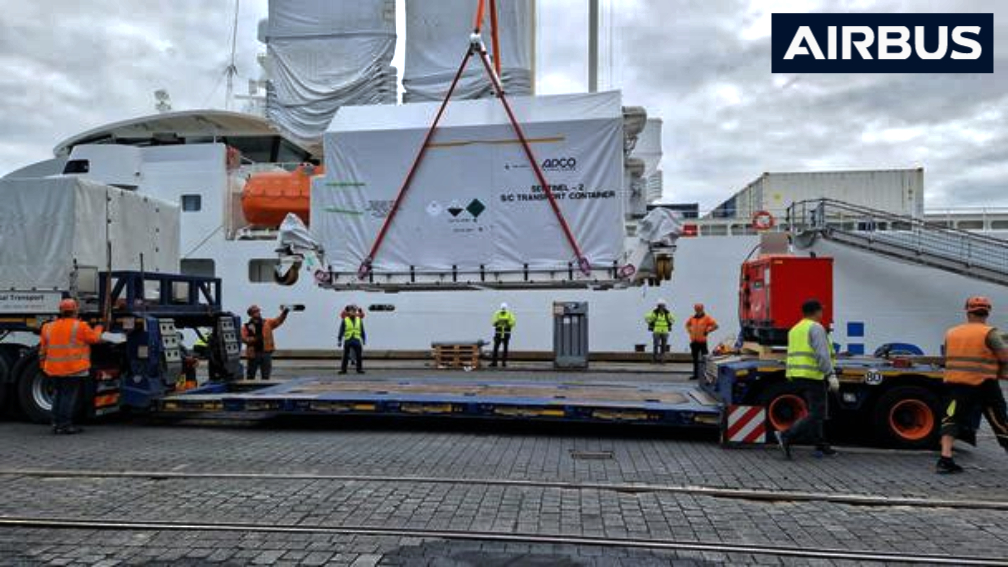
Spacecraft to reach launch site on board sail-assisted Canopée ship. Photo courtesy of Airbus.

After road transport from Airbus in Friedrichshafen to Bremen, Germany, on July 2nd, the Airbus-built Sentinel-2C satellite, the third Copernicus Sentinel-2 satellite, is about to be shipped to the European spaceport in French Guiana.
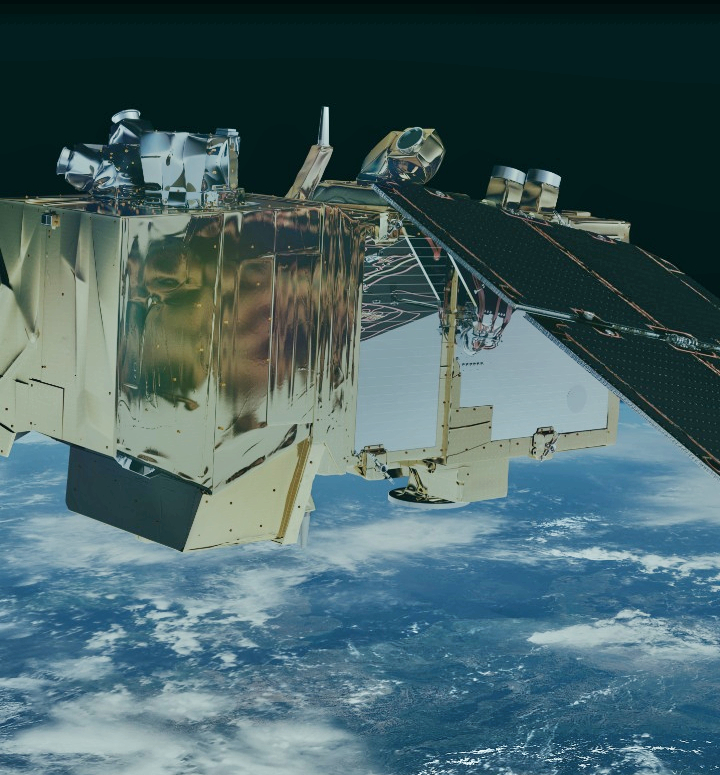
Artistic rendition of the Sentinel-2C on-orbit.

The container has been loaded onto the iconic Canopée, the first sail-assisted cargo ship designed specifically to transport Ariane 6 rocket components from European ports to the Guiana Space Centre in Kourou, where it will arrive in approximately two weeks.

Photo of launch from the Guiana Space Center, courtesy of Arianespace.

Data collected by the Copernicus Sentinel-2 satellites is being used to monitor land use and change, soil sealing, land management, agriculture, forestry, natural disasters (floods, forest fires, landslides, volcanic eruptions and erosion) and to support humanitarian aid missions. Environmental monitoring, which provides information on the pollution of lakes and coastal waters, is also part of these activities, as is the monitoring of glaciers, ice and snow.

The Sentinel-2 mission contributes to the management of food security by providing information for the agricultural sector. Copernicus Sentinel-2, with its multispectral instrument, is the first optical Earth Observation (EO) mission of its kind to include three bands in the “red edge“, which provide key information on vegetation conditions. The satellite is designed to provide images that can be used to distinguish between different crop types, as well as data on numerous plant indices such as leaf area index, leaf chlorophyll content and leaf water content – all of which are essential for accurately monitoring plant growth.

Sentinel-2C, like its predecessors Sentinel-2A and -2B, will provide “color vision” for Copernicus, the EO component of the EU Space Program, generating optical images from the visible to the shortwave infrared region of the electromagnetic spectrum. From an altitude of 786 kilometers, the 1.1 ton ‘C’ satellite will provide continuous imaging in 13 spectral bands with resolutions of 10, 20 or 60 meters and a uniquely large swath width of 290 kilometres. The optical design of the MultiSpectral Instrument (MSI) has been optimised to provide state-of-the-art image data quality over its very wide field of view, to be transmitted via Airbus’ laser-based SpaceDataHighway (EDRS).
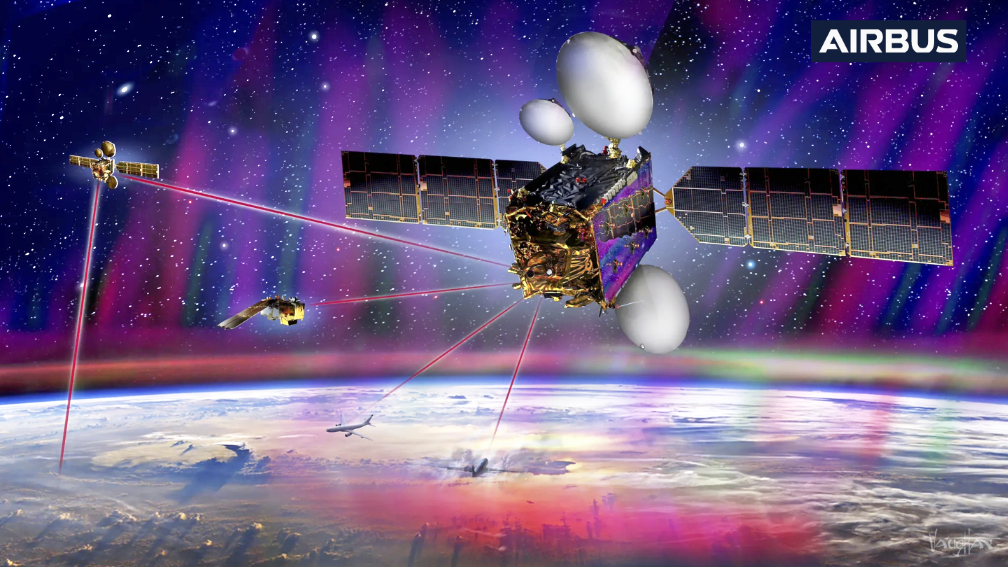
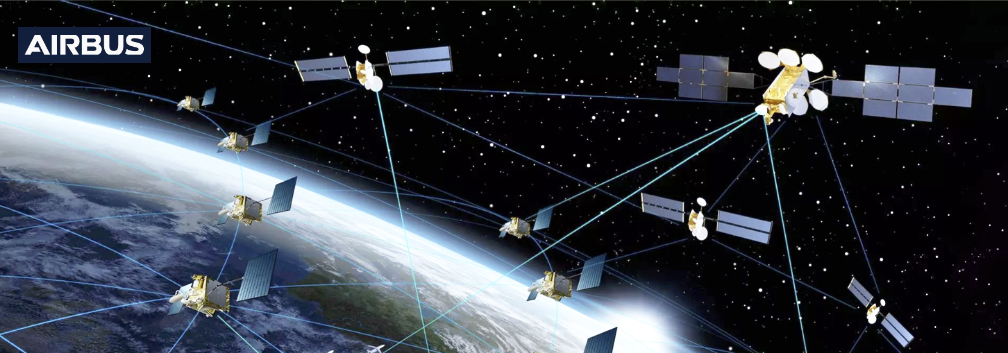
SpaceDataHighway™ (SDH) is a public-private partnership between ESA (European Space Agency) and Airbus. The SpaceDataHighway service uses the Airbus-owned and operated European Data Relay System (EDRS) laser communication infrastructure to provide this high bandwidth capability for both LEO satellites and airborne platforms.

The telescope structure and mirrors are made of Silicon Carbide, a material pioneered by Airbus to provide very high optical stability and minimize thermo-elastic deformation, resulting in excellent geometric image quality. This is unprecedented in this category of optical imagers. Each Sentinel-2 satellite collects 1.5 terabytes per day after on-board compression. 

The Sentinel-2 mission is based on a constellation of two identical satellites, Sentinel-2A (launched in 2015) and Sentinel-2B (launched in 2017), flying in the same orbit but 180° apart to optimize coverage and revisit time. The satellites orbit the Earth every 100 minutes, covering all land surfaces, large islands, inland and coastal waters every five days. Once in orbit, Sentinel-2C will replace its predecessor, Sentinel-2A, while Sentinel-2D will later replace Sentinel-2B to ensure continuity of data beyond 2035.

The Sentinel-2 mission has been made possible through close cooperation among the European Commission, ESA, industry, service providers and data users. Some 60 companies have been involved in its development, led by Airbus Defence and Space in Germany.

Airbus has played a key role in building the satellites and instruments for Copernicus since the program began in 1998, contributing its environmental expertise to all six Sentinel missions and the new next-generation Copernicus satellites: CRISTAL, LSTM and ROSE-L.

The Sentinel satellites are part of Copernicus, the EO component of the EU Space Program, managed by the European Commission (EC) in partnership with the European Space Agency (ESA). The Copernicus Sentinels provide remote sensing data of the Earth, providing key operational services related to the environment and security.

Pre-launch activities will be carried out in Kourou to prepare Copernicus Sentinel-2C for launch on the final Vega rocket operated by Arianespace in September.
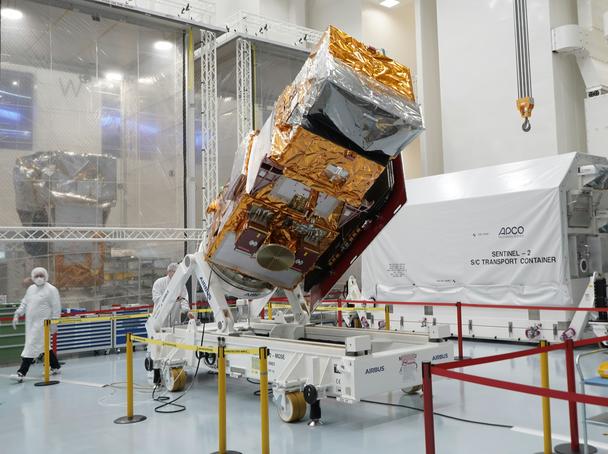
Copernicus Sentinel-2C - Copyright Airbus
Copernicus Sentinel-2C before loading into its container.
Photo is courtesy of Airbus.

“About half of the data used to assess and monitor the impact of climate change on Earth is actually delivered by satellites,” said Marc Steckling, Head of Earth Observation, Science and Exploration at Airbus. “The Copernicus Sentinel-2 satellites have provided valuable climate information to scientists since 2015 and Sentinel-2C will ensure continuity. Additionally, they have also made monitoring marine litter from space a reality, a significant achievement considering how critical this issue has become.”

Filed Under: Contracts & Commercial Deals, Defense Budgets & Procurement Tagged With: Featured

Primary Sidebar

Coverage

  • Missions & Constellations
  • Business & Finance
  • Military & Defense
  • Launch
  • Software Automation & Ground Systems
  • Government & Regulation
  • Services & Applications

Most Read Stories

  • Rheinmetall Withdraws From Mynaric Bidding Process; Rocket Lab Acquisition Clears Major Competitive Hurdle
  • L3Harris Unveils XL-300P: The First P25 Handheld with 5G and Satellite Direct-to-Device Connectivity
  • Rheinmetall Walked Away. Germany Should Take the Hint.
  • Guardians in the Kill Chain: How the Space Force Led the Opening Salvo of Operation Epic Fury
  • Rocket Lab Emerging as Potential Bus Provider for 2,800-Satellite Equatys Constellation

Secondary Sidebar

Footer


Satnews is a leading provider of satellite news, events, publications, research and other satellite industry information in both commercial and military enterprises worldwide.

Stories By Category

  • Business & Finance
  • Government & Regulation
  • Launch
  • Military & Defense
  • Missions & Constellations
  • Services & Applications
  • Software Automation & Ground Systems
  • Spectrum & Licensing
  • Startups & NewSpace Business

About Us

  • Leadership & Editorial Team
  • SatNews History
  • Free Satnews Subscription
  • SatNews Events
  • Magazines

Navigation

  • Latest Stories
  • Magazines
  • Events
  • Contact
  • Cookie & Privacy Policy for Satnews

We use cookies to ensure that we give you the best experience on our website. If you continue to use this site we will assume that you are happy with it.
x
Sign up Now (For Free)
Access daily or weekly satellite news updates covering all aspects of the commercial and military satellite industry.
Invalid email address
Notify Me Regarding ( At least one ):
We value your privacy and will not sell or share your email or other information with any other company. You may also unsubscribe at anytime.

Click Here to see our full privacy policy.
Thanks for subscribing!