


• Skip to primary navigation
  • Skip to main content
  • Skip to primary sidebar
  • Skip to secondary sidebar
  • Skip to footer
  • NEWS:
  • SatNews
  • SatMagazine
  • MilSatMagazine
  • SmallSat News
  • |     EVENTS:
  • SmallSat Symposium
  • Satellite Innovation
  • MilSat Symposium
  • SmallSat Europe

SatNews

Satellite Industry Intelligence Since 1983

Subscribe
  • LATEST
  • Missions & Constellations
    • Exploration & Science Missions
    • In-Orbit Servicing & Orbital Operations
    • LEO Constellations
    • Mission Autonomy & Onboard Systems
    • Mission Deployments & Manifests
    • Navigation & PNT
    • SmallSat
    • Spacecraft & Payload Technology
    View All in Missions & Constellations →
    Voyager Technologies Executes Strategic Investment in Max Space Expandable Habitat ArchitectureVoyager Technologies Executes Strategic Investment in Max Space Expandable Habitat Architecture
    Titans of LEO in a Heavenly Price battleTitans of LEO in a Heavenly Price battle
    Satellite Connectivity in a Post Capacity EraSatellite Connectivity in a Post Capacity Era
    MTN Launches Click-to-Deploy StarEdge Horizon Satellite Service on AWS MarketplaceMTN Launches Click-to-Deploy StarEdge Horizon Satellite Service on AWS Marketplace
  • Business
    • Contracts & Commercial Deals
    • Earnings & Financial Reporting
    • Events & Conferences
    • Funding & Venture Capital
    • Market Forecasts
    • Mergers & Acquisitions
    • Personnel Moves & Appointments
    View All in Business & Finance →
    York Space Systems Acquires Orbion Space Technology to Deepen Vertical Integration for SDA ConstellationsYork Space Systems Acquires Orbion Space Technology to Deepen Vertical Integration for SDA Constellations
    Rheinmetall Withdraws From Mynaric Bidding Process; Rocket Lab Acquisition Clears Major Competitive HurdleRheinmetall Withdraws From Mynaric Bidding Process; Rocket Lab Acquisition Clears Major Competitive Hurdle
    MTN Launches Click-to-Deploy StarEdge Horizon Satellite Service on AWS MarketplaceMTN Launches Click-to-Deploy StarEdge Horizon Satellite Service on AWS Marketplace
    Spring Forward: Legacy Operators Are Killing GEO. That’s the Plan.Spring Forward: Legacy Operators Are Killing GEO. That’s the Plan.
  • Defense
    • Counterspace & ASAT
    • Defense Budgets & Procurement
    • ISR & Reconnaissance
    • MILSATCOM
    • Missile Warning & Defense
    • National Security Programs
    • Space Domain Awareness
    View All in Military & Defense →
    Your Teleport Can’t Dodge a MissileYour Teleport Can’t Dodge a Missile
    BAE Systems Completes Preliminary Design Review for $1.2 Billion Space Force Epoch 2 ProgramBAE Systems Completes Preliminary Design Review for $1.2 Billion Space Force Epoch 2 Program
    Guardians in the Kill Chain: How the Space Force Led the Opening Salvo of Operation Epic FuryGuardians in the Kill Chain: How the Space Force Led the Opening Salvo of Operation Epic Fury
    BlackSky Awarded $99M Air Force Contract for Advanced Optical Testbed; Lockheed Martin Expands Missile ProductionBlackSky Awarded $99M Air Force Contract for Advanced Optical Testbed; Lockheed Martin Expands Missile Production
  • Gov
    • Export Controls & Compliance
    • International Space Agreements
    • National Space Policy
    • Space Law & Treaties
    • Space Sustainability & Debris Policy
    • Space Traffic Management / Debris Removal
    View All in Government & Regulation →
    Saying Goodbye to the ISS, and Hello to the Orbital Tenancy Trap Saying Goodbye to the ISS, and Hello to the Orbital Tenancy Trap 
    FAA Rescinds Proposed Orbital Debris Rule Amid Industry Pressure and Regulatory ReassessmentFAA Rescinds Proposed Orbital Debris Rule Amid Industry Pressure and Regulatory Reassessment
    The Iran Precedent: Operation Epic Fury and the Law of Armed Conflict in SpaceThe Iran Precedent: Operation Epic Fury and the Law of Armed Conflict in Space
    Geopolitical Scrutiny: The Strategic Implications of APT Satellite’s Chinese State OwnershipGeopolitical Scrutiny: The Strategic Implications of APT Satellite’s Chinese State Ownership
  • Launch
    • Launch Providers
    • Launch Schedule & Calendars
    • Launch Sites & Infrastructure
    • Rocket Technology & Vehicles
    View All in Launch →
    Firefly Aerospace Returns to Flight with Successful “Stairway to Seven” MissionFirefly Aerospace Returns to Flight with Successful “Stairway to Seven” Mission
    SpaceX Evolves Beyond Broadband with “Million-Satellite” AI Data Center Plan; Amazon Mounts Legal ChallengeSpaceX Evolves Beyond Broadband with “Million-Satellite” AI Data Center Plan; Amazon Mounts Legal Challenge
    Times Microwave Systems Launches Levitate™ Ultra-Lightweight Cables for UAV and Defense AvionicsTimes Microwave Systems Launches Levitate™ Ultra-Lightweight Cables for UAV and Defense Avionics
    Blue Origin Accelerates New Glenn 9×4 Production and TeraWave Constellation DevelopmentBlue Origin Accelerates New Glenn 9×4 Production and TeraWave Constellation Development
  • Software
    • Autonomous Ground Operations
    • Data Processing & AI/ML
    • Digital Twins & Modeling
    • Ground Segment & Teleports
    • Mission Planning & Simulation
    • Space Systems Software Engineering
    • Spectrum & Licensing
    View All in Software Automation & Ground Systems →
    Your Teleport Can’t Dodge a MissileYour Teleport Can’t Dodge a Missile
    Missile Strike Targets Strategic SES Ha’Ela Teleport in Central IsraelMissile Strike Targets Strategic SES Ha’Ela Teleport in Central Israel
    ATLAS Space Operations Establishes South Pacific Hub with New Ground Station in American SamoaATLAS Space Operations Establishes South Pacific Hub with New Ground Station in American Samoa
    Danish Army Selects BAE Systems OneArc for 7-Year Simulation Modernization ProgramDanish Army Selects BAE Systems OneArc for 7-Year Simulation Modernization Program
  • Services & Apps
    • Climate & Environmental Monitoring
    • Disaster Response & Security Mapping
    • Earth Observation & Imaging
    • Maritime & Aviation Satcom
    • Satellite Communications
    View All in Services & Applications →
    Your Teleport Can’t Dodge a MissileYour Teleport Can’t Dodge a Missile
    Jazz Secures Industry-Leading 190 MHz in Pakistan’s Landmark $507M 5G Spectrum AuctionJazz Secures Industry-Leading 190 MHz in Pakistan’s Landmark $507M 5G Spectrum Auction
    Spring Forward: Legacy Operators Are Killing GEO. That’s the Plan.Spring Forward: Legacy Operators Are Killing GEO. That’s the Plan.
    Synthetic Aperture Radar as the Modern Backbone of Maritime Domain AwarenessSynthetic Aperture Radar as the Modern Backbone of Maritime Domain Awareness
  • SatNews Events
  • Magazines
  • Calendar
  • Jobs

Scientists use NASA data to predict solar corona before Eclipse

April 3, 2024

Solar eclipse
NASA

Our Sun, like many stars, is adorned with a crown. It’s called a corona (Latin for “crown” or “wreath”) and consists of long, thread-like strands of plasma billowing out from the Sun’s surface. The powerful magnetic field of the Sun defines these strands, causing them to ripple and evolve their structures constantly. The strands are faint, however, so the only way to observe the corona with the naked eye is during a total solar eclipse.

In anticipation of the solar eclipse on April 8, 2024, scientists at Predictive Science are using data from NASA’s Solar Dynamics Observatory (SDO) to predict what our Sun’s crown may look like

on that day. What’s more, their model uses the computational efforts of NASA’s Pleiades Supercomputer to update its predictions in near real-time. This means that the model continuously updates its predictions as it ingests data beamed down from SDO, providing information as close to real-time as possible.

The solar corona is our star’s outer atmosphere. It “extends out into interplanetary space as the solar wind,” said Predictive Science president Jon Linker. Driven by heat and magnetic turbulence in the Sun, this wind blows out to the edges of the solar system. “It envelopes the planets,” Linker said, “including Earth.”

As Earth and other planets bathe in coronal outflow, their atmospheres react to the energetic particles and magnetic fields found within the solar wind. This reaction, called space weather, can range from mild to severe, just like terrestrial weather. Extreme space weather events, such as large solar eruptions called coronal mass ejections, can disrupt important communications technology, affect astronauts in orbit, or even harm the electric grids we all rely on.

Space weather is one of the most tangible effects of the Sun’s dynamic exterior, and creating accurate forecasts is something scientists are striving toward. According to Linker, refining these solar models helps build the foundation for forecasting. “If you’re going to predict the path of a coronal mass ejection, just like for a hurricane, to have this more accurate background is really important,” he said.

SDO and other solar observatories provide detailed insights about the corona, but scientists are still missing some vital information about the forces that drive its activity, which is needed to predict the corona’s appearance with precision. “We don’t have a way of measuring the magnetic field accurately in the corona,” said Emily Mason, a research scientist at Predictive Science. “That’s one of the things that makes this so challenging.”
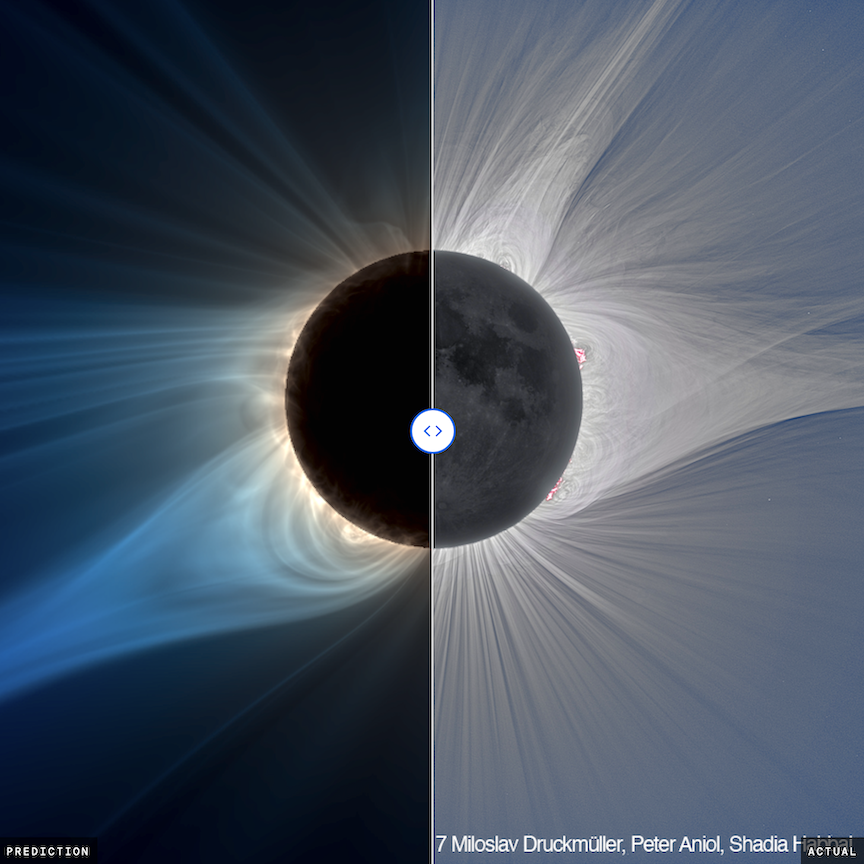
To build their model, researchers at Predictive Science use measurements of the Sun’s changing magnetic field at the solar surface to drive their model in near real-time. A key to this innovation was creating an automated process that converts raw data from SDO to show how magnetic flux and energy are injected into the corona over time. Adding this dynamic into the model allows the corona to evolve over time, leading to solar eruptions. “We developed a software pipeline that took in the magnetic field maps, picked out all of the areas that should be energized, and then fine-tuned the amount of energy to add to those areas,” Mason said. Building this automatic pipeline was a huge step forward for the team. In past predictions, the model used a static snapshot of the surface magnetic field — not ideal for keeping up with the ever-changing Sun, especially during our current heightened period of solar activity. Similarly, in iterations from 2017 and 2021, Mason explained that a teammate used to “literally hand-draw which areas on the Sun needed to be energized” by analyzing extreme ultraviolet activity in certain regions. Continuously updating the magnetic field is central to all of the changes with this year’s model, and the team has high hopes for the results.

The recurrence of total solar eclipses provides opportunities to test the accuracy of their models against real-life conditions and update them accordingly. “We’ve used the eclipse predictions every time to do something new with the model,” said Cooper Downs, a research scientist at Predictive Science who orchestrated the automated modeling pipeline. “I’m really excited to see over the next two weeks how this prediction keeps improving. I think it will be a really drastic difference from what we used to be able to do.”

Mason shares his enthusiasm. “The eclipse is just such a fantastic chance to go, ‘Look at this! This is what we think it’s gonna look like! Don’t you want to learn more about this?” she said with a grin. “It’s a really exciting opportunity for us to share the things that excite us all year round with everybody else.”

By Rachel Lense
NASA’s Goddard Space Flight Center, Greenbelt, Md.

Filed Under: Climate & Environmental Monitoring, Exploration & Science Missions

Primary Sidebar

Coverage

  • Missions & Constellations
  • Business & Finance
  • Military & Defense
  • Launch
  • Software Automation & Ground Systems
  • Government & Regulation
  • Services & Applications

Most Read Stories

  • Global Shift Toward Sovereign Launch Gains Momentum Amid Geopolitical Tensions
  • SES Executive Confirms End of the 15-Year Satellite Era
  • SpaceX Unveils ‘Stargaze’ System to Revolutionize Space Traffic Management
  • AST SpaceMobile Encapsulates BlueBird 7 Satellite for Inaugural New Glenn Mission
  • Bidding War Intensifies for Mynaric as Rheinmetall Challenges Rocket Lab Acquisition

Secondary Sidebar

Footer


Satnews is a leading provider of satellite news, events, publications, research and other satellite industry information in both commercial and military enterprises worldwide.

Stories By Category

  • Business & Finance
  • Government & Regulation
  • Launch
  • Military & Defense
  • Missions & Constellations
  • Services & Applications
  • Software Automation & Ground Systems
  • Spectrum & Licensing
  • Startups & NewSpace Business

About Us

  • Leadership & Editorial Team
  • SatNews History
  • Free Satnews Subscription
  • SatNews Events
  • Magazines

Navigation

  • Latest Stories
  • Magazines
  • Events
  • Contact
  • Cookie & Privacy Policy for Satnews

We use cookies to ensure that we give you the best experience on our website. If you continue to use this site we will assume that you are happy with it.
x
Sign up Now (For Free)
Access daily or weekly satellite news updates covering all aspects of the commercial and military satellite industry.
Invalid email address
Notify Me Regarding ( At least one ):
We value your privacy and will not sell or share your email or other information with any other company. You may also unsubscribe at anytime.

Click Here to see our full privacy policy.
Thanks for subscribing!