

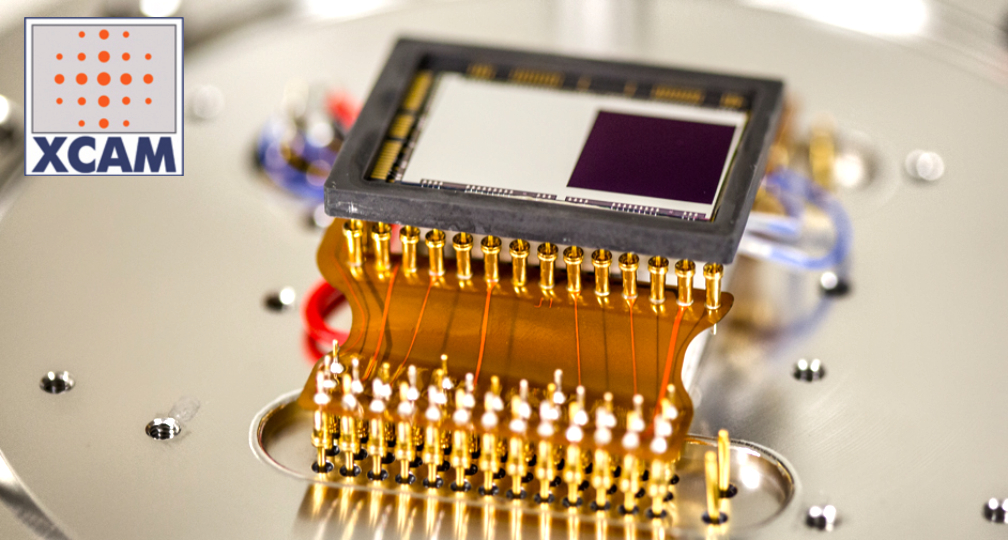

XCAM Ltd. recently secured more than £200,000 grant funding from the UK Space Agency’s Centre for Earth Observation Instrumentation (CEOI) to develop and evaluate a New Space, ultra-low-light, camera system suitable for use in a range of compact EO instruments in the visible and NIR (Near-infrared spectroscopy) wavelengths.
It is anticipated that the camera system created from this project will lead to the development of very high resolution, multi-spectral imaging instrument that will transform Earth is monitored in the future for applications such as, solar induced fluorescence effects, night-time imaging for development goals, polar ice mapping, thermospheric wind speed monitoring and many more.
The project will use new high frame rate, state-of-the-art sensors developed by collaborator BAE Systems and integrate them into XCAM’s versatile and high-performance ‘Nuscis‘ camera system for space imaging applications. Once the new system has been developed, XCAM will perform system characterisation against a number of use-cases and project partners, the Centre for Electronic Imaging (CEI) at the Open University, will conduct radiation tests to up-screen the technology ready for space use, with an early adopter already identified in Michigan Aerospace Corporation.

In a separate project, XCAM will also be joining a team led by Glasgow-based firm, Craft Prospect, to develop the next generation of their Forward-Looking Imager (FLI) technology, also funded by the CEOI.
“We welcome this valuable grant funding and the partnership generated with BAE Systems, which will lead to an increase in sales for our unique specialist camera systems into our global export markets. We hope to prove through this project that these new sensitive, ultra-low-noise sensors alongside our camera system will transform the performance of compact space imaging cameras leading to new ways of monitoring our planet from space.” — Karen Holland, CEO, XCAM Ltd.
“Michigan Aerospace is pleased to support XCAM’s efforts to ruggedize low-noise CMOS detectors for space applications. The work that XCAM is undertaking will enable sensitive low-noise cameras to be available for small form factor satellites that enable the creation of observing constellations such as our instrument that will measure neutral winds in the thermosphere from a 6U CubeSat. The system being proposed by XCAM is of interest to us as a candidate for future missions. Michigan Aerospace Corporation is interested in seeing this technology advance and we look forward to supporting XCAM in testing the ruggedized detector systems for future satellite applications.” — Jane Pavlich, President, Michigan Aerospace Corporation
“BAE Systems’ Sensor Solutions is a global leader in high-performance imaging solutions for the space, defense, and science markets. We recently developed the HWK4123 ultra-low noise image sensor that is capable of imaging in starlight conditions. BAE Systems supports XCAM’s objectives to incorporate the HWK4123 sensor into a new, experimental, small satellite format suitable for a range of Earth observation applications. This technology will create significant new opportunities in the Earth observation and related space domains.” — Deren Mehmet, BAE Systems
