

• Skip to primary navigation
  • Skip to main content
  • Skip to primary sidebar
  • Skip to secondary sidebar
  • Skip to footer
  • NEWS:
  • SatNews
  • SatMagazine
  • MilSatMagazine
  • SmallSat News
  • |     EVENTS:
  • SmallSat Symposium
  • Satellite Innovation
  • MilSat Symposium
  • SmallSat Europe

SatNews

Satellite Industry Intelligence Since 1983

Subscribe
  • LATEST
  • SatNews Events
  • Magazines
  • Calendar
  • Subscribe
  • Missions & Constellations
    • Exploration & Science Missions
    • In-Orbit Servicing & Orbital Operations
    • LEO Constellations
    • Mission Autonomy & Onboard Systems
    • Mission Deployments & Manifests
    • Navigation & PNT
    • SmallSat
    • Spacecraft & Payload Technology
    View All in Missions & Constellations →
    Cerberus Capital Management to Acquire Airbus U.S. Space & Defense Satellite Manufacturing UnitCerberus Capital Management to Acquire Airbus U.S. Space & Defense Satellite Manufacturing Unit
    NATO NCIA Plans EUR 2.7 Billion in Commercial Contracts Through 2028 as Space Share RisesNATO NCIA Plans EUR 2.7 Billion in Commercial Contracts Through 2028 as Space Share Rises
    Radiation-Resistant Lens Designs Adapt to Accelerate Space Payload ProductionRadiation-Resistant Lens Designs Adapt to Accelerate Space Payload Production
    Seibersdorf Laboratories and Tumbleweed Partner on Microgravity R&D Service for Pharma and BiotechSeibersdorf Laboratories and Tumbleweed Partner on Microgravity R&D Service for Pharma and Biotech
  • Business
    • Contracts & Commercial Deals
    • Earnings & Financial Reporting
    • Events & Conferences
    • Funding & Venture Capital
    • Market Forecasts
    • Mergers & Acquisitions
    • Personnel Moves & Appointments
    View All in Business & Finance →
    Build, Buy or Merge: Satellite Companies Move to Own Their LaunchBuild, Buy or Merge: Satellite Companies Move to Own Their Launch
    Early Signals, 2016: SpaceX’s First Backer Opened the First SmallSat SymposiumEarly Signals, 2016: SpaceX’s First Backer Opened the First SmallSat Symposium
    EnSilica Reaches Initial Agreement for $80 Million Resilient GNSS ASIC ProgramEnSilica Reaches Initial Agreement for $80 Million Resilient GNSS ASIC Program
    Thales Alenia Space Signs €240 Million Contract With OHB for Sentinel-3NG Topography AltimetersThales Alenia Space Signs €240 Million Contract With OHB for Sentinel-3NG Topography Altimeters
  • Defense
    • Counterspace & ASAT
    • Defense Budgets & Procurement
    • ISR & Reconnaissance
    • MILSATCOM
    • Missile Warning & Defense
    • National Security Programs
    • Space Domain Awareness
    View All in Military & Defense →
    ARES Shield AI Completes First In-Orbit Object Detection Test Aboard D-Orbit SpacecraftARES Shield AI Completes First In-Orbit Object Detection Test Aboard D-Orbit Spacecraft
    A Second LEO Network Has Paying Customers and a Launch ProblemA Second LEO Network Has Paying Customers and a Launch Problem
    GAO Finds Pentagon Lacks Coordinated View of Military Space Supply Chain RisksGAO Finds Pentagon Lacks Coordinated View of Military Space Supply Chain Risks
    Orbital Proximity Incidents Mask Broader Satellite Jamming ThreatOrbital Proximity Incidents Mask Broader Satellite Jamming Threat
  • Gov
    • Export Controls & Compliance
    • International Space Agreements
    • National Space Policy
    • Space Law & Treaties
    • Space Sustainability & Debris Policy
    • Space Traffic Management / Debris Removal
    View All in Government & Regulation →
    United States Finalizes 20 Agenda Item Positions Ahead of WRC-27 Spectrum NegotiationsUnited States Finalizes 20 Agenda Item Positions Ahead of WRC-27 Spectrum Negotiations
    FCC Upper C-Band Auction 115 Creates Indirect Spectrum and Market Shifts for SmallSat and LEO OperatorsFCC Upper C-Band Auction 115 Creates Indirect Spectrum and Market Shifts for SmallSat and LEO Operators
    FCC Sets April 27, 2027 Start Date for Upper C-Band Auction, Pressuring BroadcastersFCC Sets April 27, 2027 Start Date for Upper C-Band Auction, Pressuring Broadcasters
    Senate Appropriators Move to Bar Sole-Source Awards Over $100 Million for Space Data Network and SB-AMTISenate Appropriators Move to Bar Sole-Source Awards Over $100 Million for Space Data Network and SB-AMTI
  • Launch
    • Launch Providers
    • Launch Schedule & Calendars
    • Launch Sites & Infrastructure
    • Rocket Technology & Vehicles
    View All in Launch →
    NATO Stands Up Starlift Launch Brokerage to Connect Alliance Demand With Allied SpaceportsNATO Stands Up Starlift Launch Brokerage to Connect Alliance Demand With Allied Spaceports
    ULA Clears Blue Origin BE-4 Engines, Focuses Vulcan Failure Probe on Core Stage Fuel SupplyULA Clears Blue Origin BE-4 Engines, Focuses Vulcan Failure Probe on Core Stage Fuel Supply
    Google Selects Blue Origin’s New Glenn Rocket for 2029 AI Satellite LaunchGoogle Selects Blue Origin’s New Glenn Rocket for 2029 AI Satellite Launch
    NASA’s Voyager 1 Reaches One Light-Day From Earth at 16.1 Billion MilesNASA’s Voyager 1 Reaches One Light-Day From Earth at 16.1 Billion Miles
  • Software
    • Autonomous Ground Operations
    • Data Processing & AI/ML
    • Digital Twins & Modeling
    • Ground Segment & Teleports
    • Mission Planning & Simulation
    • Space Systems Software Engineering
    • Spectrum & Licensing
    View All in Software Automation & Ground Systems →
    Lite Coms Secures Over $100 Million in Q3 2026 Defense SATCOM OrdersLite Coms Secures Over $100 Million in Q3 2026 Defense SATCOM Orders
    RBC Signals Secures $10 Million Strategic Growth Investment Led by Washington Harbour PartnersRBC Signals Secures $10 Million Strategic Growth Investment Led by Washington Harbour Partners
    Ramon.Space Raises $124 Million Series B to Scale Orbital Computing InfrastructureRamon.Space Raises $124 Million Series B to Scale Orbital Computing Infrastructure
    Gilat Cuts 2026 Growth Forecast to 3% Amid Launch and IFC DelaysGilat Cuts 2026 Growth Forecast to 3% Amid Launch and IFC Delays
  • Services & Apps
    • Climate & Environmental Monitoring
    • Disaster Response & Security Mapping
    • Earth Observation & Imaging
    • Maritime & Aviation Satcom
    • Satellite Communications
    View All in Services & Applications →
    Smart and Elveo Mobile Complete Direct-to-Device Satellite Trials on Philippine Sea RouteSmart and Elveo Mobile Complete Direct-to-Device Satellite Trials on Philippine Sea Route
    Thales Alenia Space Awarded DGA Contract for French IRIS Military Optical ConstellationThales Alenia Space Awarded DGA Contract for French IRIS Military Optical Constellation
    Ubotica Demonstrates Autonomous Onboard Satellite Scheduling for Maritime SurveillanceUbotica Demonstrates Autonomous Onboard Satellite Scheduling for Maritime Surveillance
    UniSQ Demonstrates Tomographic Spectrometer During KREPE-3 Re-Entry CampaignUniSQ Demonstrates Tomographic Spectrometer During KREPE-3 Re-Entry Campaign

Unlocking PRETTY smallsat navigation for Earth data

October 13, 2023

PRETTY CubeSat with two patch antennas
PRETTY CubeSat with two patch antennas. Photo is courtesy of ESA.

Earth is being continuously bathed in radio signals from satellite navigation (satnav) satellites, which are useful for far more than navigation. Dedicated space missions acquire these signal reflections to collect valuable environmental information. The shoebox-sized PRETTY CubeSat, flying on Europe’s Vega launcher, will investigate a new frequency and novel observation angle to better measure the rate of climate change — at the same time, gathering radiation data on the surrounding space environment.

The PRETTY (Passive REflecTometry and dosimeTrY) mission will peer ahead to the horizon to receive signals from Global Navigation Satellite System (GNSS) satellites visible just above it. Two patch antennas on its forward face will pick up the same signal from the same satellite, or rather one signal that has reached it through space, and the equivalent signal that has reflected off Earth’s cryosphere or oceans.

Using a highly advanced version of ‘spot the difference,’ PRETTY will compare the twin signals onboard to derive ice and sea height to an accuracy of at least 50 cm from a 550 km orbital altitude.

PRETTY is testing 'slant' reflectometry
PRETTY is testing ‘slant’ reflectometry. Image is courtesy of ESA.

Meanwhile, a miniaturized dosimeter will be tracking the CubeSat’s ongoing radiation exposure, amassing data which will help ensure the reliability and sustainability of future smallsats.

Environmental data from reflected satnav

ESA radiometer engineer Manuel Martin Neira (photo below) was the original inventor of the GNSS ‘reflectometry’ concept.

This concept is in active use today by numerous missions worldwide to acquire comparatively-low-cost altimetry and scatterometry-based wind and wave data.

Integrating CubeSat
Integrating the PRETTY CubeSat at TU Graz, with team members Manuela Wenger (left) and Andreas Johann Hörmer (right).

Neira explained that PRETTY incorporates some important innovations and said, “Existing reflectometry missions look straight down, but such a vertical geometry gives rise to a very rough sea surface. By peering down at a shallow angle the sea appears smoother – akin to the way that Venetian blinds can variously appear open or closed, depending on the angle that you observe them. The result is that reflected GNSS signals remain more coherent in turn. In addition, PRETTY is making use of a new GNSS frequency for the first time, employing the longer-wavelength E5/L5 as transmitted by European Galileo and US GPS satellites. The PRETTY team made this change late in mission development, guided by ground testing that showed superior accuracy using this frequency band.”
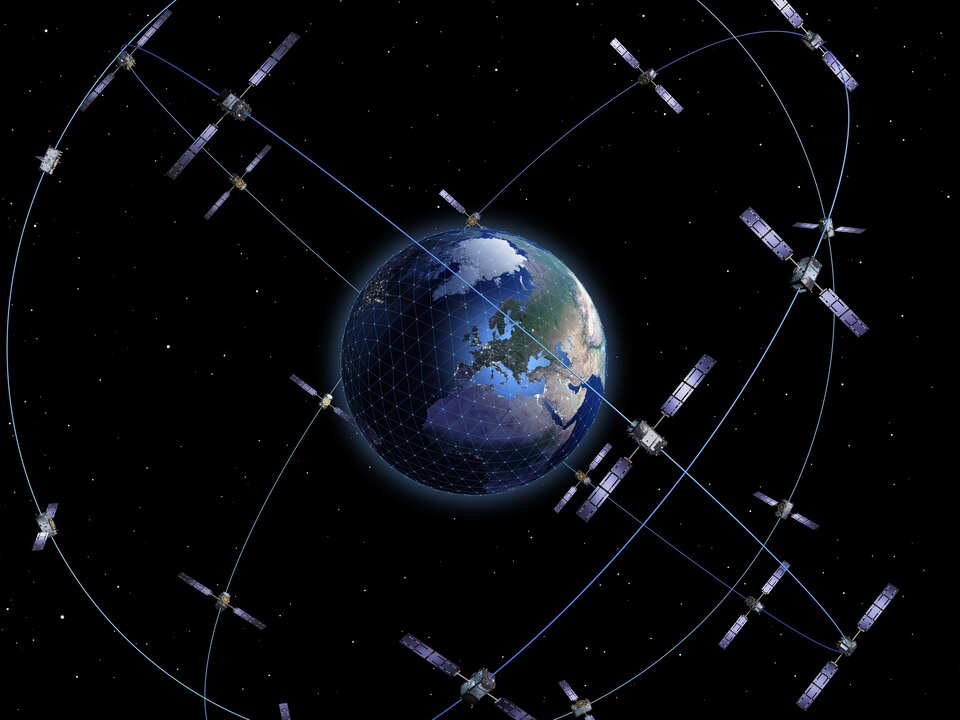
Global Galileo constellation, continuously transmitting signals
Artistic rendition of the global Galileo constellation that is continuously transmitting signals.

“The custom-made antenna needed for the reflectometry in E5/L5 also enables what is called beam forming, a technique allowing the payload to actively and simultaneously track the direct and reflected signal coming from the GNSS satellites, further increasing the scope of the technology demonstration.” — Camille Pirat, system engineer in ESA’s CubeSat Systems Unit and PRETTY Technical Officer

All-Austrian team

Funded through ESA’s General Support Technology Program by Austria, PRETTY has been developed by an all-Austrian consortium, with Beyond Gravity Austria as prime contractor developing the reflectometry payload.

“Beyond Gravity worked with Manuel to develop the reflectometry processing core being flown on PRETTY through a previous ESA project. Next, we looked for a flight opportunity – initially we hoped for the International Space Station or else to fit aboard the OPS-SAT CubeSat overseen by TU Graz. Then the success of OPS-SAT led us to consider a dedicated CubeSat mission. In fact PRETTY ended up as Beyond Gravity’s first CubeSat. For me, the most scientifically exciting places to observe are going to be the poles, because it’s really there that we’re likely to see the most change in surface height over the planned one-year lifetime of the mission – although in practice we hope to continue for longer.” — Andreas Dielacher, system engineer at Beyond Gravity

Additionally, Seibersdorf Laboratories contributing a radiation dosimeter payload and Technical University of Graz serving as overall system integrator and operator.

PRETTY team with CubeSat
The PRETTY team with the CubeSat. Photo is courtesy of ESA.

Intensive computation

CubeSats are small, inexpensive satellites that are built from standardized 10 cm boxes, hosting all of the necessary necessary systems as well as mission payloads. In PRETTY’s case, the CubeSat’s processing core works in combination with the patch antennas and a software derived radio, offering added flexibility during the post-launch commissioning phase.

Europe's Vega launcher
Europe’s Vega launcher.

“We will actually employ two methods of correlating the original and reflected signals. The first is the standard technique making use of the code embedded in the signal. The second is by making use of the higher-frequency satnav signals themselves, directly comparing their differing signal phases through a method called ‘interferometry.’ This latter method is more computationally demanding, requiring a lot of power and producing waste heat. This being so, we will typically perform two observation sessions of a maximum half an hour each per day, resting in the meantime to downlink results to our ground stations and allow heat to dissipate. And typically we will observe during local twilight or night. Avoiding heat from sunlight gives our receiver a better signal to noise ratio.” — Andreas Johann Hörmer, managing the mission at TU Graz

PRETTY's ground station antenna at TU Graz
PRETTY’s ground station antenna at TU Graz.

A scientific consortium is waiting to make use of PRETTY’s altimetry and also scatterometry data, coordinated by Norwegian University of Science and Technology.

Radiation mapper

SATDOS miniaturised dosimeter
SATDOS miniaturised dosimeter — the PRETTY CubeSat’s secondary payload is a miniaturised dosimeter for space radiation, SATDOS, will operate throughout its mission to give an authoritative map of LEO. Its developer — Seibersdorf Laboratories — specializes in testing the rad-hardening of satellite components. SATDOS will measure various radiation influences on satellite systems, from transitory ‘single event effects’ to ‘total ionizing dose’ effects that gradually undo overall system reliability.

“Analyzing observed radiation effects using SATDOS enables us to make informed assessments of ongoing space weather and the reliability of satellite electronics – thereby contributing to the sustainability of future space missions, especially smaller ones.” — Christoph Tscherne, PRETTY project manager at Seibersdorf Laboratories

Vega upper composite being lifted onto launcher
Vega upper composite being lifted onto the launcher.

PRETTY has been supported through the Fly element of ESA’s GSTP, aiming to provide early space testing of innovative technologies.

Filed Under: International Space Agreements, SmallSat

Primary Sidebar

Coverage

  • Missions & Constellations
  • Business & Finance
  • Military & Defense
  • Launch
  • Software Automation & Ground Systems
  • Government & Regulation
  • Services & Applications

Most Read Stories

  • Blue Origin Reconstructs Launch Complex 36 Tower, Targets November Return to Flight for New Glenn
  • Amazon Navigates Launch Delays with Under 400 Satellites in Orbit Ahead of Nov. 13 Vulcan Return
  • Northwood Space Secures $375M Series C at $2B Valuation to Expand Shared Ground Station Network
  • NASA Outlines Artemis IV Starship Refueling Architecture as Launch Estimates Vary
  • SpaceX Explores Boost Mobile Acquisition in Push to Build Hybrid Terrestrial-Satellite Network

Secondary Sidebar

Footer


Satnews is a leading provider of satellite news, events, publications, research and other satellite industry information in both commercial and military enterprises worldwide.

Stories By Category

  • Business & Finance
  • Government & Regulation
  • Launch
  • Military & Defense
  • Missions & Constellations
  • Services & Applications
  • Software Automation & Ground Systems
  • Spectrum & Licensing
  • Startups & NewSpace Business

About Us

  • Leadership & Editorial Team
  • SatNews History
  • Free Satnews Subscription
  • SatNews Events
  • Magazines

Navigation

  • Latest Stories
  • Magazines
  • Events
  • Contact
  • Cookie & Privacy Policy for Satnews

We use cookies to ensure that we give you the best experience on our website. If you continue to use this site we will assume that you are happy with it.
x
Sign up Now (For Free)
Access daily or weekly satellite news updates covering all aspects of the commercial and military satellite industry.
Invalid email address
Notify Me Regarding ( At least one ):
We value your privacy and will not sell or share your email or other information with any other company. You may also unsubscribe at anytime.

Click Here to see our full privacy policy.
Thanks for subscribing!