

• Skip to primary navigation
  • Skip to main content
  • Skip to primary sidebar
  • Skip to secondary sidebar
  • Skip to footer
  • NEWS:
  • SatNews
  • SatMagazine
  • MilSatMagazine
  • SmallSat News
  • |     EVENTS:
  • SmallSat Symposium
  • Satellite Innovation
  • MilSat Symposium
  • SmallSat Europe

SatNews

Satellite Industry Intelligence Since 1983

Subscribe
  • LATEST
  • SatNews Events
  • Magazines
  • Calendar
  • Subscribe
  • Missions & Constellations
    • Exploration & Science Missions
    • In-Orbit Servicing & Orbital Operations
    • LEO Constellations
    • Mission Autonomy & Onboard Systems
    • Mission Deployments & Manifests
    • Navigation & PNT
    • SmallSat
    • Spacecraft & Payload Technology
    View All in Missions & Constellations →
    Access Hub and Maargin Release White Paper on Frugal LEO Constellations and Orbital AIAccess Hub and Maargin Release White Paper on Frugal LEO Constellations and Orbital AI
    SmallSat Europe Speaker Focus: Merek Chertkow, The Radiation Team
    U.S. Space Force Awards $3.2 Billion for Space-Based Interceptor LayerU.S. Space Force Awards $3.2 Billion for Space-Based Interceptor Layer
    NASA Objects to Blue Origin’s “Project Sunrise”NASA Objects to Blue Origin’s “Project Sunrise”
  • Business
    • Contracts & Commercial Deals
    • Earnings & Financial Reporting
    • Events & Conferences
    • Funding & Venture Capital
    • Market Forecasts
    • Mergers & Acquisitions
    • Personnel Moves & Appointments
    View All in Business & Finance →
    Satellite Technology and the Legacy of the Media PioneerSatellite Technology and the Legacy of the Media Pioneer
    SES and ARD Announce Decade-Long Satellite Distribution ExtensionSES and ARD Announce Decade-Long Satellite Distribution Extension
    Telesat Reports 25% Decline in GEO Revenue Amid Strategic Shift to Lightspeed LEOTelesat Reports 25% Decline in GEO Revenue Amid Strategic Shift to Lightspeed LEO
    SmallSat Europe Speaker Focus: Olaf Eckart, BMW GroupSmallSat Europe Speaker Focus: Olaf Eckart, BMW Group
  • Defense
    • Counterspace & ASAT
    • Defense Budgets & Procurement
    • ISR & Reconnaissance
    • MILSATCOM
    • Missile Warning & Defense
    • National Security Programs
    • Space Domain Awareness
    View All in Military & Defense →
    U.S. Space Force Integrates Domain Awareness Capabilities into Balikatan 2026U.S. Space Force Integrates Domain Awareness Capabilities into Balikatan 2026
    BAE Systems Enters Production for NavGuide M-Code GPS ReceiverBAE Systems Enters Production for NavGuide M-Code GPS Receiver
    Space Force Awards $3.2 Billion in Golden Dome Contracts for Orbital Interceptor ConstellationSpace Force Awards $3.2 Billion in Golden Dome Contracts for Orbital Interceptor Constellation
    USSF Finalizes GPS III Constellation with Successful SV-10 DeploymentUSSF Finalizes GPS III Constellation with Successful SV-10 Deployment
  • Gov
    • Export Controls & Compliance
    • International Space Agreements
    • National Space Policy
    • Space Law & Treaties
    • Space Sustainability & Debris Policy
    • Space Traffic Management / Debris Removal
    View All in Government & Regulation →
    Spectrum-Sharing Rules Get an OverhaulSpectrum-Sharing Rules Get an Overhaul
    ESA spells out satellite benefits – and risksESA spells out satellite benefits – and risks
    SmallSat Europe Speaker Focus: Jorge Ciccorossi, ITU Radiocommunications BureauSmallSat Europe Speaker Focus: Jorge Ciccorossi, ITU Radiocommunications Bureau
    Canada Tightens Re-entry Regulations as SpaceX Starlink Constellations DescendCanada Tightens Re-entry Regulations as SpaceX Starlink Constellations Descend
  • Launch
    • Launch Providers
    • Launch Schedule & Calendars
    • Launch Sites & Infrastructure
    • Rocket Technology & Vehicles
    View All in Launch →
    NanoAvionics Satellites Reach Orbit on SpaceX CAS500-2 MissionNanoAvionics Satellites Reach Orbit on SpaceX CAS500-2 Mission
    GalaxEye Successfully Launches “Mission Drishti” OptoSAR SatelliteGalaxEye Successfully Launches “Mission Drishti” OptoSAR Satellite
    Foxconn Launches Second-Generation PEARL Satellites via SpaceX Falcon 9Foxconn Launches Second-Generation PEARL Satellites via SpaceX Falcon 9
    FAA Grounds Blue Origin Following New Glenn Upper Stage Failure and Facility AnomalyFAA Grounds Blue Origin Following New Glenn Upper Stage Failure and Facility Anomaly
  • Software
    • Autonomous Ground Operations
    • Data Processing & AI/ML
    • Digital Twins & Modeling
    • Ground Segment & Teleports
    • Mission Planning & Simulation
    • Space Systems Software Engineering
    • Spectrum & Licensing
    View All in Software Automation & Ground Systems →
    SES Accelerates Multi-Orbit IFC Strategy with meoSphere and Next-Gen ESA DevelopmentSES Accelerates Multi-Orbit IFC Strategy with meoSphere and Next-Gen ESA Development
    SmallSat Europe Speaker Focus: Koen Willems, ST Engineering iDirect EuropeSmallSat Europe Speaker Focus: Koen Willems, ST Engineering iDirect Europe
    GMV to Lead Mission Planning for ESA’s Next-Generation Copernicus ExpansionGMV to Lead Mission Planning for ESA’s Next-Generation Copernicus Expansion
    Global Invacom Secures Exclusive Worldwide Distribution for Prodelin Antenna RangeGlobal Invacom Secures Exclusive Worldwide Distribution for Prodelin Antenna Range
  • Services & Apps
    • Climate & Environmental Monitoring
    • Disaster Response & Security Mapping
    • Earth Observation & Imaging
    • Maritime & Aviation Satcom
    • Satellite Communications
    View All in Services & Applications →
    SmallSat Europe Speaker Focus: Massimo Comparini, Leonardo Space DivisionSmallSat Europe Speaker Focus: Massimo Comparini, Leonardo Space Division
    The waiver was the policy. Thursday is the paperwork.The waiver was the policy. Thursday is the paperwork.
    Solstar Confirms Successful On-Orbit Operation of Deke Space Communicator Following Launch on SpaceX Transporter-16 MissionSolstar Confirms Successful On-Orbit Operation of Deke Space Communicator Following Launch on SpaceX Transporter-16 Mission
    IEC Telecom Unveils Voucher-Based Connectivity Solution at Singapore Maritime Week 2026IEC Telecom Unveils Voucher-Based Connectivity Solution at Singapore Maritime Week 2026

UPDATE: NASA and SpaceX’s Psyche stand down due to weather, new date established

October 12, 2023

A SpaceX Falcon Heavy rocket with the Psyche spacecraft onboard is seen at Launch Complex 39A as preparations continue for the Psyche mission, Wednesday, Oct. 11, 2023, at NASA’s Kennedy Space Center in Florida. NASA’s Psyche spacecraft will travel to a metal-rich asteroid by the same name orbiting the Sun between Mars and Jupiter to study its composition. The spacecraft also carries the agency’s Deep Space Optical Communications technology demonstration, which will test laser communications beyond the Moon.

UPDATE: NASA and SpaceX are standing down from the October 12 launch of the agency’s Psyche mission due to unfavorable weather conditions. NASA and SpaceX are now targeting launch at 10:19 a.m. EDT Friday, October 13, from Launch Complex 39A at Kennedy Space Center in Florida.

The live launch broadcast with commentary will begin at 9:30 a.m. EDT on the NASA Television public channel and also will air on YouTube, X, Facebook, Twitch, Daily Motion, the NASA app, and the agency’s website.
A SpaceX Falcon Heavy rocket with the Psyche spacecraft onboard is seen at Launch Complex 39A as preparations continue for the Psyche mission, Wednesday, Oct. 11, 2023, at NASA’s Kennedy Space Center in Florida. NASA’s Psyche spacecraft will travel to a metal-rich asteroid by the same name orbiting the Sun between Mars and Jupiter to study its composition. The oberpacecraft also carries the agency’s Deep Space Optical Communications technology demonstration, which will test laser communications beyond the Moon.

The spacecraft is targeting an October 12 liftoff atop a Falcon Heavy rocket. Its destination, a metal-rich asteroid, may tell us more about how planets form.

In less than 24 hours, NASA’s Psyche spacecraft is slated to launch from the agency’s Kennedy Space Center in Florida. With its sights set on a mysterious asteroid of the same name, Psyche is NASA’s first scientific mission to be launched on a SpaceX Falcon Heavy rocket.

Launch is set for 10:16 a.m. EDT on Thursday, October 12, with additional opportunities identified each day through October 25. Each opportunity is instantaneous, meaning there is only one exact time per day when launch can occur.

“The team has worked tirelessly to prepare the spacecraft for its journey to a one-of-a-kind asteroid,” said Henry Stone, Psyche’s project manager at NASA’s Jet Propulsion Laboratory in Southern California. “All spacecraft systems, science instruments, and software have been integrated and extensively tested, and the spacecraft is fully configured for flight. We look forward to the launch and – more importantly – to accomplishing the mission’s objectives, marking yet another historic voyage of scientific discovery.“

The orbiter’s solar arrays are folded and stowed for launch. All systems have been tested and re-tested many times, along with the payload of three science instruments. Loaded with 2,392 pounds (1,085 kilograms) of the neutral gas xenon – the propellant that will get Psyche to the asteroid belt – the spacecraft sits inside the launch vehicle’s cone-shaped payload fairing, which protects it from aerodynamic pressure and heat during launch. The spacecraft and fairing have been mated to the SpaceX Falcon Heavy, which is poised for takeoff from Kennedy Space Center’s historic Launch Complex 39A.

Integrated onto the spacecraft is a technology demonstration called Deep Space Optical Communications (DSOC). DSOC will test high-data-rate laser communications – which could be used by future NASA missions – beyond the Moon for the first time. The tech demo will not relay Psyche mission data.

The rocket has two stages and two side boosters. After the side boosters separate and return to land, the core stage will be expended into the Atlantic Ocean. Then the second stage of the rocket, which will help Psyche escape Earth’s gravity, will fire its engine.

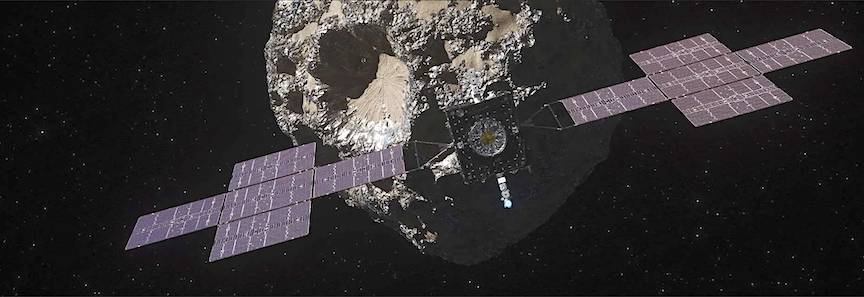
Once the rocket is out of Earth’s atmosphere, about four minutes after launch, the fairing will separate from its ride and split into two halves, which are jettisoned back to Earth. The spacecraft will then separate from the upper stage about an hour after launch. Soon after, it will deploy its twin solar arrays, one at a time, and direct them at the Sun. At this point, the spacecraft is in a planned “safe mode” (a precautionary standby status), with the Sun illuminating the deployed solar panels, and will begin to direct the low-gain antenna toward Earth for communications.

It could take up to two hours after separation from the rocket before the first signal is received.

Once stable communications have been established, mission controllers will begin to reconfigure the spacecraft into its planned operating mode. The ensuing three months of initial checkout include a commissioning phase to confirm that all hardware and software is operating as expected, including the electric thrusters. Starting about five months after launch, the thrusters will fire, one at a time, during long stretches of the trajectory to get to the asteroid.

Psyche’s efficient solar electric propulsion system works by accelerating and expelling charged atoms, or ions, of the neutral gas xenon – creating a thrust that will gently push the spacecraft on a journey of nearly six years and about 2.2 billion miles (3.6 billion kilometers) to the asteroid Psyche in the main asteroid belt between Mars and Jupiter.

Along the way, in May 2026, the spacecraft will fly by Mars and use the Red Planet’s gravity to slingshot itself toward Psyche, saving propellant while gaining speed and changing direction.

After the spacecraft reaches the asteroid in 2029, it will spend about 26 months in orbit, gathering images and other data.

Scientists believe Psyche could be part of the core of a planetesimal – an early planetary building block – and composed of a mixture of rock and iron-nickel metal. The metal will not be mined; it will be studied to give researchers a better idea of what makes up Earth’s core and how rocky planets formed in our solar system. Humans can’t bore a path to our planet’s core – or the cores of the other rocky planets – so visiting Psyche could provide a one-of-a-kind window into the violent history of collisions and accumulation of matter that created planets like our own.

More About the Mission

Arizona State University leads the Psyche mission. A division of Caltech in Pasadena, JPL is responsible for the mission’s overall management, system engineering, integration and test, and mission operations. Maxar Technologies in Palo Alto, California, provided the high-power solar electric propulsion spacecraft chassis.

JPL manages DSOC for the Technology Demonstration Missions program within NASA’s Space Technology Mission Directorate and the Space Communications and Navigation program within the Space Operations Mission Directorate.

.

Filed Under: Exploration & Science Missions, Government & Regulation

Primary Sidebar

Coverage

  • Missions & Constellations
  • Business & Finance
  • Military & Defense
  • Launch
  • Software Automation & Ground Systems
  • Government & Regulation
  • Services & Applications

Most Read Stories

  • What the SpaceX IPO Changes for Every Satellite Operator
  • NASA Shuts Off Instrument on Voyager 1 to Extend Interstellar Mission
  • Russia Replaces Starlink With European-Built Satellites
  • Isaacman’s Budget Math: How NASA Plans to Reach the Moon With a Quarter Less Money
  • FCC Modernizes Satellite Spectrum Rules to Unleash Next-Generation Broadband

Secondary Sidebar

Footer


Satnews is a leading provider of satellite news, events, publications, research and other satellite industry information in both commercial and military enterprises worldwide.

Stories By Category

  • Business & Finance
  • Government & Regulation
  • Launch
  • Military & Defense
  • Missions & Constellations
  • Services & Applications
  • Software Automation & Ground Systems
  • Spectrum & Licensing
  • Startups & NewSpace Business

About Us

  • Leadership & Editorial Team
  • SatNews History
  • Free Satnews Subscription
  • SatNews Events
  • Magazines

Navigation

  • Latest Stories
  • Magazines
  • Events
  • Contact
  • Cookie & Privacy Policy for Satnews

We use cookies to ensure that we give you the best experience on our website. If you continue to use this site we will assume that you are happy with it.
x
Sign up Now (For Free)
Access daily or weekly satellite news updates covering all aspects of the commercial and military satellite industry.
Invalid email address
Notify Me Regarding ( At least one ):
We value your privacy and will not sell or share your email or other information with any other company. You may also unsubscribe at anytime.

Click Here to see our full privacy policy.
Thanks for subscribing!