

• Skip to primary navigation
  • Skip to main content
  • Skip to primary sidebar
  • Skip to secondary sidebar
  • Skip to footer
  • NEWS:
  • SatNews
  • SatMagazine
  • MilSatMagazine
  • SmallSat News
  • |     EVENTS:
  • SmallSat Symposium
  • Satellite Innovation
  • MilSat Symposium
  • SmallSat Europe

SatNews

Satellite Industry Intelligence Since 1983

Subscribe
  • LATEST
  • SatNews Events
  • Magazines
  • Calendar
  • Subscribe
  • Missions & Constellations
    • Exploration & Science Missions
    • In-Orbit Servicing & Orbital Operations
    • LEO Constellations
    • Mission Autonomy & Onboard Systems
    • Mission Deployments & Manifests
    • Navigation & PNT
    • SmallSat
    • Spacecraft & Payload Technology
    View All in Missions & Constellations →
    Viasat Completes ViaSat-3 Constellation with Successful Flight 3 LaunchViasat Completes ViaSat-3 Constellation with Successful Flight 3 Launch
    GMV to Lead Mission Planning for ESA’s Next-Generation Copernicus ExpansionGMV to Lead Mission Planning for ESA’s Next-Generation Copernicus Expansion
    Canada Tightens Re-entry Regulations as SpaceX Starlink Constellations DescendCanada Tightens Re-entry Regulations as SpaceX Starlink Constellations Descend
    The waiver was the policy. Thursday is the paperwork.The waiver was the policy. Thursday is the paperwork.
  • Business
    • Contracts & Commercial Deals
    • Earnings & Financial Reporting
    • Events & Conferences
    • Funding & Venture Capital
    • Market Forecasts
    • Mergers & Acquisitions
    • Personnel Moves & Appointments
    View All in Business & Finance →
    SmallSat Europe Speaker Focus: Koen Willems, ST Engineering iDirect EuropeSmallSat Europe Speaker Focus: Koen Willems, ST Engineering iDirect Europe
    U.S. Commercial Service to Host “Future in Orbit” Networking Event at SpaceBR 2026U.S. Commercial Service to Host “Future in Orbit” Networking Event at SpaceBR 2026
    SmallSat Europe Speaker Focus: Dr. Jakob Stöber, McKinsey & CompanySmallSat Europe Speaker Focus: Dr. Jakob Stöber, McKinsey & Company
    Bright Ascension Finalizes Leadership Transition with John Baughn as CEOBright Ascension Finalizes Leadership Transition with John Baughn as CEO
  • Defense
    • Counterspace & ASAT
    • Defense Budgets & Procurement
    • ISR & Reconnaissance
    • MILSATCOM
    • Missile Warning & Defense
    • National Security Programs
    • Space Domain Awareness
    View All in Military & Defense →
    BAE Systems Enters Production for NavGuide M-Code GPS ReceiverBAE Systems Enters Production for NavGuide M-Code GPS Receiver
    Space Force Awards $3.2 Billion in Golden Dome Contracts for Orbital Interceptor ConstellationSpace Force Awards $3.2 Billion in Golden Dome Contracts for Orbital Interceptor Constellation
    USSF Finalizes GPS III Constellation with Successful SV-10 DeploymentUSSF Finalizes GPS III Constellation with Successful SV-10 Deployment
    Meink: Space Force Programs Ready to Execute Once FY27 Budget LandsMeink: Space Force Programs Ready to Execute Once FY27 Budget Lands
  • Gov
    • Export Controls & Compliance
    • International Space Agreements
    • National Space Policy
    • Space Law & Treaties
    • Space Sustainability & Debris Policy
    • Space Traffic Management / Debris Removal
    View All in Government & Regulation →
    SmallSat Europe Speaker Focus: Tanja Masson-Zwaan, Leiden UniversitySmallSat Europe Speaker Focus: Tanja Masson-Zwaan, Leiden University
    How CubeSat Proliferation is Redefining Sovereignty and Diplomatic Leverage at the United NationsHow CubeSat Proliferation is Redefining Sovereignty and Diplomatic Leverage at the United Nations
    FCC Modernization of Spectrum Rules Unlocks Sevenfold Gain in Satellite CapacityFCC Modernization of Spectrum Rules Unlocks Sevenfold Gain in Satellite Capacity
    The Smartest Money in the Room Is Looking UpThe Smartest Money in the Room Is Looking Up
  • Launch
    • Launch Providers
    • Launch Schedule & Calendars
    • Launch Sites & Infrastructure
    • Rocket Technology & Vehicles
    View All in Launch →
    FAA Grounds Blue Origin Following New Glenn Upper Stage Failure and Facility AnomalyFAA Grounds Blue Origin Following New Glenn Upper Stage Failure and Facility Anomaly
    NanoAvionics to Launch Trio of Milestone Payloads on SpaceX CAS500-2 MissionNanoAvionics to Launch Trio of Milestone Payloads on SpaceX CAS500-2 Mission
    Astrobotic Achieves Record 300-Second Burn with New Detonation EngineAstrobotic Achieves Record 300-Second Burn with New Detonation Engine
    Bad news, but good news followedBad news, but good news followed
  • Software
    • Autonomous Ground Operations
    • Data Processing & AI/ML
    • Digital Twins & Modeling
    • Ground Segment & Teleports
    • Mission Planning & Simulation
    • Space Systems Software Engineering
    • Spectrum & Licensing
    View All in Software Automation & Ground Systems →
    Global Invacom Secures Exclusive Worldwide Distribution for Prodelin Antenna RangeGlobal Invacom Secures Exclusive Worldwide Distribution for Prodelin Antenna Range
    SmallSat Europe Speaker Focus: Giovanni Pandolfi Bortoletto, Leaf SpaceSmallSat Europe Speaker Focus: Giovanni Pandolfi Bortoletto, Leaf Space
    SpinLaunch Selects Equinix to Deploy Global Ground Infrastructure for Meridian Space ConstellationSpinLaunch Selects Equinix to Deploy Global Ground Infrastructure for Meridian Space Constellation
    RF-Design Launches FiberLink CompactLine FCLR1811S4 for Ground Segment OptimizationRF-Design Launches FiberLink CompactLine FCLR1811S4 for Ground Segment Optimization
  • Services & Apps
    • Climate & Environmental Monitoring
    • Disaster Response & Security Mapping
    • Earth Observation & Imaging
    • Maritime & Aviation Satcom
    • Satellite Communications
    View All in Services & Applications →
    Solstar Confirms Successful On-Orbit Operation of Deke Space Communicator Following Launch on SpaceX Transporter-16 MissionSolstar Confirms Successful On-Orbit Operation of Deke Space Communicator Following Launch on SpaceX Transporter-16 Mission
    IEC Telecom Unveils Voucher-Based Connectivity Solution at Singapore Maritime Week 2026IEC Telecom Unveils Voucher-Based Connectivity Solution at Singapore Maritime Week 2026
    GomSpace and STETMAN Establish UASAT Joint Venture for Ukrainian Sovereign CommunicationsGomSpace and STETMAN Establish UASAT Joint Venture for Ukrainian Sovereign Communications
    Market Dynamics and Non-Terrestrial Network (NTN) ChipsetsMarket Dynamics and Non-Terrestrial Network (NTN) Chipsets

Webb + Hubble capture detailed views of DART impact

October 2, 2022

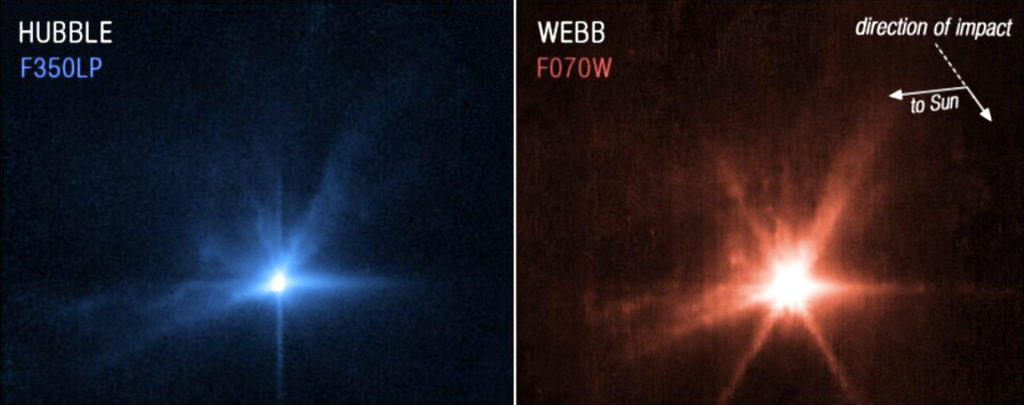
Two of the great space observatories — the NASA/ESA/CSA James Webb Space Telescope and the NASA/ESA Hubble Space Telescope — have captured views of a unique experiment to smash a spacecraft into a small asteroid. Observations of NASA’s Double Asteroid Redirection Test (DART) impact mark the first time that Webb and Hubble were used to simultaneously observe the same celestial target. This was the world’s first test of the kinetic impact technique using a spacecraft to deflect an asteroid by modifying the object’s orbit. DART is a test for defending Earth against potential asteroid or comet hazards.
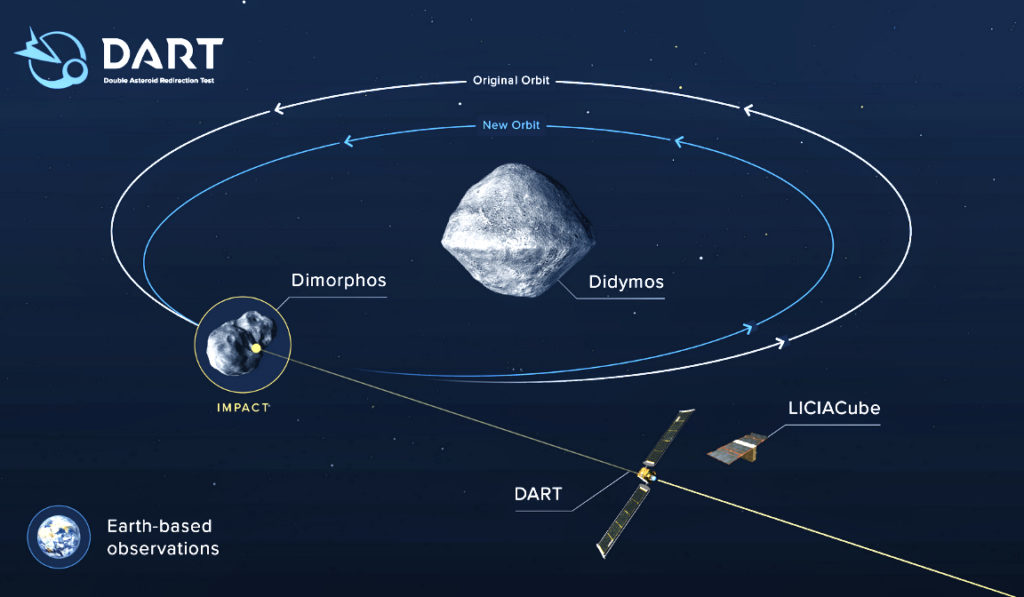
On Sept. 26, 2022, DART impacted the asteroid moonlet Dimorphos, a small body just 530 feet (160 meters) in diameter. It orbits a larger, 2,560-foot (780-meter) asteroid called Didymos. Image is courtesy of The Johns Hopkins University Applied Physics Laboratory LLC.

The observations are more than just an operational milestone for each telescope – there are also key science questions relating to the makeup and history of our Solar System that researchers can explore when combining the capabilities of these observatories.

Observations from Webb and Hubble together will allow scientists to gain knowledge about the nature of the surface of Dimorphos, how much material was ejected by the collision, and how fast it was ejected. Additionally, observing the impact across a wide array of wavelengths between Webb and Hubble will reveal the distribution of particle sizes in the expanding dust cloud, helping to determine whether it threw off lots of big chunks or mostly fine dust. Combining this information will help scientists to understand how effectively a kinetic impact can modify an asteroid’s orbit.

Webb took one observation of the impact location before the collision took place, then several observations over the next few hours. Images from Webb’s Near-Infrared Camera (NIRCam) show a tight, compact core, with plumes of material appearing as wisps streaming away from the center of where the impact took place.
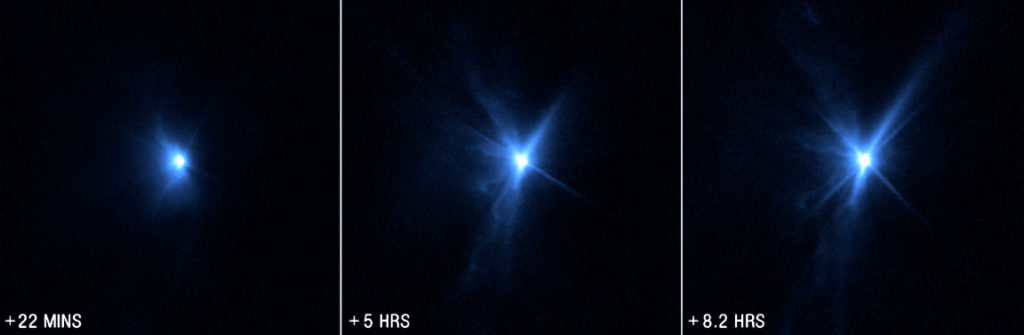
These images from NASA’s Hubble Space Telescope, taken (left to right) 22 minutes, 5 hours, and 8.2 hours after NASA’s Double Asteroid Redirection Test (DART) intentionally impacted Dimorphos, show expanding plumes of ejecta from the asteroid’s body. The Hubble images show ejecta from the impact that appear as rays stretching out from the body of the asteroid. The bolder, fanned-out spike of ejecta to the left of the asteroid is in the general direction from which DART approached. These observations, when combined with data from NASA’s James Webb Space Telescope, will allow scientists to gain knowledge about the nature of the surface of Dimorphos, how much material was ejected by the collision, how fast it was ejected, and the distribution of particle sizes in the expanding dust cloud.
Credits: Science: NASA, ESA, Jian-Yang Li (PSI); image processing: Alyssa Pagan (STScI)

Observing the impact with Webb presented the flight operations, planning, and science teams with very unique challenges. Because of the asteroid’s speed of travel across the sky, the teams worked in the weeks leading up to the impact to enable and test a method of tracking asteroids moving over three times faster than the original speed limit set for Webb.

Scientists also plan to observe the asteroid in the coming months using Webb’s Near-Infrared Spectrograph (NIRSpec), developed under ESA leadership, and Mid-Infrared Instrument (MIRI), which was a joint ESA-NASA creation. Spectroscopic data from these innovative instruments will provide researchers with insight into the asteroid’s chemical composition.

Webb observed the impact over five hours total and captured 10 images. The data were collected as part of Webb’s Cycle 1 Guaranteed Time Observation Program 1245 led by Heidi Hammel of Association of Universities for Research in Astronomy (AURA).

Hubble also managed to capture observations of the moonlet ahead of the impact, then again 15 minutes after DART met the surface of Dimorphos. Images from Hubble’s Wide Field Camera 3 show the impact in visible light. Ejecta from the impact appear as rays stretching out from the body of the asteroid. The bolder, fanned-out spike of ejecta to the left of the asteroid is where DART impacted.
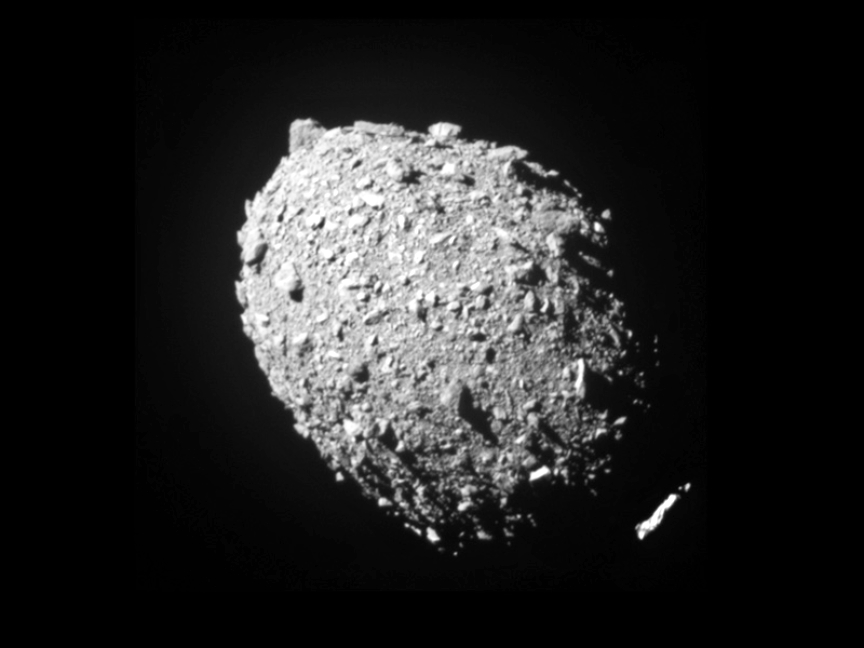
On September 26, 2022, DART impacted the asteroid moonlet Dimorphos, a small body just 530 feet (160 meters) in diameter. It orbits a larger, 2,560-foot (780-meter) asteroid called Didymos. Photo is courtesy of NASA.

Some of the rays appear to be curved slightly, but astronomers need to take a closer look to determine what this could mean. In the Hubble images, astronomers estimate that the brightness of Didymos increased by three times following the impact, and are also particularly intrigued by how that brightness then held steady, even eight hours after impact.

Hubble will monitor Dimorphos ten more times over the next three weeks. These regular, relatively long-term observations as the ejecta cloud expands and fades over time will paint a more complete picture of the cloud’s expansion from the ejection to its disappearance.

Due to launch in late 2024, ESA’s Hera mission will perform a detailed post-impact survey of the target asteroid Dimorphos. Hera will turn the grand-scale experiment into a well-understood and repeatable planetary defence technique that might one day be carried out for real.
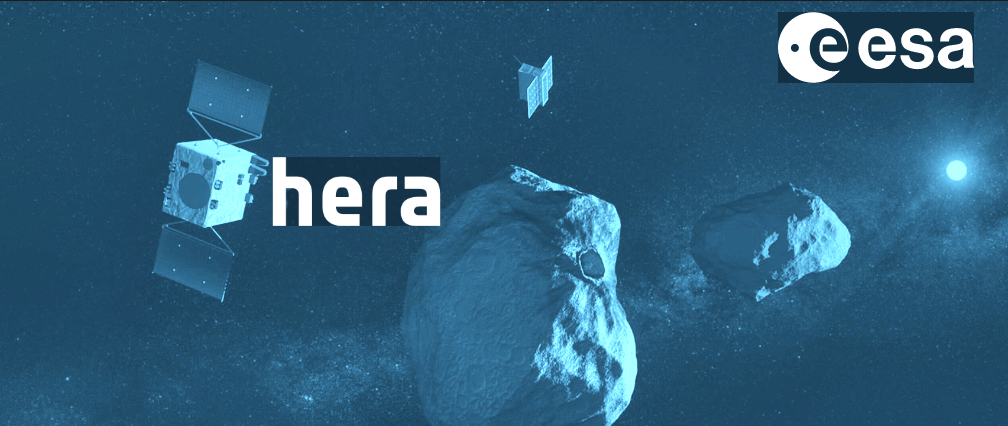
Ian Carnelli, Hera mission manager said, “We’ve been looking forward to the DART impact for over 17 years, and it’s so exciting to see it through the eyes of the greatest space observatories Webb and Hubble. These images provide us with clues of what happened in the first hours after impact, and clearly there is much more happening than we had foreseen! It makes the Hera mission even more important now as we absolutely need to get up close to Didymos to understand in full detail what really happened.”

Just like Webb and Hubble, NASA’s DART and ESA’s Hera missions are a great example of what international collaboration can achieve: the two missions are supported by the same teams of scientists and astronomers, and take place through an international collaboration called AIDA – the Asteroid Impact and Deflection Assessment.

NASA and ESA worked together in the early 2000s to develop asteroid monitoring systems, but recognised there was a missing link in the chain from asteroid threat identification to ways of addressing that threat. In response, NASA oversaw the DART mission while ESA developed the Hera mission to gather additional data on DART’s impact.

With the Hera mission, ESA is assuming even greater responsibility for protecting our planet and ensuring that Europe plays a leading role in the common effort to tackle asteroid risks.

Filed Under: Exploration & Science Missions, Government & Regulation

Primary Sidebar

Coverage

  • Missions & Constellations
  • Business & Finance
  • Military & Defense
  • Launch
  • Software Automation & Ground Systems
  • Government & Regulation
  • Services & Applications

Most Read Stories

  • Planet Labs Imposes Indefinite Blackout on Iran Satellite Imagery at U.S. Request
  • Amazon in Reported Talks to Acquire Globalstar in $9 Billion Move to Challenge Starlink
  • What the SpaceX IPO Changes for Every Satellite Operator
  • Russia Replaces Starlink With European-Built Satellites
  • The Downlink Deficit: The Pentagon's Optical Mesh Network and the Terrestrial Bottleneck

Secondary Sidebar

Footer


Satnews is a leading provider of satellite news, events, publications, research and other satellite industry information in both commercial and military enterprises worldwide.

Stories By Category

  • Business & Finance
  • Government & Regulation
  • Launch
  • Military & Defense
  • Missions & Constellations
  • Services & Applications
  • Software Automation & Ground Systems
  • Spectrum & Licensing
  • Startups & NewSpace Business

About Us

  • Leadership & Editorial Team
  • SatNews History
  • Free Satnews Subscription
  • SatNews Events
  • Magazines

Navigation

  • Latest Stories
  • Magazines
  • Events
  • Contact
  • Cookie & Privacy Policy for Satnews

We use cookies to ensure that we give you the best experience on our website. If you continue to use this site we will assume that you are happy with it.
x
Sign up Now (For Free)
Access daily or weekly satellite news updates covering all aspects of the commercial and military satellite industry.
Invalid email address
Notify Me Regarding ( At least one ):
We value your privacy and will not sell or share your email or other information with any other company. You may also unsubscribe at anytime.

Click Here to see our full privacy policy.
Thanks for subscribing!