

• Skip to primary navigation
  • Skip to main content
  • Skip to primary sidebar
  • Skip to secondary sidebar
  • Skip to footer
  • NEWS:
  • SatNews
  • SatMagazine
  • MilSatMagazine
  • SmallSat News
  • |     EVENTS:
  • SmallSat Symposium
  • Satellite Innovation
  • MilSat Symposium
  • SmallSat Europe

SatNews

Satellite Industry Intelligence Since 1983

Subscribe
  • LATEST
  • SatNews Events
  • Magazines
  • Calendar
  • Subscribe
  • Missions & Constellations
    • Exploration & Science Missions
    • In-Orbit Servicing & Orbital Operations
    • LEO Constellations
    • Mission Autonomy & Onboard Systems
    • Mission Deployments & Manifests
    • Navigation & PNT
    • SmallSat
    • Spacecraft & Payload Technology
    View All in Missions & Constellations →
    Telesat Delays Lightspeed Constellation Service to Mid-2028 Following Pathfinder Software DelaysTelesat Delays Lightspeed Constellation Service to Mid-2028 Following Pathfinder Software Delays
    FCC Proposes 25 MHz Mid-Band Spectrum Auction with Dual 5G and Direct-to-Device AllocationsFCC Proposes 25 MHz Mid-Band Spectrum Auction with Dual 5G and Direct-to-Device Allocations
    Xona Is in Orbit. Its CEO Says U.S. GPS Backup Leans on China.Xona Is in Orbit. Its CEO Says U.S. GPS Backup Leans on China.
    City Labs Flew 20 Curies. Now It Wants FAA Approval for 10 Million.City Labs Flew 20 Curies. Now It Wants FAA Approval for 10 Million.
  • Business
    • Contracts & Commercial Deals
    • Earnings & Financial Reporting
    • Events & Conferences
    • Funding & Venture Capital
    • Market Forecasts
    • Mergers & Acquisitions
    • Personnel Moves & Appointments
    View All in Business & Finance →
    Satellites Can’t Wait for the 2030 Post-Quantum Deadline, MilSat Panel SaysSatellites Can’t Wait for the 2030 Post-Quantum Deadline, MilSat Panel Says
    War in Space Isn’t Insurable Yet, Gallagher’s Rush SaysWar in Space Isn’t Insurable Yet, Gallagher’s Rush Says
    RG-XX Bids Are In. The Award Is a Year Away.RG-XX Bids Are In. The Award Is a Year Away.
    Golden Dome Panel Splits on the Program’s Political RiskGolden Dome Panel Splits on the Program’s Political Risk
  • Defense
    • Counterspace & ASAT
    • Defense Budgets & Procurement
    • ISR & Reconnaissance
    • MILSATCOM
    • Missile Warning & Defense
    • National Security Programs
    • Space Domain Awareness
    View All in Military & Defense →
    MUOS Gets Two More Satellites and a Life to 2040MUOS Gets Two More Satellites and a Life to 2040
    SDA’s First Tracking Satellites Slip to Spring, Sandhoo SaysSDA’s First Tracking Satellites Slip to Spring, Sandhoo Says
    Hughes Secures $42.5M Space Systems Command Award for Multi-Orbit Automated EM&C ArchitectureHughes Secures $42.5M Space Systems Command Award for Multi-Orbit Automated EM&C Architecture
    “I Can’t Refuel You. I’m Sorry”: Satellite Servicers Can’t Agree on a Plug“I Can’t Refuel You. I’m Sorry”: Satellite Servicers Can’t Agree on a Plug
  • Gov
    • Export Controls & Compliance
    • International Space Agreements
    • National Space Policy
    • Space Law & Treaties
    • Space Sustainability & Debris Policy
    • Space Traffic Management / Debris Removal
    View All in Government & Regulation →
    Part 100 Puts FCC Satellite Licensing on an Assembly LinePart 100 Puts FCC Satellite Licensing on an Assembly Line
    FCC Proposes Modernized Direct-to-Device Rules, Explores 482 MHz Expansion for Satellite CellularFCC Proposes Modernized Direct-to-Device Rules, Explores 482 MHz Expansion for Satellite Cellular
    Canada’s Satellite-to-Phone Network Can’t Go It Alone, So Terrestar Joined EquatysCanada’s Satellite-to-Phone Network Can’t Go It Alone, So Terrestar Joined Equatys
    NTIA’s 500 MHz Mandate Is Its Top Job, Patrick SaysNTIA’s 500 MHz Mandate Is Its Top Job, Patrick Says
  • Launch
    • Launch Providers
    • Launch Schedule & Calendars
    • Launch Sites & Infrastructure
    • Rocket Technology & Vehicles
    View All in Launch →
    HIMERA and GomSpace Begin Orbital Operations of OBRIA NANO Test Satellite for Sovereign Ukrainian NetworkHIMERA and GomSpace Begin Orbital Operations of OBRIA NANO Test Satellite for Sovereign Ukrainian Network
    Blue Origin Reconstructs Launch Complex 36 Tower, Targets November Return to Flight for New GlennBlue Origin Reconstructs Launch Complex 36 Tower, Targets November Return to Flight for New Glenn
    DIA Space Security Report Reveals Detailed Orbital Imagery of China’s Shenlong SpaceplaneDIA Space Security Report Reveals Detailed Orbital Imagery of China’s Shenlong Spaceplane
    The Launch Crunch Is Coming as Falcon 9 Winds DownThe Launch Crunch Is Coming as Falcon 9 Winds Down
  • Software
    • Autonomous Ground Operations
    • Data Processing & AI/ML
    • Digital Twins & Modeling
    • Ground Segment & Teleports
    • Mission Planning & Simulation
    • Space Systems Software Engineering
    • Spectrum & Licensing
    View All in Software Automation & Ground Systems →
    MBSat Selects ST Engineering iDirect Intuition Platform for Ground Infrastructure in OmanMBSat Selects ST Engineering iDirect Intuition Platform for Ground Infrastructure in Oman
    AnySignal Co-Founder Urges Ground Station Interoperability to Resolve Orbital Data BottlenecksAnySignal Co-Founder Urges Ground Station Interoperability to Resolve Orbital Data Bottlenecks
    Arqiva Secures Three-Year Satellite Services Agreement with Kuwait’s GulfsatArqiva Secures Three-Year Satellite Services Agreement with Kuwait’s Gulfsat
    TrustPoint and Calian Deliver Industry’s First Mass-Market Ready C-band GNSS AntennaTrustPoint and Calian Deliver Industry’s First Mass-Market Ready C-band GNSS Antenna
  • Services & Apps
    • Climate & Environmental Monitoring
    • Disaster Response & Security Mapping
    • Earth Observation & Imaging
    • Maritime & Aviation Satcom
    • Satellite Communications
    View All in Services & Applications →
    Tim Farrar: Carriers Are Finding Few Will Pay for Direct-to-DeviceTim Farrar: Carriers Are Finding Few Will Pay for Direct-to-Device
    Scanway and Pixxel Sign Pact to Expand Optical Payload and Earth Observation Data ServicesScanway and Pixxel Sign Pact to Expand Optical Payload and Earth Observation Data Services
    KTL Selects Keysight NR-NTN Test Suite to Accelerate Satellite Acceptance TestingKTL Selects Keysight NR-NTN Test Suite to Accelerate Satellite Acceptance Testing
    Leonardo Infrared Sensor Returns to Orbit Aboard SatVu HotSat-3 Thermal Imaging SatelliteLeonardo Infrared Sensor Returns to Orbit Aboard SatVu HotSat-3 Thermal Imaging Satellite

ISRO’s EOS-03 Satellite Launch On GSLV-F10 Rocket Fails 350 Seconds After Launch Due To Performance Anomaly

August 11, 2021

© Provided by DNA

The Indian Space Research Organisation (ISRO)’s highly-anticipated launch of Earth observation satellite -3 or GISAT-1 failed after the rocket entered the lower reaches of space (an altitude of 139kms), after a flight of nearly 340 seconds (5mins 40 seconds). The first two stages of the rocket (that give initial thrust for lift-off and later carry the 52-meter tall vehicle to space) performed as expected. However, shortly after the rocket switched over to its final stage — the Cryogenic engine (that burns liquid hydrogen and oxygen), there was a marked deviation in its planned flight path. A typical rocket consists of two or more stages, each of which would have its own engines (either single or grouped in a cluster). Simply put, a rocket is a combination of multiple engines(stages) that are vertically stacked. 

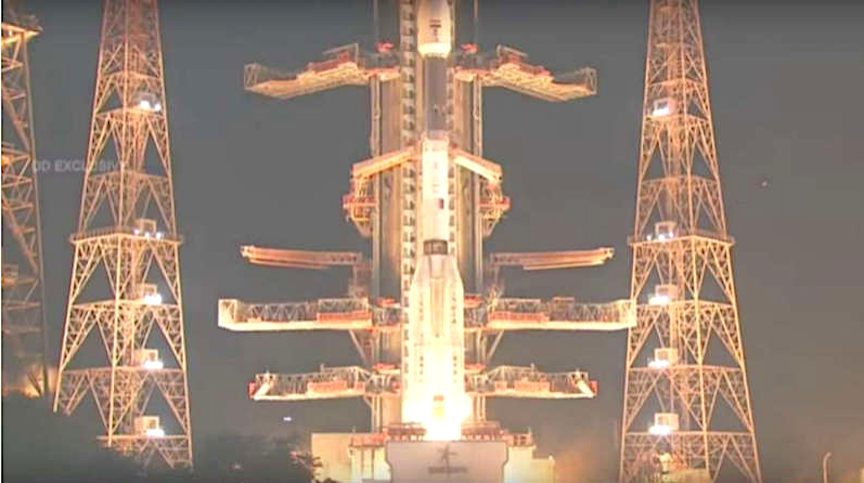
The rocket blasted off from the second launch pad at the Satish Dhawan Space Center in Sriharikota at 5:43 am, as scheduled. It was after 350 seconds of flight when the payload fairing (the nose cone or protective shield that houses the satellite) had separated that the rocket’s path deviated from the planned one. 

Several minutes of anxiety and stunned silence followed at ISRO’s Mission Control in Sriharikota and the Live commentary on the National broadcaster Doordarshan’s telecast had been stopped. Top ISRO officials and scientists at the mission control were also seen discussing urgently, while several others had already gotten off their seats (something that is done usually after the mission is accomplished successfully). 

While this indicated something amiss, Dr. K. Sivan, Chairman, ISRO later confirmed the news at the end of the Doordarshan broadcast — “Mission could not be accomplished fully because there was a technical anomaly observed in the cryogenic stage”. 
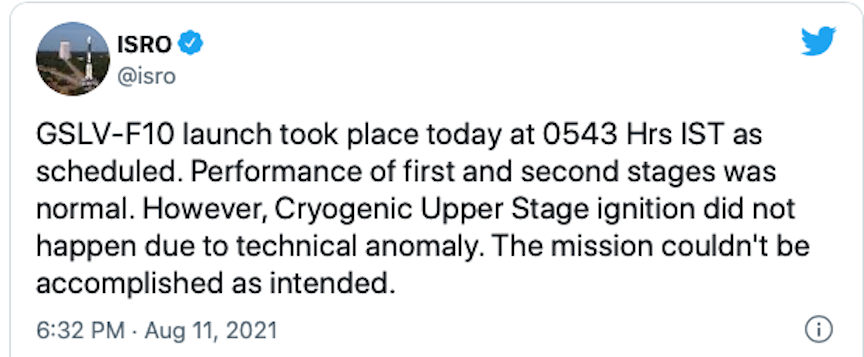
This means that the cryogenic engine (the stage that failed) was supposed to perform from 4 minutes and 56 seconds until 18minutes and 29 seconds (in space), following which the satellite was supposed to be ejected into orbit at 18 minutes and 39 seconds. But that process was hit by a glitch sometime around 5 minutes and 40 seconds.

This is the second failure of the GSLV variant of ISRO (which can lift about 2.5 tons to space). The earlier failure was in 2010 when the vehicle had exploded nearly 45 seconds after lift-off. This was the second launch for ISRO in the calendar year 2021, the earlier one being a PSLV launch in late February. ISRO’s missions and crucial work had been affected during the second wave of the COVID-19 pandemic that struck the country between March and June. However, it is also notable that this was the third launch attempt of this satellite — the first two attempts in March 2020 and March 2021 were called off. 

According to ISRO, GISAT-1 or EOS-3 was meant to provide near-real-time imaging of a large region of interest at frequent intervals, quick monitoring of natural disasters, episodic events and also obtain spectral signatures for agriculture, forestry, mineralogy, disaster warning, cloud properties, snow& glaciers and oceanography. 

EOS-3, an agile Earth observation satellite was meant to be placed in Geostationary orbit (36,000kms from Earth’s equator). This orbit is typically meant for communication satellites that have to cover a large swathe of land. A satellite in geostationary orbit would be in sync with the rotation cycle of the Earth (24hrs) and it would appear to be stationary when seen from the Earth, thus giving it the name. It is said that three aptly positioned Geostationary satellites can cover pretty much all of Earth’s surface.

Conventionally, such Earth-observation satellites are placed in Low-Earth orbit (between 500 and 2000kms), to ensure high-resolution imagery, better capabilities. However, it is pertinent to note that ISRO’s latest agile Earth-observation satellite is to be placed 36,000kms away from the Earth’s surface. Being placed in the 36,000km circular orbit would also mean that the 2268kg GISAT-1 is beyond the range of anti-satellite missiles. 

Story from [email protected] (DNA Web Desk)

Filed Under: Earth Observation & Imaging, Launch Sites & Infrastructure

Primary Sidebar

Coverage

  • Missions & Constellations
  • Business & Finance
  • Military & Defense
  • Launch
  • Software Automation & Ground Systems
  • Government & Regulation
  • Services & Applications

Most Read Stories

  • AT&T, T-Mobile, and Verizon Form Joint Venture to Standardize Satellite Direct-to-Device Connectivity
  • SpaceX Acquires Grain Management’s 800 MHz Spectrum Portfolio to Launch Standalone Starlink Mobile Carrier
  • SpaceX Unveils 250 kW Starlink Gen3 AI Satellites Featuring 10 Tbps Throughput and Onboard Edge Compute
  • FCC Grants SpaceX Approval for 15,000-Satellite Very Low Earth Orbit Direct-to-Device Constellation
  • Rocket Lab Challenges NASA’s $700M Mars Orbiter Award to Blue Origin While Scaling Vertical Integration via $8B Iridium Acquisition

Secondary Sidebar

Footer


Satnews is a leading provider of satellite news, events, publications, research and other satellite industry information in both commercial and military enterprises worldwide.

Stories By Category

  • Business & Finance
  • Government & Regulation
  • Launch
  • Military & Defense
  • Missions & Constellations
  • Services & Applications
  • Software Automation & Ground Systems
  • Spectrum & Licensing
  • Startups & NewSpace Business

About Us

  • Leadership & Editorial Team
  • SatNews History
  • Free Satnews Subscription
  • SatNews Events
  • Magazines

Navigation

  • Latest Stories
  • Magazines
  • Events
  • Contact
  • Cookie & Privacy Policy for Satnews

We use cookies to ensure that we give you the best experience on our website. If you continue to use this site we will assume that you are happy with it.
x
Sign up Now (For Free)
Access daily or weekly satellite news updates covering all aspects of the commercial and military satellite industry.
Invalid email address
Notify Me Regarding ( At least one ):
We value your privacy and will not sell or share your email or other information with any other company. You may also unsubscribe at anytime.

Click Here to see our full privacy policy.
Thanks for subscribing!