

• Skip to primary navigation
  • Skip to main content
  • Skip to primary sidebar
  • Skip to secondary sidebar
  • Skip to footer
  • NEWS:
  • SatNews
  • SatMagazine
  • MilSatMagazine
  • SmallSat News
  • |     EVENTS:
  • SmallSat Symposium
  • Satellite Innovation
  • MilSat Symposium
  • SmallSat Europe

SatNews

Satellite Industry Intelligence Since 1983

Subscribe
  • LATEST
  • SatNews Events
  • Magazines
  • Calendar
  • Subscribe
  • Missions & Constellations
    • Exploration & Science Missions
    • In-Orbit Servicing & Orbital Operations
    • LEO Constellations
    • Mission Autonomy & Onboard Systems
    • Mission Deployments & Manifests
    • Navigation & PNT
    • SmallSat
    • Spacecraft & Payload Technology
    View All in Missions & Constellations →
    FCC Proposes 25 MHz Mid-Band Spectrum Auction with Dual 5G and Direct-to-Device AllocationsFCC Proposes 25 MHz Mid-Band Spectrum Auction with Dual 5G and Direct-to-Device Allocations
    Xona Is in Orbit. Its CEO Says U.S. GPS Backup Leans on China.Xona Is in Orbit. Its CEO Says U.S. GPS Backup Leans on China.
    City Labs Flew 20 Curies. Now It Wants FAA Approval for 10 Million.City Labs Flew 20 Curies. Now It Wants FAA Approval for 10 Million.
    Eutelsat Q1 LEO Revenue Rises 30% to €70.9M as OneWeb Offsets Video DeclineEutelsat Q1 LEO Revenue Rises 30% to €70.9M as OneWeb Offsets Video Decline
  • Business
    • Contracts & Commercial Deals
    • Earnings & Financial Reporting
    • Events & Conferences
    • Funding & Venture Capital
    • Market Forecasts
    • Mergers & Acquisitions
    • Personnel Moves & Appointments
    View All in Business & Finance →
    Satellites Can’t Wait for the 2030 Post-Quantum Deadline, MilSat Panel SaysSatellites Can’t Wait for the 2030 Post-Quantum Deadline, MilSat Panel Says
    War in Space Isn’t Insurable Yet, Gallagher’s Rush SaysWar in Space Isn’t Insurable Yet, Gallagher’s Rush Says
    RG-XX Bids Are In. The Award Is a Year Away.RG-XX Bids Are In. The Award Is a Year Away.
    Golden Dome Panel Splits on the Program’s Political RiskGolden Dome Panel Splits on the Program’s Political Risk
  • Defense
    • Counterspace & ASAT
    • Defense Budgets & Procurement
    • ISR & Reconnaissance
    • MILSATCOM
    • Missile Warning & Defense
    • National Security Programs
    • Space Domain Awareness
    View All in Military & Defense →
    MUOS Gets Two More Satellites and a Life to 2040MUOS Gets Two More Satellites and a Life to 2040
    SDA’s First Tracking Satellites Slip to Spring, Sandhoo SaysSDA’s First Tracking Satellites Slip to Spring, Sandhoo Says
    Hughes Secures $42.5M Space Systems Command Award for Multi-Orbit Automated EM&C ArchitectureHughes Secures $42.5M Space Systems Command Award for Multi-Orbit Automated EM&C Architecture
    “I Can’t Refuel You. I’m Sorry”: Satellite Servicers Can’t Agree on a Plug“I Can’t Refuel You. I’m Sorry”: Satellite Servicers Can’t Agree on a Plug
  • Gov
    • Export Controls & Compliance
    • International Space Agreements
    • National Space Policy
    • Space Law & Treaties
    • Space Sustainability & Debris Policy
    • Space Traffic Management / Debris Removal
    View All in Government & Regulation →
    Part 100 Puts FCC Satellite Licensing on an Assembly LinePart 100 Puts FCC Satellite Licensing on an Assembly Line
    FCC Proposes Modernized Direct-to-Device Rules, Explores 482 MHz Expansion for Satellite CellularFCC Proposes Modernized Direct-to-Device Rules, Explores 482 MHz Expansion for Satellite Cellular
    Canada’s Satellite-to-Phone Network Can’t Go It Alone, So Terrestar Joined EquatysCanada’s Satellite-to-Phone Network Can’t Go It Alone, So Terrestar Joined Equatys
    NTIA’s 500 MHz Mandate Is Its Top Job, Patrick SaysNTIA’s 500 MHz Mandate Is Its Top Job, Patrick Says
  • Launch
    • Launch Providers
    • Launch Schedule & Calendars
    • Launch Sites & Infrastructure
    • Rocket Technology & Vehicles
    View All in Launch →
    HIMERA and GomSpace Begin Orbital Operations of OBRIA NANO Test Satellite for Sovereign Ukrainian NetworkHIMERA and GomSpace Begin Orbital Operations of OBRIA NANO Test Satellite for Sovereign Ukrainian Network
    Blue Origin Reconstructs Launch Complex 36 Tower, Targets November Return to Flight for New GlennBlue Origin Reconstructs Launch Complex 36 Tower, Targets November Return to Flight for New Glenn
    DIA Space Security Report Reveals Detailed Orbital Imagery of China’s Shenlong SpaceplaneDIA Space Security Report Reveals Detailed Orbital Imagery of China’s Shenlong Spaceplane
    The Launch Crunch Is Coming as Falcon 9 Winds DownThe Launch Crunch Is Coming as Falcon 9 Winds Down
  • Software
    • Autonomous Ground Operations
    • Data Processing & AI/ML
    • Digital Twins & Modeling
    • Ground Segment & Teleports
    • Mission Planning & Simulation
    • Space Systems Software Engineering
    • Spectrum & Licensing
    View All in Software Automation & Ground Systems →
    MBSat Selects ST Engineering iDirect Intuition Platform for Ground Infrastructure in OmanMBSat Selects ST Engineering iDirect Intuition Platform for Ground Infrastructure in Oman
    AnySignal Co-Founder Urges Ground Station Interoperability to Resolve Orbital Data BottlenecksAnySignal Co-Founder Urges Ground Station Interoperability to Resolve Orbital Data Bottlenecks
    Arqiva Secures Three-Year Satellite Services Agreement with Kuwait’s GulfsatArqiva Secures Three-Year Satellite Services Agreement with Kuwait’s Gulfsat
    TrustPoint and Calian Deliver Industry’s First Mass-Market Ready C-band GNSS AntennaTrustPoint and Calian Deliver Industry’s First Mass-Market Ready C-band GNSS Antenna
  • Services & Apps
    • Climate & Environmental Monitoring
    • Disaster Response & Security Mapping
    • Earth Observation & Imaging
    • Maritime & Aviation Satcom
    • Satellite Communications
    View All in Services & Applications →
    Tim Farrar: Carriers Are Finding Few Will Pay for Direct-to-DeviceTim Farrar: Carriers Are Finding Few Will Pay for Direct-to-Device
    Scanway and Pixxel Sign Pact to Expand Optical Payload and Earth Observation Data ServicesScanway and Pixxel Sign Pact to Expand Optical Payload and Earth Observation Data Services
    KTL Selects Keysight NR-NTN Test Suite to Accelerate Satellite Acceptance TestingKTL Selects Keysight NR-NTN Test Suite to Accelerate Satellite Acceptance Testing
    Leonardo Infrared Sensor Returns to Orbit Aboard SatVu HotSat-3 Thermal Imaging SatelliteLeonardo Infrared Sensor Returns to Orbit Aboard SatVu HotSat-3 Thermal Imaging Satellite

Constellations… Accidents Waiting To Happen? An NSR Report…

April 14, 2021

Last week, two major constellations operators, OneWeb and SpaceX, nearly crashed in space when two of their satellites almost collided. Another near-miss happened the same day when two other satellites nearly struck each other over the Arctic. And last month, the 2-ton NOAA-17 satellite broke up, sending dangerous debris all along its orbit.

This type of space debris and close calls are becoming too common, especially as more satellites are launched, and space junk, even from decades ago, persists and compounds the problem.

Space Situational Awareness (SSA), the commercialized service of monitoring orbit and warning operators, maybe the best market response to this litter challenge. Yet, while the risk and opportunity grow daily, the SSA market lags.

Fractured coordination, capabilities, offering, and pricing structure, and long-established low priority affected to cleaning up space is such that SSA struggles as any emerging market does with a solid perception that “if it ain’t broke, don’t fix it.” Furthermore, it presents different views on the danger of debris, and the necessity of its services. Lastly, it suffers from far smaller funding and budget than is provided to constellations. However, while constellations may appear crucial, especially to certain investment and bottom lines, SSA is, in fact, crucial to the safe and sustainable use of space to avoid constellations from becoming accidents waiting to happen.

Why is the SSA market lagging, what impact will that have on the industry, and what can be done to change the situation?

Government Play or Commercial Opportunity?

NSR’s In-Orbit Servicing & Space Situational Awareness Markets, 4th Edition (IoSM4) report forecasts SSA services to grow from just $2 million to $282 million in annual revenues between 2020 and 2029. While that seems impressive, NSR also forecasts that SSA players will only capture 20% of the serviceable addressable market during that time. In other words, out of every five high-risk satellites operating over the next decade, only one will be actively monitored and tracked, with warnings provided to its operator by a commercial provider.

Competition with government programs is one reason behind this trend. Increased funding and development of programs, such as the U.S. Space Fence, JAXA’s SSA, and the EU Space Surveillance & Traffic (EUSST) will challenge the commercial market through the capabilities and services offered.

Additionally, the issues of dual-use, and splitting between classified and non-classified data, muddy the water and are expected to limit the commercial play. However, given the high-strategic value of the assets, government and military customers are still expected to drive commercial SSA market revenues, at 53% of the cumulative opportunity over the decade, 95% of which will be for non-GEO satellites.
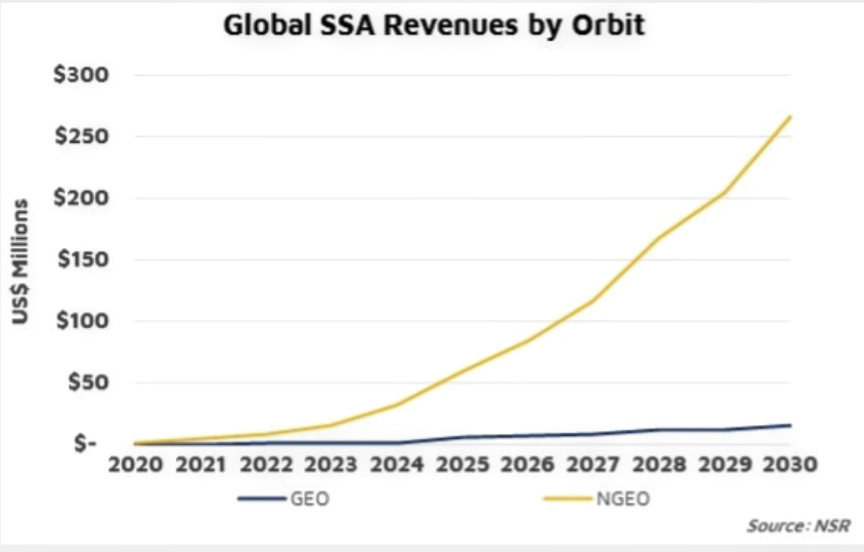
While growing government programs will bring greater monitoring capability, a severe lack of coordination and fragmentation of performance hold the SSA market back, at best, and spell disaster for operators in the worst case.

Worst Case Scenarios

Take the OneWeb/Starlink near-collision. According to one report, the U.S. Space Force alerted OneWeb, who then contacted Starlink to quickly create a mitigation plan. For a reason yet unknown outside of SpaceX, the company turned off its automated collision avoidance system, allowing OneWeb to take full control of the situation by maneuvering their satellite away. There was no pre-arranged plan, and coordination was handled last minute.

There is no central governing authority for SSA or satellite collision avoidance. Licensing regulations remain fragmented, region to region, and underdeveloped, failing to set minimum required capabilities and standards.

While it is generally imprudent to fear that the sky is falling, these incidents will continue, in greater frequency, and one day, the worst-case scenarios will unfold, and collisions will happen. In the meantime, late coordination costs money, through reactive avoidance maneuvers, shortening satellite & revenue-generating lifetimes.

There is hope here. Support for SSA coordination has grown, such as through statements made recently by the U.S. Space Command who support setting international “rules of behavior in space.” At the same time, projects such as IBM’s SSA, and Imagine LAB’s Eyes on the Sky projects are aiming to crowdsource and coordinate the development of SSA data and monitoring capabilities. In the commercial sector, partnerships such as those between LeoLabs and SpaceX serve to support and improve the development of SSA services. The Bottom Line

Space is full of junk. Debris, defunct satellites and other objects like rocket bodies as far back as from the first few rocket launches remain a danger in orbit. With constellations continuing to drive the market, the chances of collision will only increase.

Space Situational Awareness is necessary for monitoring and warning against this risk, yet the capabilities and market remain significantly fragmented and underdeveloped. Coordination, collaboration, and setting stronger standards for collision avoidance will be necessary to move this market forward. Otherwise, collisions, not constellations, will be the main market outcome.

Dallas Kasaboski

Author: Dallas Kasaboski, Principal Analysts, NSR

Filed Under: LEO Constellations, Market Forecasts

Primary Sidebar

Coverage

  • Missions & Constellations
  • Business & Finance
  • Military & Defense
  • Launch
  • Software Automation & Ground Systems
  • Government & Regulation
  • Services & Applications

Most Read Stories

  • AT&T, T-Mobile, and Verizon Form Joint Venture to Standardize Satellite Direct-to-Device Connectivity
  • SpaceX Unveils 250 kW Starlink Gen3 AI Satellites Featuring 10 Tbps Throughput and Onboard Edge Compute
  • SpaceX Acquires Grain Management’s 800 MHz Spectrum Portfolio to Launch Standalone Starlink Mobile Carrier
  • FCC Grants SpaceX Approval for 15,000-Satellite Very Low Earth Orbit Direct-to-Device Constellation
  • Rocket Lab Challenges NASA’s $700M Mars Orbiter Award to Blue Origin While Scaling Vertical Integration via $8B Iridium Acquisition

Secondary Sidebar

Footer


Satnews is a leading provider of satellite news, events, publications, research and other satellite industry information in both commercial and military enterprises worldwide.

Stories By Category

  • Business & Finance
  • Government & Regulation
  • Launch
  • Military & Defense
  • Missions & Constellations
  • Services & Applications
  • Software Automation & Ground Systems
  • Spectrum & Licensing
  • Startups & NewSpace Business

About Us

  • Leadership & Editorial Team
  • SatNews History
  • Free Satnews Subscription
  • SatNews Events
  • Magazines

Navigation

  • Latest Stories
  • Magazines
  • Events
  • Contact
  • Cookie & Privacy Policy for Satnews

We use cookies to ensure that we give you the best experience on our website. If you continue to use this site we will assume that you are happy with it.
x
Sign up Now (For Free)
Access daily or weekly satellite news updates covering all aspects of the commercial and military satellite industry.
Invalid email address
Notify Me Regarding ( At least one ):
We value your privacy and will not sell or share your email or other information with any other company. You may also unsubscribe at anytime.

Click Here to see our full privacy policy.
Thanks for subscribing!