

• Skip to primary navigation
  • Skip to main content
  • Skip to primary sidebar
  • Skip to secondary sidebar
  • Skip to footer
  • NEWS:
  • SatNews
  • SatMagazine
  • MilSatMagazine
  • SmallSat News
  • |     EVENTS:
  • SmallSat Symposium
  • Satellite Innovation
  • MilSat Symposium
  • SmallSat Europe

SatNews

Satellite Industry Intelligence Since 1983

Subscribe
  • LATEST
  • SatNews Events
  • Magazines
  • Calendar
  • Subscribe
  • Missions & Constellations
    • Exploration & Science Missions
    • In-Orbit Servicing & Orbital Operations
    • LEO Constellations
    • Mission Autonomy & Onboard Systems
    • Mission Deployments & Manifests
    • Navigation & PNT
    • SmallSat
    • Spacecraft & Payload Technology
    View All in Missions & Constellations →
    NASA and ISISPACE Deploy GRITSS CubeSat to Advance Orbital Reference Frame PrecisionNASA and ISISPACE Deploy GRITSS CubeSat to Advance Orbital Reference Frame Precision
    OCCAM Space Secures Flight Heritage via D-Orbit Integration on SpaceX Transporter-17 RideshareOCCAM Space Secures Flight Heritage via D-Orbit Integration on SpaceX Transporter-17 Rideshare
    Global Memory Migration to AI Data Centers Extends Telecom Supply Chain CrisisGlobal Memory Migration to AI Data Centers Extends Telecom Supply Chain Crisis
    Ground Control and CLS Selected for France Maritime Vessel Monitoring InitiativeGround Control and CLS Selected for France Maritime Vessel Monitoring Initiative
  • Business
    • Contracts & Commercial Deals
    • Earnings & Financial Reporting
    • Events & Conferences
    • Funding & Venture Capital
    • Market Forecasts
    • Mergers & Acquisitions
    • Personnel Moves & Appointments
    View All in Business & Finance →
    Satellite-to-Cell Competition Intensifies as Regulatory Review LoomsSatellite-to-Cell Competition Intensifies as Regulatory Review Looms
    Pakistan Seeks NASA Partnership for 2035 Lunar Mission AmbitionsPakistan Seeks NASA Partnership for 2035 Lunar Mission Ambitions
    York Space Systems Finalizes $300 Million Acquisition of Satellite Terminal Provider ALL.SPACEYork Space Systems Finalizes $300 Million Acquisition of Satellite Terminal Provider ALL.SPACE
    Blue Origin Moves to Raise $10 Billion in First-Ever Outside Funding RoundBlue Origin Moves to Raise $10 Billion in First-Ever Outside Funding Round
  • Defense
    • Counterspace & ASAT
    • Defense Budgets & Procurement
    • ISR & Reconnaissance
    • MILSATCOM
    • Missile Warning & Defense
    • National Security Programs
    • Space Domain Awareness
    View All in Military & Defense →
    Pulse Space Secures $40 Million U.S. Space Force Contract for Laser-Based Power Beaming TechnologyPulse Space Secures $40 Million U.S. Space Force Contract for Laser-Based Power Beaming Technology
    GAO Report Cites $11 Billion Cost Overruns and Launch Delivery Bottlenecks in Space Force PortfolioGAO Report Cites $11 Billion Cost Overruns and Launch Delivery Bottlenecks in Space Force Portfolio
    Space Force and True Anomaly Complete First Tactical Intercept of VICTUS HAZE MissionSpace Force and True Anomaly Complete First Tactical Intercept of VICTUS HAZE Mission
    Europe’s sovereign-intelligence boom is just beginning, and it needs more companies like ICEYEEurope’s sovereign-intelligence boom is just beginning, and it needs more companies like ICEYE
  • Gov
    • Export Controls & Compliance
    • International Space Agreements
    • National Space Policy
    • Space Law & Treaties
    • Space Sustainability & Debris Policy
    • Space Traffic Management / Debris Removal
    View All in Government & Regulation →
    Balancing Orbit: How Regulators Trade Commercial Viability for National SecurityBalancing Orbit: How Regulators Trade Commercial Viability for National Security
    ITU Rejects Globalstar Extension Request for French-Licensed HIBLEO FleetITU Rejects Globalstar Extension Request for French-Licensed HIBLEO Fleet
    The Supplemental Mobile Network and The Regional Threat.The Supplemental Mobile Network and The Regional Threat.
    BNP Paribas Outlines Steep Regulatory Obstacles in SpaceX Mobile Integration StrategyBNP Paribas Outlines Steep Regulatory Obstacles in SpaceX Mobile Integration Strategy
  • Launch
    • Launch Providers
    • Launch Schedule & Calendars
    • Launch Sites & Infrastructure
    • Rocket Technology & Vehicles
    View All in Launch →
    China Achieves Historic First Orbital Booster Recovery via At-Sea Net SystemChina Achieves Historic First Orbital Booster Recovery via At-Sea Net System
    Blue Origin Insulates Lunar Landers from Launch Pad Recovery FalloutBlue Origin Insulates Lunar Landers from Launch Pad Recovery Fallout
    South Korea Formally Ratifies 2035 “K-Starlink” Low Earth Orbit Constellation PlanSouth Korea Formally Ratifies 2035 “K-Starlink” Low Earth Orbit Constellation Plan
    SEOPS Completes Multi-National Integration of 10 Payloads for SpaceX Transporter-17 MissionSEOPS Completes Multi-National Integration of 10 Payloads for SpaceX Transporter-17 Mission
  • Software
    • Autonomous Ground Operations
    • Data Processing & AI/ML
    • Digital Twins & Modeling
    • Ground Segment & Teleports
    • Mission Planning & Simulation
    • Space Systems Software Engineering
    • Spectrum & Licensing
    View All in Software Automation & Ground Systems →
    Seiren Solidifies Ground Segment Framework for FUSION-1 SmallSat Mission Through SSC and Infostellar PartnershipSeiren Solidifies Ground Segment Framework for FUSION-1 SmallSat Mission Through SSC and Infostellar Partnership
    Powering the Automated Floor: Intralogistics Operators Must Unify AGV Charging InfrastructurePowering the Automated Floor: Intralogistics Operators Must Unify AGV Charging Infrastructure
    Poland Sovereignty: GMV to Develop Core Ground Control Platform for CAMILA ConstellationPoland Sovereignty: GMV to Develop Core Ground Control Platform for CAMILA Constellation
    Software Over the Air: FatPipe Launches Acceleration Tool to Unclog Starlink and Amazon LEO LinksSoftware Over the Air: FatPipe Launches Acceleration Tool to Unclog Starlink and Amazon LEO Links
  • Services & Apps
    • Climate & Environmental Monitoring
    • Disaster Response & Security Mapping
    • Earth Observation & Imaging
    • Maritime & Aviation Satcom
    • Satellite Communications
    View All in Services & Applications →
    Astrolight Framework Urges Industrialized Laser Backbone to Protect European Space AutonomyAstrolight Framework Urges Industrialized Laser Backbone to Protect European Space Autonomy
    ESA Backs TUSK IC to Commercialize Made-in-Europe Ka-Band Flat-Panel Antenna SiliconESA Backs TUSK IC to Commercialize Made-in-Europe Ka-Band Flat-Panel Antenna Silicon
    Breaking Orbital Silence: Planet Labs Restores Strategic Middle East Imagery PipelinesBreaking Orbital Silence: Planet Labs Restores Strategic Middle East Imagery Pipelines
    SpaceX Controlled-Deorbit Report Discloses Decommissioning of 260 Starlink Satellites Over Six MonthsSpaceX Controlled-Deorbit Report Discloses Decommissioning of 260 Starlink Satellites Over Six Months

NASA’s Perseverance Drives On Mars’ Terrain For First Time

March 8, 2021

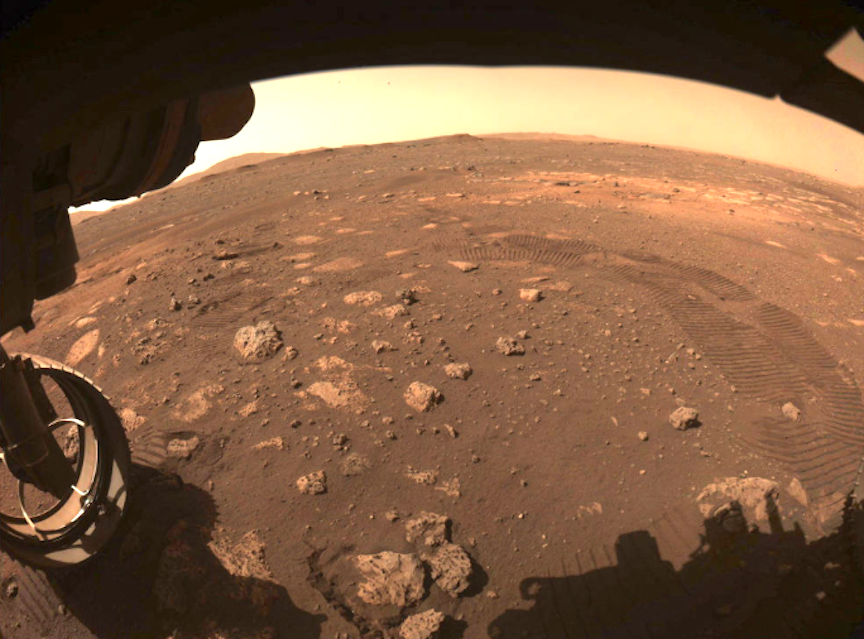
This image was captured while NASA’s Perseverance rover drove on Mars for the first time on March 4, 2021. One of Perseverance’s Hazard Avoidance Cameras (Hazcams) captured this image as the rover completed a short traverse and turn from its landing site in Jezero Crater.
Credits: NASA/JPL-Caltech

This isn’t the usual Student Driver …

NASA’s Mars 2020 Perseverance rover performed its first drive on Mars March 4, covering 21.3 feet (6.5 meters) across the Martian landscape. The drive served as a mobility test that marks just one of many milestones as team members check out and calibrate every system, subsystem, and instrument on Perseverance. Once the rover begins pursuing its science goals, regular commutes extending 656 feet (200 meters) or more are expected.

“When it comes to wheeled vehicles on other planets, there are few first-time events that measure up in significance to that of the first drive,” said Anais Zarifian, Mars 2020 Perseverance rover mobility test bed engineer at NASA’s Jet Propulsion Laboratory in Southern California. “This was our first chance to ‘kick the tires’ and take Perseverance out for a spin. The rover’s six-wheel drive responded superbly. We are now confident our drive system is good to go, capable of taking us wherever the science leads us over the next two years.”

The drive, which lasted about 33 minutes, propelled the rover forward 13 feet (4 meters), where it then turned in place 150 degrees to the left and backed up 8 feet (2.5 meters) into its new temporary parking space. To help better understand the dynamics of a retrorocket landing on the Red Planet, engineers used Perseverance’s Navigation and Hazard Avoidance Cameras to image the spot where Perseverance touched down, dispersing Martian dust with plumes from its engines.

More Than Roving

The rover’s mobility system is not only thing getting a test drive during this period of initial checkouts. On February 26 — Perseverance’s eighth Martian day, or sol, since landing — mission controllers completed a software update, replacing the computer program that helped land Perseverance with one they will rely on to investigate the planet.

More recently, the controllers checked out Perseverance’s Radar Imager for Mars’ Subsurface Experiment (RIMFAX) and Mars Oxygen In-Situ Resource Utilization Experiment (MOXIE) instruments, and deployed the Mars Environmental Dynamics Analyzer (MEDA) instrument’s two wind sensors, which extend out from the rover’s mast. Another significant milestone occurred on March 2, or sol 12, when engineers unstowed the rover’s 7-foot-long (2-meter-long) robotic arm for the first time, flexing each of its five joints over the course of two hours.

“Tuesday’s first test of the robotic arm was a big moment for us,” said Robert Hogg, Mars 2020 Perseverance rover deputy mission manager. “That’s the main tool the science team will use to do close-up examination of the geologic features of Jezero Crater, and then we’ll drill and sample the ones they find the most interesting. When we got confirmation of the robotic arm flexing its muscles, including images of it working beautifully after its long trip to Mars — well, it made my day.”

Upcoming events and evaluations include more detailed testing and calibration of science instruments, sending the rover on longer drives, and jettisoning covers that shield both the adaptive caching assembly (part of the rover’s Sample Caching System) and the Ingenuity Mars Helicopter during landing. The experimental flight test program for the Ingenuity Mars Helicopter will also take place during the rover’s commissioning.

Through it all, the rover is sending down images from the most advanced suite of cameras ever to travel to Mars. The mission’s cameras have already sent about 7,000 images. On Earth, Perseverance’s imagery flows through the powerful Deep Space Network (DSN), managed by NASA’s Space Communications and Navigation (SCaN) program. In space, several Mars orbiters play an equally important role.

“Orbiter support for downlink of data has been a real gamechanger,” said Justin Maki, chief engineer for imaging and the imaging scientist for the Mars 2020 Perseverance rover mission at JPL. “When you see a beautiful image from Jezero, consider that it took a whole team of Martians to get it to you. Every picture from Perseverance is relayed by either the European Space Agency’s Trace Gas Orbiter, or NASA’s MAVEN, Mars Odyssey, or Mars Reconnaissance Orbiter. They are important partners in our explorations and our discoveries.”

The sheer volume of imagery and data already coming down on this mission has been a welcome bounty for Matt Wallace, who recalls waiting anxiously for the first images to trickle in during NASA’s first Mars rover mission, Sojourner, which explored Mars in 1997. On March 3, Wallace became the mission’s new project manager. He replaced John McNamee, who is stepping down as he intended, after helming the project for nearly a decade.

“John has provided unwavering support to me and every member of the project for over a decade,” said Wallace. “He has left his mark on this mission and team, and it has been my privilege to not only call him boss but also my friend.”

Touchdown Site Named

With Perseverance departing from its touchdown site, mission team scientists have memorialized the spot, informally naming it for the late science fiction author Octavia E. Butler. The groundbreaking author and Pasadena, California, native was the first African American woman to win both the Hugo Award and Nebula Award, and she was the first science fiction writer honored with a MacArthur Fellowship. The location where Perseverance began its mission on Mars now bears the name “Octavia E. Butler Landing.”

Official scientific names for places and objects throughout the solar system — including asteroids, comets, and locations on planets — are designated by the International Astronomical Union. Scientists working with NASA’s Mars rovers have traditionally given unofficial nicknames to various geological features, which they can use as references in scientific papers.

“Butler’s protagonists embody determination and inventiveness, making her a perfect fit for the Perseverance rover mission and its theme of overcoming challenges,” said Kathryn Stack Morgan, deputy project scientist for Perseverance. “Butler inspired and influenced the planetary science community and many beyond, including those typically under-represented in STEM fields.”

“I can think of no better person to mark this historic landing site than Octavia E. Butler, who not only grew up next door to JPL in Pasadena, but she also inspired millions with her visions of a science-based future,” said Thomas Zurbuchen, NASA associate administrator for science. “Her guiding principle, ‘When using science, do so accurately,’ is what the science team at NASA is all about. Her work continues to inspire today’s scientists and engineers across the globe – all in the name of a bolder, more equitable future for all.”

Butler, who died in 2006, authored such notable works as “Kindred,” “Bloodchild,” “Speech Sounds,” “Parable of the Sower,” “Parable of the Talents,” and the “Patternist” series. Her writing explores themes of race, gender, equality, and humanity, and her works are as relevant today as they were when originally written and published.

More About the Mission

A key objective of Perseverance’s mission on Mars is astrobiology, including the search for signs of ancient microbial life. The rover will characterize the planet’s geology and past climate, pave the way for human exploration of the Red Planet, and be the first mission to collect and cache Martian rock and regolith.

Subsequent NASA missions, in cooperation with ESA (European Space Agency), would send spacecraft to Mars to collect these sealed samples from the surface and return them to Earth for in-depth analysis.

The Mars 2020 Perseverance mission is part of NASA’s Moon to Mars exploration approach, which includes Artemis missions to the Moon that will help prepare for human exploration of the Red Planet.

JPL, which is managed for NASA by Caltech in Pasadena, built and manages operations of the Perseverance rover.

For more information about NASA’s Mars missions, go to:

To see images as they come down from the rover and vote on the favorite of the week, go to:

Filed Under: Data Processing & AI/ML, Earth Observation & Imaging

Primary Sidebar

Coverage

  • Missions & Constellations
  • Business & Finance
  • Military & Defense
  • Launch
  • Software Automation & Ground Systems
  • Government & Regulation
  • Services & Applications

Most Read Stories

  • Direct-to-Device Momentum: AST SpaceMobile Successfully Launches Giant Next-Gen BlueBird Satellites Atop SpaceX Falcon 9
  • Orbital Paperwork War: China's Spectrum Squatting Reserves 244,000 Satellite Slots to Combat SpaceX's LEO Monopoly
  • U.S. viewership of the 2026 World Cup via satellite television is strong and easily accessible
  • Arianespace fights back – possibly!
  • Space Logistics Pivot: USSF Launches Challenge to Develop Multi-Orbit 'Warehouses' and Fuel Depots

Secondary Sidebar

Footer


Satnews is a leading provider of satellite news, events, publications, research and other satellite industry information in both commercial and military enterprises worldwide.

Stories By Category

  • Business & Finance
  • Government & Regulation
  • Launch
  • Military & Defense
  • Missions & Constellations
  • Services & Applications
  • Software Automation & Ground Systems
  • Spectrum & Licensing
  • Startups & NewSpace Business

About Us

  • Leadership & Editorial Team
  • SatNews History
  • Free Satnews Subscription
  • SatNews Events
  • Magazines

Navigation

  • Latest Stories
  • Magazines
  • Events
  • Contact
  • Cookie & Privacy Policy for Satnews

We use cookies to ensure that we give you the best experience on our website. If you continue to use this site we will assume that you are happy with it.
x
Sign up Now (For Free)
Access daily or weekly satellite news updates covering all aspects of the commercial and military satellite industry.
Invalid email address
Notify Me Regarding ( At least one ):
We value your privacy and will not sell or share your email or other information with any other company. You may also unsubscribe at anytime.

Click Here to see our full privacy policy.
Thanks for subscribing!