The attendee response to the Satnews Satellite Innovation 2020 Virtual event has been most interesting… a small sample of the responses to questions asked of some of those in attendance revealed, “I had no idea a virtual event could accomplish an event of this size,” to “Most surprising… and I was able to discuss and visit and talk with some exhibitors in real time,” to “Speakers were highly knowledgeable and presented their information in a direct and enlightening manner. I came away knowing more than when I first logged on,” to “Virtual works!”
The first session of Day Two at Satellite Innovation 2020 Virtual was entitled “Executive Market Forecast — Space Systems” and was moderated by Randy Segal of Hogan Lovells. The subject-matter experts on the panel included Janna Lewis of BAE Systems, Dr. Giulio Renzo of Avio SpA, Jeff Matthews of Deloitte Consulting and Jackie Schmoll of L3Harris Technologies.

The first thrust of this session was to discuss 2020/21 — these have been seen as shift years in financing and system developments for various space systems. The rush to the moon and other space tourism events, plus multiple deep space projects, have not yet been put on hold. The FCC has finalized plans for the transfer of 280 megahertz of C-band spectrum for use in 5G cellular networks and that has lead to much needed orders for satellite builds for the major manufacturers. LEO broadband constellations, such as OneWeb and Starlink, continue to grow despite bankruptcy in the former’s case, as well as a somewhat nebulous marketplace. Satellites continue play a pivotal role in communications, especially in the locked down situation the world is currently facing.
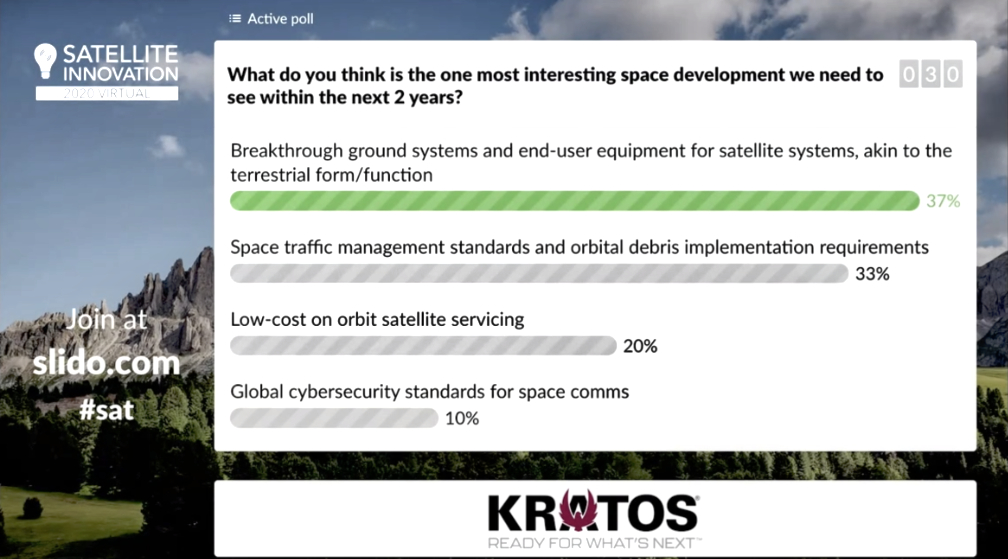
Randy Segal started the conversations by mentioning the Smallsat Symposium that will occur next February where she hopes all can finally get togther with handshakes and hugs with all our friends. She noted there are some new, interesting elements to think about, such as… what do we need to see occur within the industry during the next two years!
Attendee questions with an accompany percentage as to overall interest was shown on screen.
Randy continued by asking that, in the middle of plenty of launch events and with rideshare becoming the norm, how do you panelists see this as changing the way the industry thinks about satellite development and launch and how are launch dynamics changing? Randy noted that cost of launches is going down and it will be interesting to see how the many launch delays currently being experienced will change the economics. A challenge for firms that aggregate payloads for launches is to fill that purchased fairing with client payloads and that presents a totally different type of dynamics.
The moderator also opened the doorway to discussion with some thoughts regarding US Government policy and shifts over past year and how that has supported innovation and the interaction with the commercial space industry. She inquired, what are the most significant announcements and changes for the industry in this regard? She asked the panelists to talk about the space system industry at large, but the government sector cannot be ignored when as relationships are so crucially important to overall success.
Jeff Matthews said he’s been tracking launch dynamics for eight years and understands that the the ability to close a business case is subject to getting on-orbit in a short period of time. Ridesharing is an easy way to accomplish this goal, as well as reducing development costs. Rideshare opens a large aperture of options and enables a small satellite company to participate. He believes we’ll see more rideshare opportunities opening up, although he also said that some cannibalization will occur when small launchers designed specially for smallsat launches become operational. He added that his firm is looking at the future of Vandenberg Air Force Base (VAFB) in California, where the base and western range are more supportive of downstream space apps as well as launch. There’s also a lot of room to innovate with ground systems. He commended the US government for thinking outside the box and is witnessing the controlled collision of technology across the government and commercial environs. VAFB will help sponsor and grow commercial actives in the region. The DoD will be able to access commercial capabilities. He doesn’t believe anything has slowed down during this COVID invasion. Over the past ten years, Deloitte has worked on AI, the cloud and how to accelerate sector use cases. Space plus Artificial Intelligence (AI) is in a massive transformative position.
Jeff continued that there is now more room for non-traditionals on the backend and there will be more contracts, more funding and more value to users. He also reported that in this morning (October 7, 2020), Momentus becames the latest space company to go public (see satnews.com/2020/10/07/momentus-monumental-merger-of-estimated-1-2-billion-to-become-public-with-stable-road-acquisition-corp/). Jeff stated that there has to be breakthroughs on architecture for mega-constellations and that “someone has to come up with a secret sauce.” He notes the successful emergence of business ops after emerge from bankruptcy as well as more space startups going public either directly or through a Special Purpose Acquisition Company (SPARC—see Investopedia’s explanation at www.investopedia.com/terms/s/spac.asp). Jeff believes there will be Continued growth and VC/PE investments in space and that, eventually, there will be success for space tourism and asteroid mining business endeavors. In regard to what has been most surprising to him over the past year, he related that one surprise was to Tom Cruise is going to participate in a movie that will be filmed on ISS. On a more realistic note, he was surprised at the amount of capital inflowing into the industry and the number of investors that are still looking over the next 12 months to invest. He was glad to hear about the Momentus move and was surprised this was happening during a global downturn and recession.
Janna Lewis stated that important strides are being made by the government with commercial companies, from 5G and remote sensing to cyber critical policies. She thinks the most significant changes will happen with acquisitions and the purchase of space systems, with organizational changes then occurring to support new policies and developments. Policy shifts are going to touch everyone and will influence how the government interacts with commercial space companies. Such changes are coming fast, and many want even faster action. New acquisition units within such organizations as the United States Space Force (USSF) are coming online and they will implement additional policies at a more rapid pace. This will lead to acceleration within the communications industry with new technologies and faster implementation of those technologies. She noted the government is now trying to help companies thru the “can be overwhelming” contract process. It’s a challenge to know there are resources out there.
When asked about other pivots or trends occurring over the past year, Ms. Lewis noted the inclusion of the commercial cloud and the addition of ground stations by major players, which will be incredibly influential and transformational as to how we are going to process information.
Jackie Schmoll stated she is closely aligned with what the government is doing. The Department of Defense (DoD) has really been given the authority to engage in government acquisitions — what will they do with it. She would like to see the government acquisition process engage and implement plans for commercial companies. During the last month, the Space Development Agency (SDA) stuck with their schedule and they haven’t skipped a beat — they awarded the Transport Layer contracts on-time in parity with their schedule (see www.sda.mil/transport/ for information regarding this constellation). The SDA has released another RFP for industry proposals for launch services. Such actions will bring more commercial entities into the government acquisition processes and that will produce more competition which will bring about innovation.
When queried about what she has seen over the past year of interest, Ms. Schmoll said she has witnessed resiliency and adaptability and across the supply chain and with partners. Opportunities now exist where, previously, a company could never talk to the government from a home office. The coronavirus has allowed her firm to break through some previous norms, in spite of some challenges. She has also seen where there might be gaps and companies must innovate and change just in case this viral invasion happens again or continues on creating havoc. COVID-19 wasn’t something that wasn’t on anyone’s radar and was difficult, initially, to figure out. Phased reopenings, travel bans, all must to adapt as to how we do business. These necessities may draw more people into the industry, as working remotely on technology has now become a necessity. We can be flexible and use tools we may not have previously used and considerations must be as to how all are going to come out of this crisis stronger than before.
As far as trends or pivots over the past year, she said that going from various cloud services with occasional use to actually using them constantly. She added there is so much AI and ML data these days and wonders how this information gets stored into the cloud without having to do a lot of processing. She’s also seeing that the government will actually be able to invest in various opportunities.
Randy said she was astonished by the number of companies seeking government contracts., saying, “This has become their oxygen for breathing. [The process is] Simpler than before, it’s still, for a startup company, fascinating that they are drinking from this fire hose.” She wanted to know more from the agencies as to what are the rules that now apply for export, government contracting,and cross border contracting. She’s never seen this kind of diversity before, nor the desire for startup satellite companies to go after a lot of these government funding mechanisms. A few years ago, it almost impossible to get government attention; however, today, it is a much different relationship with the government. She also said that congested spectrum will work itself out over the next year and will be an example of how companies can successfully work together.
Following the first session, the keynote for Day Two was presented by Dr. Jan Worner, the Director General of the European Space Agency (ESA).
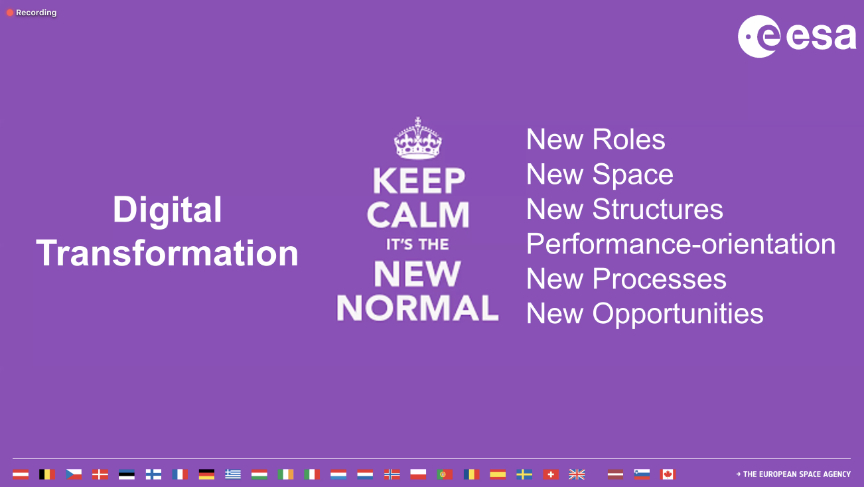
Dr. Wörner started by stating this virus is changing us and all are afraid of getting the virus; however, this also brings new opportunities for the future — the “new normal” — accelerated transformation for digital transformation. He stated that with satellites, the pulse of Earth can be taken. He discussed the three different layers in Europe… the ERC (Sentinel), Aeolus and MetOp-C ESA satellites — the United Space in Europe.
Satellites operate in the environmental space as well as autonomous shipping, such as auto docking for ships. He noted that big data is used incorrectly as meaning much data, where actually he said big data means combining the data of several sources and bringing that together for a better understanding.
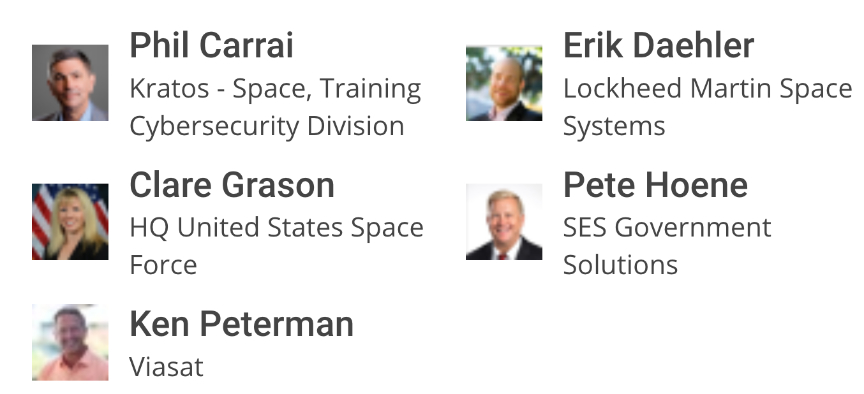
The second session of the day was “Space Force — Use of Commercial Satellite Services” and featured the moderator, Phil Carrai of Kratos — Space, Training and Cybersecurity Division with panelists Clare Grason of Headquarters United States Space Force, Ken Peterman of Viasat, Erik Daehler of Lockheed Martin Space Systems and Pete Hoene of SES Government Solutions (SES-GS).
Clare Grason reported that the creation of the United States Space Force (USSF) is massively important as to how we acquire, buy and deliver commercial SATCOM. She noted the USSF has a 100 different contracts that aren’t currently leveraging the organization’s collective buying power. There is a strategy underway now for strategic customers and partners and other stakeholders to modernize how we bring in commercial SATCOM capabilities on a best value trade off basis. That process is getting better and was implemented about 18 months ago and will continue to get better as more deals are cemented into place. The market innovations over the past five years have been pretty phenomenal and, currently, the second phase of LEO mania is underway and is garnering a lot of attention. There is excitement also in the other portions of the industry, as well. A sample of one of those innovations are flat panel terminals, now an expensive reality. She said those types of terminals offer ease of use and access to satellites and can easily roam between commercial and military systems, which dovetail directly into the ambitions of the USSF.
She said commercial SATCOM is also moving toward government acquisition and commercial technology will benefit the DoD. She stated that commercial SATCOM is not a commodity nd that there are distinguishing characteristics for the systems the USSF is interested in. Price is not the most important factor. By applying best value tradeoffs, the USSF can apply strengths to areas of offers and proposals that go beyond price. The government can incentivize or guide industry in writing proposals that really reflect the interest areas of the organization on the front end and on the back end and be able to distinguish what merits go to what strengths. Industry feedback is necessary for the USSF to understand what is needed in the marketplace.
Grason added that the USSF is happy to see the commercial market understand the importance of ground architecture and to not just focus on the space segment. Within the DoD, the intent is to buy end services and to stay out of the integration of those services as government many not be the most effective integrator. This is a market trend. Suppliers are working together to promote resiliency and interoperability.
Additionally, the USSF customers have always valued commercial SATCOM and customers are now turning to commercial SATCOM due to reliability and availability factors. Commercial SATCOM users aren’t subjected to an arduous decision process. Now under the umbrella of USSF, commercial SATCOM will be enhanced with certain security capabilities. Also, MILSATCOM will become more of a business. If certain aspects of MILSATCOM were monetized and had to choose where the dollars had to be placed, commercial SATCOM would be selected. Commercial SATCOM is being looked at to fill certain gaps, for a variety of purposes.
Pete Hoene said that the operator challenge when dealing with the government/military has been the Lowest Price Technically Acceptable (LPTA) paradigm. That didn’t give the industry any incentive to participate. Looking at the number of different innovations, advantage should be taken of LEO and MEO. The companies upcoming MPOWER technology will be 10x more powerful than what is currently available. How do we have a MEO/LEO/GEo config that we can take advantage of? All kinds of enemies o there that would like to disrupt our services. What we can do is include comm SATCOM in the military enterprise architecture. Feaues not considered for comm satcom but now being brought into the play for gov acceptance. How to transition from WGS to comm systems is exciting and there’s about two years to get it right.
Pete also indicated that LEO is going to be really exciting and can achieve fiber-like latency via MEO. The warfighter can use apps and deploy them and reach back to the garrison to obtain that data. The combination will transform the way we consider how to use commercial SATCOM and the high throughput of 5000 beams per satellite. He added that as a commercial operator, his company has to make certain their networks are secure as well as spacecradft encryption and ground stations are protected as well as the net infrastructure. There are going to be increasing challenges ahead as enemmies will try to take networks down. Companies must have the ability to transition to another network or mitigate any attacks. The commercial industry is taking some big steps in regard to these challenges.
Ken Peterman noted that Viasat is building an entire structure as a major service and the firm is trying to evolve the acquisition process from invention to accepting, adopting and buying a service. When the DoD was the only one buying, there was congestion. Prices are going to come down and clients will pay for only the portions of the net they are using. The security attributes are far better with commercial firms than DoD-purpose built systems in the field today, so the DoD will benefit from private investment as the market transitions. He also added that sensor satellites can route their traffic up over GEO and get that data to where it needs to be located. LEO must wait to transmit that date until the satellite is over a ground station. The interconnection between these eco systems will be very powerful. Sensor satellites can route their traffic up over GEO and get to where it needs to be… LEO has to wait until they are over a ground station. The interconnection between these eco systems is very powerful.
Ken added there is a misconception regarding the selection of either, or… the move is toward providing a connectivity service that is delivered over a hybrid solution. Viasat provides connectivity on multiple networks simultaneously and the systems are complimentary… LEO systems are closer to the Earth and have lower latency but over blue water 85 percent of the time, LEO can’t be reallocated to other parts of the world. With GEO, there are satellites that have coverage over larger portions of the Earth. The best attributes of both can be offered that serve the application. Intelligent parsing of traffic enhances the customer service. In regard to cybersecurity, Ken relates that there are millions of individual users that push terabytes of data over the net and real time situational awareness of everything on a network is absolutely required. His company has been able to be predictive as to when a cyber event will occur in the private sector.
Erik Daehler said that really understanding the mission needs is of high value to customers. The drive to the lowest price solution extracted all of the value out of the satellite capabilities. Cross partnership are necessary between government, sponsors and communication partners for the implementation of advanced technologies. There will be great opportunity in next weave of space, from miniaturized computers, mesh networks and so on and layers will be integrated that were previously only present in stovepipes. When it comes to cybersecurity, extremely high walls are built that no one can get through. Nw strategies find the implementation of protected mechanisms that don’t look like the rest of the systems and those are walled off. The flip must be made from a defensive posture and then work from inside out.
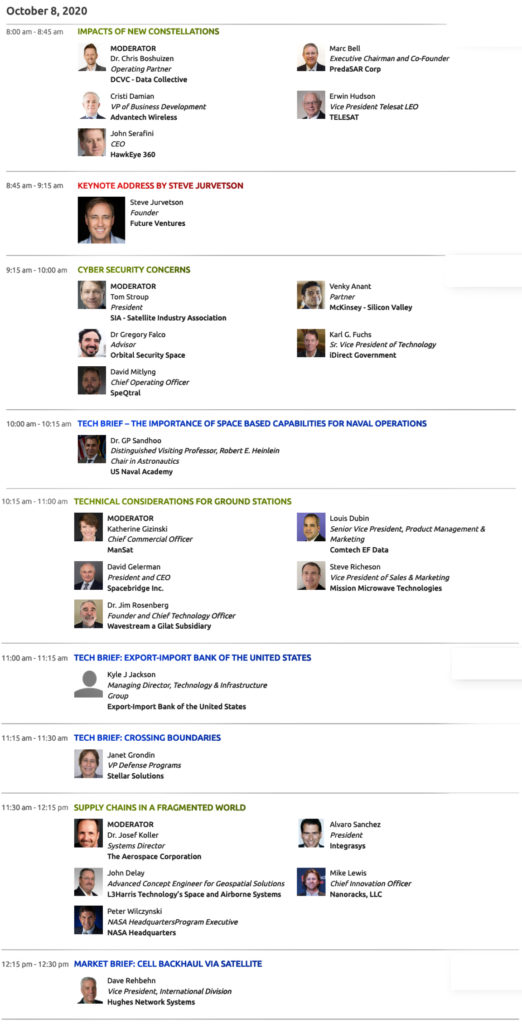
Here’s what to look forward to in Day Three of the Satellite Innovation 2020 Virtual event…