

• Skip to primary navigation
  • Skip to main content
  • Skip to primary sidebar
  • Skip to secondary sidebar
  • Skip to footer
  • NEWS:
  • SatNews
  • SatMagazine
  • MilSatMagazine
  • SmallSat News
  • |     EVENTS:
  • SmallSat Symposium
  • Satellite Innovation
  • MilSat Symposium
  • SmallSat Europe

SatNews

Satellite Industry Intelligence Since 1983

Subscribe
  • LATEST
  • SatNews Events
  • Magazines
  • Calendar
  • Subscribe
  • Missions & Constellations
    • Exploration & Science Missions
    • In-Orbit Servicing & Orbital Operations
    • LEO Constellations
    • Mission Autonomy & Onboard Systems
    • Mission Deployments & Manifests
    • Navigation & PNT
    • SmallSat
    • Spacecraft & Payload Technology
    View All in Missions & Constellations →
    High-Stakes Rescue: Commercial Satellite Servicer Encapsulated for Swift Telescope Orbital BoostHigh-Stakes Rescue: Commercial Satellite Servicer Encapsulated for Swift Telescope Orbital Boost
    SpaceX’s Secret ‘Starfall’ Capsule Wins FAA Approval for Pacific Reentry TestsSpaceX’s Secret ‘Starfall’ Capsule Wins FAA Approval for Pacific Reentry Tests
    NOAA Activates First Dedicated U.S. Space Weather Satellite One Million Miles from EarthNOAA Activates First Dedicated U.S. Space Weather Satellite One Million Miles from Earth
    Thales Alenia Space to coordinate EROSS SC On-Orbit Servicing projectThales Alenia Space to coordinate EROSS SC On-Orbit Servicing project
  • Business
    • Contracts & Commercial Deals
    • Earnings & Financial Reporting
    • Events & Conferences
    • Funding & Venture Capital
    • Market Forecasts
    • Mergers & Acquisitions
    • Personnel Moves & Appointments
    View All in Business & Finance →
    Space Force Modernization: Viasat Secures Prime Contract for Agile PTS-G ‘Swarm 1’ FleetSpace Force Modernization: Viasat Secures Prime Contract for Agile PTS-G ‘Swarm 1’ Fleet
    SpaceX: The targets might be toughSpaceX: The targets might be tough
    SOMA Satellite Factory: Planet Labs Expands San Francisco HQ to Supercharge Production PipelineSOMA Satellite Factory: Planet Labs Expands San Francisco HQ to Supercharge Production Pipeline
    Riding the Starship: The SpaceX IPO Is Set to Rocket Seattle’s Aerospace EcosystemRiding the Starship: The SpaceX IPO Is Set to Rocket Seattle’s Aerospace Ecosystem
  • Defense
    • Counterspace & ASAT
    • Defense Budgets & Procurement
    • ISR & Reconnaissance
    • MILSATCOM
    • Missile Warning & Defense
    • National Security Programs
    • Space Domain Awareness
    View All in Military & Defense →
    Space Logistics Pivot: USSF Launches Challenge to Develop Multi-Orbit ‘Warehouses’ and Fuel DepotsSpace Logistics Pivot: USSF Launches Challenge to Develop Multi-Orbit ‘Warehouses’ and Fuel Depots
    Savox Communications Unveils ‘MissionCore’ to Unify Disconnected Battlefield Data LinksSavox Communications Unveils ‘MissionCore’ to Unify Disconnected Battlefield Data Links
    Space-Based Shield: Spire Global and Diehl Defence Partner to Build European Missile Warning NetworkSpace-Based Shield: Spire Global and Diehl Defence Partner to Build European Missile Warning Network
    Qorvo Unveils Compact X-Band Radar Module to Enhance Defense System PerformanceQorvo Unveils Compact X-Band Radar Module to Enhance Defense System Performance
  • Gov
    • Export Controls & Compliance
    • International Space Agreements
    • National Space Policy
    • Space Law & Treaties
    • Space Sustainability & Debris Policy
    • Space Traffic Management / Debris Removal
    View All in Government & Regulation →
    The Next Arena: Why the WRC-27 Summit in Shanghai is the New Space Tech FrontlineThe Next Arena: Why the WRC-27 Summit in Shanghai is the New Space Tech Frontline
    American military space closed around one company in seven daysAmerican military space closed around one company in seven days
    Major opportunities for 2 GHz over EuropeMajor opportunities for 2 GHz over Europe
    “Dual-use” is the funding word. It’s also the label operators want off.“Dual-use” is the funding word. It’s also the label operators want off.
  • Launch
    • Launch Providers
    • Launch Schedule & Calendars
    • Launch Sites & Infrastructure
    • Rocket Technology & Vehicles
    View All in Launch →
    Breaking the TRL Bottleneck: Space Phoenix Systems Debuts Cost-Effective Space Test-and-Return ServiceBreaking the TRL Bottleneck: Space Phoenix Systems Debuts Cost-Effective Space Test-and-Return Service
    Twelve Scientific Payloads Experience Microgravity Aboard SubOrbital Express-5Twelve Scientific Payloads Experience Microgravity Aboard SubOrbital Express-5
    Amazon Leo Constellation Surpasses 330 Satellites Following Latest Atlas V LaunchAmazon Leo Constellation Surpasses 330 Satellites Following Latest Atlas V Launch
    If You Thought Space Was Hard Try to Get Your Satellite On a RocketIf You Thought Space Was Hard Try to Get Your Satellite On a Rocket
  • Software
    • Autonomous Ground Operations
    • Data Processing & AI/ML
    • Digital Twins & Modeling
    • Ground Segment & Teleports
    • Mission Planning & Simulation
    • Space Systems Software Engineering
    • Spectrum & Licensing
    View All in Software Automation & Ground Systems →
    Software Over the Air: FatPipe Launches Acceleration Tool to Unclog Starlink and Amazon LEO LinksSoftware Over the Air: FatPipe Launches Acceleration Tool to Unclog Starlink and Amazon LEO Links
    Three LEO Operators Bet 2026 on a Supply Chain Built for 2027Three LEO Operators Bet 2026 on a Supply Chain Built for 2027
    NASA Advances Interoperable Space Networks with Successful PExT DemonstrationNASA Advances Interoperable Space Networks with Successful PExT Demonstration
    KSAT and iQPS Expand Strategic Alliance to Accelerate High-Frequency SAR ConstellationKSAT and iQPS Expand Strategic Alliance to Accelerate High-Frequency SAR Constellation
  • Services & Apps
    • Climate & Environmental Monitoring
    • Disaster Response & Security Mapping
    • Earth Observation & Imaging
    • Maritime & Aviation Satcom
    • Satellite Communications
    View All in Services & Applications →
    Eutelsat and Tototheo Global Forge Partnership to Deliver LEO Connectivity Across Maritime and Government SectorsEutelsat and Tototheo Global Forge Partnership to Deliver LEO Connectivity Across Maritime and Government Sectors
    Marlink Equips Groupama-FDJ Cycling Team with Hybrid Starlink and LTE NetworkMarlink Equips Groupama-FDJ Cycling Team with Hybrid Starlink and LTE Network
    Viasat Secures Lockheed Martin Contract for NOAA’s Next-Generation AircraftViasat Secures Lockheed Martin Contract for NOAA’s Next-Generation Aircraft
    SES Partners with Viva to Launch Multi-Orbit In-Flight ConnectivitySES Partners with Viva to Launch Multi-Orbit In-Flight Connectivity

NASA/ESA’s Hubble… This Ribbon Of Gas Can’t Be Tied…It Stretches Almost Halfway ‘Round the Milky Way

August 12, 2013

[SatNews] …most of this stream was stripped from the Small Magellanic Cloud some two billion years ago…

Astronomers using the NASA/ESA Hubble Space Telescope have solved the 40-year-old mystery of the origin of the Magellanic Stream, a long ribbon of gas stretching nearly halfway around the Milky Way. New Hubble observations reveal that most of this stream was stripped from the Small Magellanic Cloud some two billion years ago, with a smaller portion originating more recently from its larger neighbor.
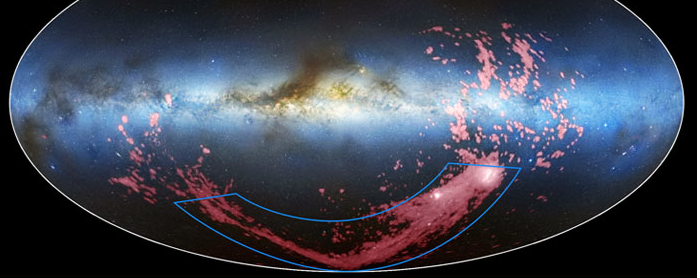

Click on graphic on right to learn more at Hubble’s website.


Tracing the origin of the Magellanic Stream

The Magellanic Clouds, two dwarf galaxies orbiting our galaxy, are at the head of a huge gaseous filament known as the Magellanic Stream. Since the Stream’s discovery in the early 1970s, astronomers have wondered whether this gas comes from one or both of the satellite galaxies. Now, new Hubble observations show that most of the gas was stripped from the Small Magellanic Cloud about two billion years ago, but surprisingly, a second region of the stream was formed more recently from the Large Magellanic Cloud.

A team of astronomers determined the source of the gas filament by using Hubble’s Cosmic Origins Spectrograph (COS), along with observations from ESO’s Very Large Telescope, to measure the abundances [1] of heavy elements, such as oxygen and sulphur, at six locations along the Magellanic Stream. COS detected these elements from the way they absorb the ultraviolet light released by faraway quasars as it passes through the foreground Stream. Quasars are the brilliant cores of active galaxies.

The team found low abundances of oxygen and sulphur along most of the stream, matching the levels in the Small Magellanic Cloud about two billion years ago, when the gaseous ribbon was thought to have been formed.

In a surprising twist, the team discovered a much higher level of sulphur in a region closer to the Magellanic Clouds. “We’re finding a consistent amount of heavy elements in the stream until we get very close to the Magellanic Clouds, and then the heavy element levels go up,” says Andrew Fox, a staff member supported by ESA at the Space Telescope Science Institute, USA, and lead author of one of two new papers reporting these results. “This inner region is very similar in composition to the Large Magellanic Cloud, suggesting it was ripped out of that galaxy more recently.”

This discovery was unexpected; computer models of the Stream predicted that the gas came entirely out of the Small Magellanic Cloud, which has a weaker gravitational pull than its more massive cousin.

“As Earth’s atmosphere absorbs ultraviolet light, it’s hard to measure the amounts of these elements accurately, as you need to look in the ultraviolet part of the spectrum to see them,” says Philipp Richter of the University of Potsdam, Germany, and lead author on the second of the two papers. “So you have to go to space. Only Hubble is capable of taking measurements like these.”

All of the Milky Way’s nearby satellite galaxies have lost most of their gas content — except the Magellanic Clouds. As they are more massive than these other satellites they can cling on to this gas, using it to form new stars. However, these Clouds are approaching the Milky Way and its halo of hot gas. As they drift closer to us, the pressure of this hot halo pushes their gas out into space. This process, together with the gravitational tug-of-war between the two Magellanic Clouds, is thought to have formed the Magellanic Stream [2].

“Exploring the origin of such a large stream of gas so close to the Milky Way is important,” adds Fox. “We now know which of our famous neighbors, the Magellanic Clouds, created this gas ribbon, which may eventually fall onto our own galaxy and spark new star formation. It’s an important step forward in figuring out how galaxies obtain gas and form new stars.”

Notes

[1] The “abundance” of an element is a measure of how common it is in its environment relative to other elements.

[2] The Magellanic Clouds can be used as a good testing ground for theories on how galaxies strip gas from one another and form new stars. This process seems episodic rather than smooth, without a continuous, slow stream of gas being stripped away from a small galaxy by a larger one. As both of the Magellanic Clouds are approaching our own galaxy, the Milky Way, they can be used to explore the dynamics of this process.

Filed Under: Exploration & Science Missions

Primary Sidebar

Coverage

  • Missions & Constellations
  • Business & Finance
  • Military & Defense
  • Launch
  • Software Automation & Ground Systems
  • Government & Regulation
  • Services & Applications

Most Read Stories

  • SpaceX Is Worth $1.75 Trillion. Only 7% of That Is Real.
  • SpaceX: 10,000 Launches Annually
  • American military space closed around one company in seven days
  • The end of GEO?
  • Analyst Projects Massive Subscription Growth for Starlink Ahead of Imminent SpaceX IPO

Secondary Sidebar

Footer


Satnews is a leading provider of satellite news, events, publications, research and other satellite industry information in both commercial and military enterprises worldwide.

Stories By Category

  • Business & Finance
  • Government & Regulation
  • Launch
  • Military & Defense
  • Missions & Constellations
  • Services & Applications
  • Software Automation & Ground Systems
  • Spectrum & Licensing
  • Startups & NewSpace Business

About Us

  • Leadership & Editorial Team
  • SatNews History
  • Free Satnews Subscription
  • SatNews Events
  • Magazines

Navigation

  • Latest Stories
  • Magazines
  • Events
  • Contact
  • Cookie & Privacy Policy for Satnews

We use cookies to ensure that we give you the best experience on our website. If you continue to use this site we will assume that you are happy with it.
x
Sign up Now (For Free)
Access daily or weekly satellite news updates covering all aspects of the commercial and military satellite industry.
Invalid email address
Notify Me Regarding ( At least one ):
We value your privacy and will not sell or share your email or other information with any other company. You may also unsubscribe at anytime.

Click Here to see our full privacy policy.
Thanks for subscribing!