

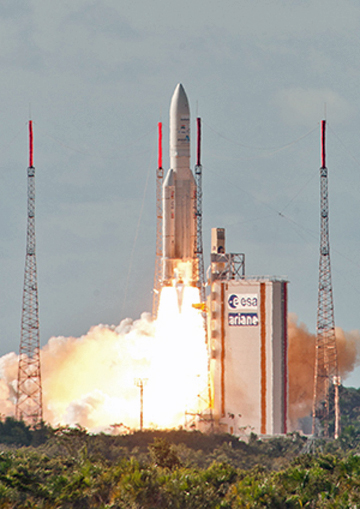
Ariane 5’s heavy-lift success with Alphasat and INSAT-3D was the launcher’s 70th flight
from French Guiana.
Photo courtesy of Arianespace.
Inmarsat is the owner and operator of Alphasat, one of the most technically advanced telecommunications satellites ever constructed for civilian applications. With a US$350 million investment from Inmarsat, Alphasat complements the company’s award-winning L-band satellite fleet, which has been powering global broadband connectivity for government and commercial customers on land, sea and in the air since 2009.
With the successful acquisition of the satellite confirmed, the Alphasat Mission Operations Team will complete partial solar array deployment overnight and commence orbit-raising on Friday night, to place the satellite into its final geostationary orbit position. This operation is scheduled to be completed on the morning of July 31st.
Rupert Pearce, CEO of Inmarsat, said, “Alphasat will strengthen our existing I-4 series satellite constellation, providing coverage over Europe, the Middle East and Africa. The launch demonstrates Inmarsat’s long-term commitment to L-band services, and marks a significant milestone in the evolution of Inmarsat’s flagship satellite fleet, bringing new capabilities both in terms of performance and resource availability.
“I would like to pay tribute to the skill and expertise of Inmarsat’s engineering teams and all our employees involved in today’s launch. It is their dedication – alongside the outstanding support we have received from our development, manufacturing and launch partners, which has helped deliver such a successful outcome.”
Designed and manufactured by Astrium, Alphasat is the largest and most sophisticated European telecommunications satellite ever built. It is part of the European Space Agency (ESA) initiative to provide a new spacecraft platform (Alphabus) capable of carrying a large state of the art communications payload. Developed by Astrium and Thales Alenia Space under a joint ESA and CNES contract, Alphabus allows the European space hardware manufacturing industry to address the top end of the telecom satellite market. It is also a showcase of Astrium’s capability in the areas of satellite mobile payloads and on-board digital signal processing, particularly in the UK.
Alphasat is an example of partnership with industry (Public-Private-Partnership) with the European Space Agency teaming up with Inmarsat to create new services and jobs. It is the largest Public-Private-Partnership space project in Europe.
Inmarsat satellites are currently relied on by the world’s shipping, oil exploration, defence, aviation and media industries, amongst others, to service their communications needs. Inmarsat is also the communications channel of choice for the media when reporting from the world’s danger zones and for NGOs, government agencies and the United Nations when coordinating rescue efforts.
The Arianespace release regarding the launch follows…
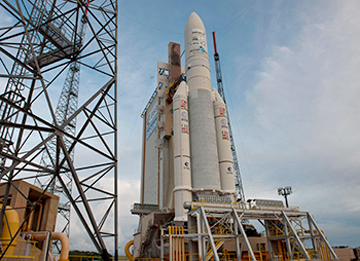
Arianespace’s workhorse Ariane 5 is shown in the ELA-3 launch zone prior to its July 25
liftoff from the Spaceport.
Photo courtesy of Arianespace.
This daylight launch provided an excellent view of the flight’s initial trajectory, as the Ariane 5 began its vertical ascent, then rotated East, arching over the Spaceport’s main base area as it progressed downrange. The flight path was visible between scattered cloud layers, and the clear meteorological conditions enabled an excellent view of the launch’s first phase—including separation of the two solid propellant boosters at an altitude of 67km.
“Once again, Ariane 5’s unmatched reliability and availability has set the highest standards in the satellite launch business. I am proud these standards have benefitted two key customers: Inmarsat and ISRO…whose two satellite programs share much in common with us,” said Arianespace Chairman and CEO Stéphane Israël. “My thanks to all teams that have made this launch a success, wherever they are: in Europe, or in French Guiana.”
Ariane 5 delivered a total lift performance of 9,760kg., which included a combined total of some 8,770kg. for the mission’s two passengers, in addition to the SYLDA dispenser system and hardware in Arianespace’s dual-payload stack. Deployed first in the flight sequence nearly 28 minutes after liftoff, Alphasat is configured with a new-generation L-band geo-mobile communications relay system that will provide voice and data transmission services across Europe, Africa and the Middle East.
Alphasat results from a public-private partnership between the European Space Agency (ESA) and operator Inmarsat, with support from the CNES French space agency. It evolved from ESA’s Advanced Research in Telecommunications Systems (ARTES) program. The UK Space Agency—in cooperation with the UK’s Regional Development Agencies for London, South-East England and East of England—backed the development of critical new payload technologies under the ARTES program. This spacecraft is the first for Europe’s new Alphabus platform, jointly developed by Astrium and Thales Alenia Space.
With a liftoff mass of 6,650kg., Alphasat was one of the heaviest passengers carried in the upper position of Ariane 5’s payload “stack.”
“Alphasat, Europe’s largest and most sophisticated telecommunications satellite ever built, is a tremendous testament to the innovation, creativity and talent of so many European agencies, governments, and those across the spectrum of the European space industry,” said Inmarsat Chief Executive Officer Rupert Pearce. “Many congratulations to the Arianespace team and thank you for managing and hosting another successful launch.”
Some five minutes after Alphasat’s deployment, Ariane 5 completed its mission with the successful separation of INSAT-3D, which will provide enhanced meteorological observation and monitoring of land/ocean surfaces. The satellite carries a six-channel imager and 19-channel sounder, as well as a data relay transponder for satellite-aided search and rescue operations.
INSAT-3D is adapted from India’s I-2K spacecraft bus and was developed by the nation’s Indian Space Research Organisation (ISRO) space agency with its ISRO Space Applications Centre.
“This is another milestone in the long standing relationship between ISRO and Arianespace,” said Dr. K. Radhakrishnan, the Chairman of ISRO, in comments by video. “We are looking forward to the excellent operational performance of INSAT-3D for the next seven years, making a difference for the weather forecasting and disaster warning systems for the country.”
India’s INSAT-3D is the 16th ISRO spacecraft the company has orbited—a partnership that dates back to the third Ariane 1 flight in 1981—while Alphasat is the eighth payload launched by Arianespace for Inmarsat.
Designated Ariane Flight VA214 in the company’s numbering system – this mission represented the 214th launch since operations began with the Ariane series of vehicles at the near-equatorial French Guiana launch site in 1979.
To date, Arianespace has lofted 18 payloads in 2013 on six missions across its entire launcher family: the heavy-lift Ariane 5, medium-lift Soyuz and lightweight Vega. This activity was composed of three Ariane 5 launches, and one mission each of Soyuz and Vega from the Spaceport. In addition, Arianespace’s Starsem affiliate conducted a Soyuz flight from Baikonur Cosmodrome.
Arianespace’s next launch is targeted for August 2th, using an Ariane 5 to orbit the Eutelsat 25B/Es’hail-1 for Es’hailSat and Eutelsat, along with GSAT-7 for the Indian Space Research Organisation.
