

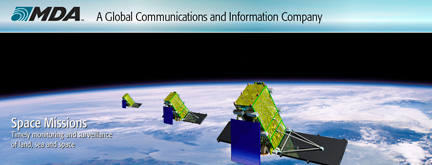
 [SatNews] MacDonald, Dettwiler and Associates (MDA) will be the silver sponsor of the 6th International Conference “Earth from Space—the Most Effective Solutions”. MDA specialists will demonstrate at the conference the results of new projects in various countries around the world using radar data, as well as discuss the development prospects of the RADARSAT Constellation Mission (RCM). As part of the system, there are plans to simultaneously use three radar satellites capable of capturing images with a resolution of 1-3m. The Canadian Space Agency has assigned the contract for the production of RCM satellites to the MDA company. It is expected that the system will be fully deployed in 2018.
RADARSAT series satellites, operated by MDA, became one of the most famous and sought-after Earth radar remote sensing satellites. In Russia, RADARSAT data are widely used to monitor environmental and shipping situations, ice situation in freezing seas, flooding progress on the Russian rivers, natural and human-induced emergencies, etc.
 Over the years of doing business with MDA, ScanEx Research & Development Center created a network of 11 certified “UniScan” ground stations in Russia and Kazakhstan for receiving and processing of RADARSAT-1 data. Data from the RADARSAT-1 was received by “UniScan” stations in direct reception mode for further processing and analysis. MDA officially announced the termination of the RADARSAT-1 satellite operation in early May this year. This spacecraft demonstrated the highest reliability and durability, having worked on orbit for more than 17 years, exceeding more than three times the expected lifespan of 5 years.
Meanwhile, RADARSAT-2 satellite continues to work on orbit, which is able to capture images at a spatial resolution of up to 1-3 meters. The first “UniScan” stations to receive data from RADARSAT-2 initiated supply of the imagery to Russian customers as of December 2010, a year after ScanEx RDC became the official distributor of RADARSAT-2 data in Russia.
Direct radar images reception to the ground stations in Russia reduced the imagery data cost as well as reduced the time required for image delivery to between 30 and 60 minutes.
 The 6th International Conference “Earth from Space – the Most Effective Solutions” will occur on October 1-3, 2013, at the Moscow Region “Vatutinki” resort hotel. Key topics of the conference are: Nature protection and access to space images and near real-time satellite-based monitoring services from civil society in Russia and abroad. Conference organizers are: ScanEx Research & Development Center, NGO Transparent World. Conference participation requests can be placed by filling in the registration form at the website: conference.scanex.ru.
Additionally, ScanEx RDC Research and Development Center has now officially become the distributor of the KOMPSAT data series in Russia and the CIS countries (Ukraine, Belarus, Moldova, Kazakhstan, Uzbekistan, Kyrgyzstan, Turkmenistan, Armenia and Azerbaijan) as of June this year, following the signing of an agreement with the Korean company Satrec Initiative Co., Ltd.
Both satellites are equipped with hardware that is acquiring images in five spectral bands: Panchromatic, blue, green, red and near-infrared. Images from the KOMPSAT-3 satellite have the pixel quantization of 14 bits / pixel, which enables to more accurately perform the classification and recognition of objects. According to experts of ScanEx RDC, high quality images of KOMPSAT-3 allow the data to be used for many tasks, including monitoring of infrastructural facilities construction, deforestation, for preparation of maps at a scale of 1:10 000, and so on.
Also important to note is the favorable price-quality ratio of KOMPSAT-3 data. Another important advantage of KOMPSAT-3 data over other very high-resolution data is that, under a license agreement, the user will have the right to display the data on the Internet (without downloading).
Thanks to this agreement with the Korean company Satrec Initiative Co., Ltd., the Russian ScanEx Center also obtains the right to distribute the data of KOMPSAT-5 satellite—the Korean first new-generation radar satellite, scheduled for launch on August 22, 2013, from the “Yasny” launch site (Orenburg Region). X-band synthetic aperture radar is installed on board KOMPSAT-5, which will provide high quality images regardless of the day time and weather conditions within the observation area. The spatial resolution of imaging will be 1m (swath width—5km), 3m (30km) and 20m (100km).
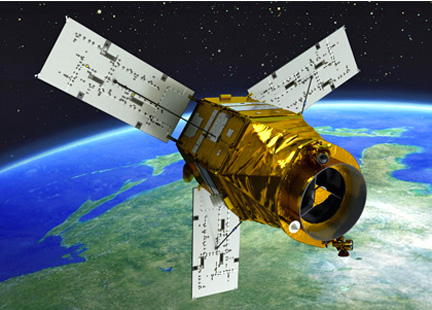
Artistic rendition of the KOMPSAT-3 satellite.
