

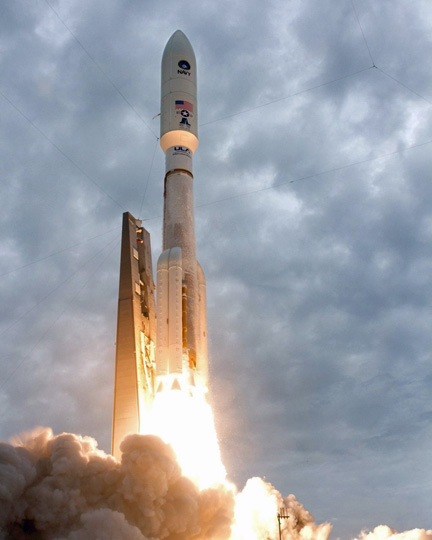
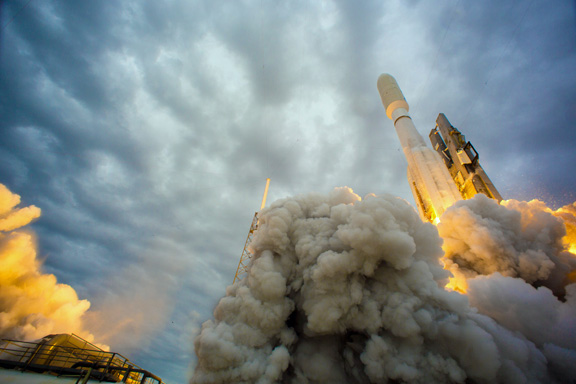
 [SatNews] The big boy was launched without a hitch…A United Launch Alliance Atlas V rocket carrying the second Mobile User Objective System (MUOS-2) satellite for the United States Navy lifted off from Space Launch Complex-41 at 9 a.m. EDT today.
This was ULA’s 6th launch of an aggressive 12 mission schedule for the year and the 72nd ULA mission since its formation in 2006.
ULA’s Statement…
“United Launch Alliance is honored to serve with our mission partners in the preparation and launch of this critical mission for the U.S. Navy and for our U.S. Air Force customer,” said Jim Sponnick, ULA vice president, Atlas and Delta Programs. “This joint government and industry team is keenly focused on mission success and enabling MUOS-2 to provide vital communications capability to the women and men protecting our freedom around the world.”
The MUOS-2 mission was launched aboard an Atlas V Evolved Expendable Launch Vehicle (EELV) 551 configuration vehicle, which includes a 5.4-meter diameter RUAG Space payload fairing along with five Aerojet Rocketdyne solid rocket motors attached to the Atlas booster. The Atlas booster for this mission was powered by the RD AMROSS RD-180 engine and the Centaur upper stage was powered by a single Aerojet Rocketdyne RL10A engine.
“At nearly 15,000 pounds, MUOS-2 is the heaviest satellite launched to date by an Atlas launch vehicle, and today’s Atlas vehicle provided 2.5 million pounds of thrust during the boost phase,” said Sponnick.
MUOS is a next-generation narrowband tactical satellite communications system designed to significantly improve beyond-line-of-sight communications for U.S. forces on the move. MUOS will provide military users 10 times more communications capacity over the existing system by leveraging 3G mobile communications technology, and will provide simultaneous voice and data capability.
Developed by the United States Air Force to assure access to space for Department of Defense and other government payloads, the EELV Program supports the full range of government mission requirements, while delivering on schedule and providing significant cost savings over the heritage launch systems.
ULA’s next launch is the Delta IV WGS-6 mission for the U.S. Air Force scheduled Aug. 7 from Space Launch Complex-37 at Cape Canaveral Air Force Station, Florida.
ULA program management, engineering, test, and mission support functions are headquartered in Denver, Colo. Manufacturing, assembly and integration operations are located at Decatur, Alabama, and Harlingen, Texas. Launch operations are located at Cape Canaveral AFS, Florida, and Vandenberg AFB, California.
End ULA’s Statement
Lockheed Martin’s Statement…
The second Mobile User Objective System (MUOS) satellite built by Lockheed Martin [NYSE: LMT] for the U.S. Navy is responding to commands after being launched today from Cape Canaveral Air Force Station, Florida. The Lockheed Martin-led initialization team is now commanding the satellite from the Naval Satellite Operations Center located at the Naval Base Ventura County, Point Mugu, California.
The MUOS constellation replaces the legacy Ultra High Frequency (UHF) Follow-On system and delivers secure, prioritized voice and data communications, a first for mobile users who need high-speed mission data on the go.
“MUOS is providing capability for mobile users that never existed before,” said Iris Bombelyn, Lockheed Martin’s vice president of Narrowband Communications. “We look forward to testing and delivering the second satellite of the MUOS constellation to our Navy customer. This on-orbit testing will prove the MUOS system capabilities and allow us to deliver the full suite of services available through the MUOS payloads, on MUOS-1 as well as MUOS-2.”
MUOS-2 launched at 9 a.m. EDT aboard a United Launch Alliance Atlas V rocket and will transition over the next nine days to reach its geosynchronous orbit location 22,000 miles above the earth. The solar arrays and antennas will then be deployed, and on-orbit testing will start for subsequent turn-over to the Navy for test and commissioning to service.
At the launch, Lockheed Martin hosted teachers from the National Science Teachers Association (NSTA) New Science Teacher Academy. The Lockheed Martin-NSTA fellows experienced how science can solve real-world challenges, helping teachers inspire and encourage student interest in science and math once they return to the classroom.
The first MUOS satellite, launched in 2012, has been providing high quality legacy voice communications for users, and terminals are already testing using the advanced payload that enables data exchanges. More than 20,000 existing terminals are compatible with and can access the MUOS legacy payload, and with the release of the new waveform developed for increased data-handling capacity, many of these terminals can be retro-fitted to access the Wideband Code Division Multiple Access (WCDMA) payload.
This advanced WCDMA payload incorporates commercial technology designed to provide 16 times the number of accesses above requirements for the legacy UHF Follow-On system. The satellites also include a hosted legacy UHF payload that will be fully compatible with the current ultra-high frequency system and legacy terminals.
The geosynchronous constellation consists of four satellites and one on-orbit spare, which are expected to achieve full operational capability in 2015, extending UHF narrowband communications availability well past 2025.
End Lockheed Martin’s Statement
