

Engineers manning Galileo’s South Pacific ground station on New Caledonia found themselves marooned by heavy rains and a flash flood—though the station carried on operating regardless. Torrential rains lashed this French-administered group of islands at the start of July. The south coast of New Caledonia’s main island of Grand Terre recorded more than 700mm (27.55 inches) of rain in 24 hours—the yearly average being roughly 1100mm.
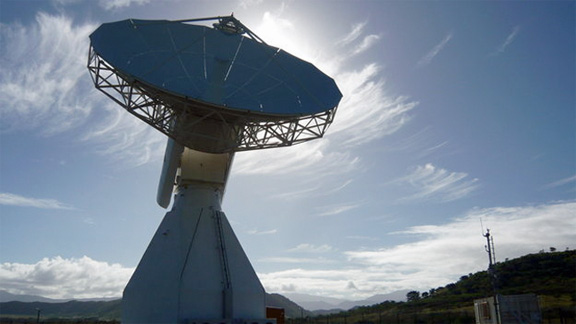
The 13m antenna at Galileo’s Nouméa ground station.
Photo courtesy of ESA.
The Galileo ground station near the capital Nouméa was caught in the deluge. Part of a growing worldwide network, it incorporates a Galileo Sensor Station that monitors the quality of navigation signals and an Uplink Station to relay navigation corrections to the satellites for rebroadcast to users.
An antenna 13 m in diameter for controlling the satellites has also been built, ready to come online later this year.
“There were three engineers on site, working on the new antenna, as the rains came,” explained Fermin Alvarez Lopez, overseeing ESA’s Galileo ground stations. “Located at a remote area of New Caledonia, Nouméa is built on a flat plain surrounded by bowl-like hills, helping to screen out unwanted radio signals. In this instance, that meant the rain funnelled down to the site area. A stream running nearby burst its banks and the access road to the site was completely washed away. The engineers had to sit tight and wait for rescue: It took 40 hours for the authorities and the hosting entity TDF to fix up the roads accessing the Galileo site to allow them to come back safely to Nouméa. TDF remained on site to ensure the station remained fully operational. The good news is that the ground station remained working throughout, thanks to high foundations and an onsite generator.”
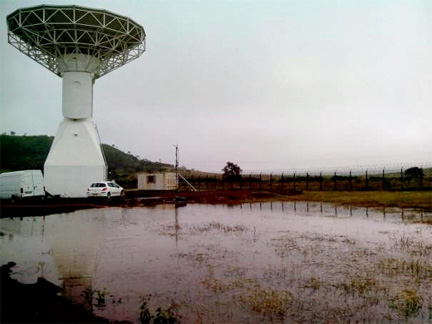
The ground station after the deluge of rain.
Photo courtesy of ESA.
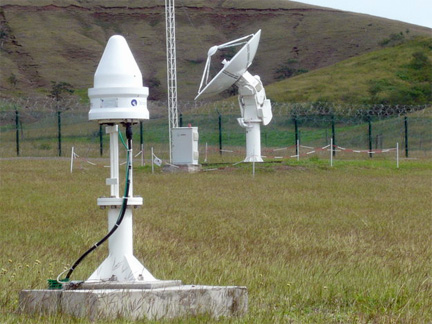
Galileo’s Nouméa ground station’s Sensor Station and Uplink Station/
Photo courtesy of ESA.
One of the most complicated developments ever undertaken by ESA, having to meet strict levels of performance, security and safety, Galileo’s ground segment is overseen from twin control centers at Fucino in Italy and Oberpfaffenhofen in Germany.
