

• Skip to primary navigation
  • Skip to main content
  • Skip to primary sidebar
  • Skip to secondary sidebar
  • Skip to footer
  • NEWS:
  • SatNews
  • SatMagazine
  • MilSatMagazine
  • SmallSat News
  • |     EVENTS:
  • SmallSat Symposium
  • Satellite Innovation
  • MilSat Symposium
  • SmallSat Europe

SatNews

Satellite Industry Intelligence Since 1983

Subscribe
  • LATEST
  • SatNews Events
  • Magazines
  • Calendar
  • Subscribe
  • Missions & Constellations
    • Exploration & Science Missions
    • In-Orbit Servicing & Orbital Operations
    • LEO Constellations
    • Mission Autonomy & Onboard Systems
    • Mission Deployments & Manifests
    • Navigation & PNT
    • SmallSat
    • Spacecraft & Payload Technology
    View All in Missions & Constellations →
    SES Space & Defense and Starlab Partner on O3b mPOWER Space-to-Space Relay ArchitectureSES Space & Defense and Starlab Partner on O3b mPOWER Space-to-Space Relay Architecture
    Artemis II Pilot Advocates Stepwise Return to Moon via Equatorial LandingsArtemis II Pilot Advocates Stepwise Return to Moon via Equatorial Landings
    Thales CEO Confirms Progression on EU’s Multi-Billion Euro IRIS² Sovereign Satellite ConstellationThales CEO Confirms Progression on EU’s Multi-Billion Euro IRIS² Sovereign Satellite Constellation
    Viasat Deploys Reflector and Boom Assembly on ViaSat-3 F3 Ahead of In-Orbit TestingViasat Deploys Reflector and Boom Assembly on ViaSat-3 F3 Ahead of In-Orbit Testing
  • Business
    • Contracts & Commercial Deals
    • Earnings & Financial Reporting
    • Events & Conferences
    • Funding & Venture Capital
    • Market Forecasts
    • Mergers & Acquisitions
    • Personnel Moves & Appointments
    View All in Business & Finance →
    STMicroelectronics Reports Q2 2026 Earnings Growth Driven by AI Data Centers and Satellite DemandSTMicroelectronics Reports Q2 2026 Earnings Growth Driven by AI Data Centers and Satellite Demand
    AT&T CEO Reaffirms Support for AST SpaceMobile, Dismisses Satellite Revenue RiskAT&T CEO Reaffirms Support for AST SpaceMobile, Dismisses Satellite Revenue Risk
    Contrivian Merges with Big Network to Build Vertically Integrated Multi-Modal Connectivity PlatformContrivian Merges with Big Network to Build Vertically Integrated Multi-Modal Connectivity Platform
    UK Government Faces £340 Million Paper Loss on Legacy OneWeb Low Earth Orbit Satellite InvestmentUK Government Faces £340 Million Paper Loss on Legacy OneWeb Low Earth Orbit Satellite Investment
  • Defense
    • Counterspace & ASAT
    • Defense Budgets & Procurement
    • ISR & Reconnaissance
    • MILSATCOM
    • Missile Warning & Defense
    • National Security Programs
    • Space Domain Awareness
    View All in Military & Defense →
    L3Harris Signs Multi-Year Framework Agreement to Quadruple THAAD Propulsion ProductionL3Harris Signs Multi-Year Framework Agreement to Quadruple THAAD Propulsion Production
    GAO Report Warns Space Force Must Improve Personnel Metrics to Support Fleet ExpansionGAO Report Warns Space Force Must Improve Personnel Metrics to Support Fleet Expansion
    NNSA Delivers Fifth Next-Generation Global Burst Detector Payload to U.S. Space Force for GPS IntegrationNNSA Delivers Fifth Next-Generation Global Burst Detector Payload to U.S. Space Force for GPS Integration
    US Space Force Triples NSSL Phase 3 Lane 1 Capacity to $17B as Total Launch Budget Reaches $30BUS Space Force Triples NSSL Phase 3 Lane 1 Capacity to $17B as Total Launch Budget Reaches $30B
  • Gov
    • Export Controls & Compliance
    • International Space Agreements
    • National Space Policy
    • Space Law & Treaties
    • Space Sustainability & Debris Policy
    • Space Traffic Management / Debris Removal
    View All in Government & Regulation →
    FCC Approves Upper C-Band Order, Allocating $5.6 Billion to SES and $504 Million to EutelsatFCC Approves Upper C-Band Order, Allocating $5.6 Billion to SES and $504 Million to Eutelsat
    GSMA Endorses Abuja Declaration to Advance Satellite Spectrum Reform and Launch ATLAS UmojaGSMA Endorses Abuja Declaration to Advance Satellite Spectrum Reform and Launch ATLAS Umoja
    UK Space Agency Unveils £62 Million Domestic Space Fund and Strategic Partnership with Space FloridaUK Space Agency Unveils £62 Million Domestic Space Fund and Strategic Partnership with Space Florida
    NewOrbit Urges Targeted UK Sovereign Allocation Toward Very Low Earth Orbit Capabilities Following £62M Government Space FundingNewOrbit Urges Targeted UK Sovereign Allocation Toward Very Low Earth Orbit Capabilities Following £62M Government Space Funding
  • Launch
    • Launch Providers
    • Launch Schedule & Calendars
    • Launch Sites & Infrastructure
    • Rocket Technology & Vehicles
    View All in Launch →
    SpaceX Targets First Starship Upper Stage Tower Catch for Flight 14SpaceX Targets First Starship Upper Stage Tower Catch for Flight 14
    L3Harris Delivers Four RS-25 Core Stage Engines to NASA for Crewed Artemis III Lunar MissionL3Harris Delivers Four RS-25 Core Stage Engines to NASA for Crewed Artemis III Lunar Mission
    Commercial Launch Providers Advance Next-Generation Heavy and Medium-Lift Vehicle Milestones Ahead of 2026 DebutsCommercial Launch Providers Advance Next-Generation Heavy and Medium-Lift Vehicle Milestones Ahead of 2026 Debuts
    SpaceX Limits Future Commercial Rideshare Bookings Past 2028 Amid Severe Manifest SaturationSpaceX Limits Future Commercial Rideshare Bookings Past 2028 Amid Severe Manifest Saturation
  • Software
    • Autonomous Ground Operations
    • Data Processing & AI/ML
    • Digital Twins & Modeling
    • Ground Segment & Teleports
    • Mission Planning & Simulation
    • Space Systems Software Engineering
    • Spectrum & Licensing
    View All in Software Automation & Ground Systems →
    Astrolight Advances End-to-End Lasercom Network to Address Orbital Bandwidth and Spectrum BottlenecksAstrolight Advances End-to-End Lasercom Network to Address Orbital Bandwidth and Spectrum Bottlenecks
    Intellian Unveils CM100 GMDSS Terminal Built for Iridium Certus 100 Safety NetworkIntellian Unveils CM100 GMDSS Terminal Built for Iridium Certus 100 Safety Network
    NASA Joins Federal Genesis Mission Initiative to Process 150 Petabytes of Space Data via AI ArchitecturesNASA Joins Federal Genesis Mission Initiative to Process 150 Petabytes of Space Data via AI Architectures
    IHI Corporation and Kuva Space Partner to Evaluate Japanese Sovereign Hyperspectral ConstellationIHI Corporation and Kuva Space Partner to Evaluate Japanese Sovereign Hyperspectral Constellation
  • Services & Apps
    • Climate & Environmental Monitoring
    • Disaster Response & Security Mapping
    • Earth Observation & Imaging
    • Maritime & Aviation Satcom
    • Satellite Communications
    View All in Services & Applications →
    Amazon Files FCC Application for 5,105-Satellite Constellation to Enable Direct-to-Device Mobile ServicesAmazon Files FCC Application for 5,105-Satellite Constellation to Enable Direct-to-Device Mobile Services
    FCC Proposes Opening Unlicensed Bluetooth and Wi-Fi Bands for Space-Based CommunicationsFCC Proposes Opening Unlicensed Bluetooth and Wi-Fi Bands for Space-Based Communications
    ALL.SPACE Hydra MAX Terminal Receives Certification for SES O3b mPOWER Multi-Orbit NetworkALL.SPACE Hydra MAX Terminal Receives Certification for SES O3b mPOWER Multi-Orbit Network
    LTN Crosses 3,000 Satellite-to-IP Migrations Following FCC Action on Upper C-Band SpectrumLTN Crosses 3,000 Satellite-to-IP Migrations Following FCC Action on Upper C-Band Spectrum

NASA… The Distant Voyages Of Voyager… (Satellite)

June 27, 2013


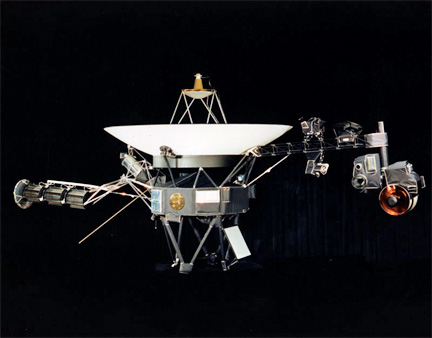
Artistic rendition of the Voyager I satellite,
courtesy of NASA/JPL.
[SatNews] Data from Voyager 1, now more than 11 billion miles from the sun, suggest the spacecraft is closer to becoming the first human-made object to reach interstellar space. Research using Voyager 1 data and published in the journal Science on Thursday provides new detail on the last region the spacecraft will cross before it leaves the heliosphere, or the bubble around our sun, and enters interstellar space. Three papers describe how Voyager 1’s entry into a region called the magnetic highway resulted in simultaneous observations of the highest rate so far of charged particles from outside heliosphere and the disappearance of charged particles from inside the heliosphere.

Scientists have seen two of the three signs of interstellar arrival they expected to see: Charged particles disappearing as they zoom out along the solar magnetic field and cosmic rays from far outside zooming in. Scientists have not yet seen the third sign, an abrupt change in the direction of the magnetic field, which would indicate the presence of the interstellar magnetic field.

“This strange, last region before interstellar space is coming into focus, thanks to Voyager 1, humankind’s most distant scout,” said Ed Stone, Voyager project scientist at the California Institute of Technology in Pasadena. “If you looked at the cosmic ray and energetic particle data in isolation, you might think Voyager had reached interstellar space, but the team feels Voyager 1 has not yet gotten there because we are still within the domain of the sun’s magnetic field.”

Scientists do not know exactly how far Voyager 1 has to go to reach interstellar space. They estimate it could take several more months, or even years, to get there. The heliosphere extends at least 8 billion miles beyond all the planets in our solar system. It is dominated by the sun’s magnetic field and an ionized wind expanding outward from the sun. Outside the heliosphere, interstellar space is filled with matter from other stars and the magnetic field present in the nearby region of the Milky Way.

Voyager 1 and its twin spacecraft, Voyager 2, were launched in 1977. They toured Jupiter, Saturn, Uranus and Neptune before embarking on their interstellar mission in 1990. They now aim to leave the heliosphere. Measuring the size of the heliosphere is part of the Voyagers’ mission.

The Science papers focus on observations made from May to September 2012 by Voyager 1’s cosmic ray, low-energy charged particle and magnetometer instruments, with some additional charged particle data obtained through April of this year.
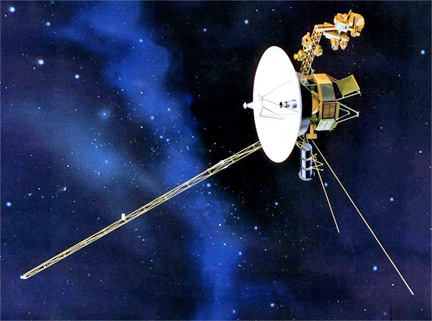

Another artistic illustration of the Voyager spacecraft,
courtesy of NASA + JPL.
Voyager 2 is about 9 billion miles from the sun and still inside the heliosphere. Voyager 1 was about 11 billion miles from the sun Aug. 25 when it reached the magnetic highway, also known as the depletion region, and a connection to interstellar space. This region allows charged particles to travel into and out of the heliosphere along a smooth magnetic field line, instead of bouncing round in all directions as if trapped on local roads. For the first time in this region, scientists could detect low-energy cosmic rays that originate from dying stars.

“We saw a dramatic and rapid disappearance of the solar-originating particles. They decreased in intensity by more than 1,000 times, as if there was a huge vacuum pump at the entrance ramp onto the magnetic highway,” said Stamatios Krimigis, the low-energy charged particle instrument’s principal investigator at the Johns Hopkins University Applied Physics Laboratory in Laurel, Maryland. “We have never witnessed such a decrease before, except when Voyager 1 exited the giant magnetosphere of Jupiter, some 34 years ago.”
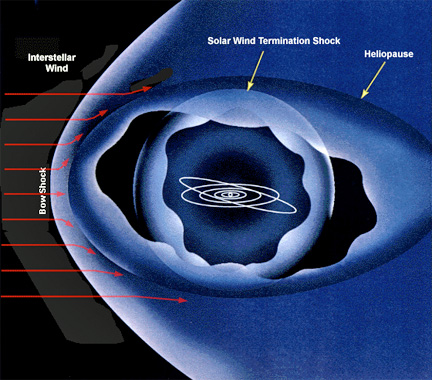

The heliosphere is the immense magnetic bubble containing our solar system, solar wind, and the entire solar magnetic field. It extends well beyond the orbit of Pluto. While the density of particles in the heliosphere is very low (it’s a much better vacuum than is created in a laboratory), it is full of particles of interest to heliospheric scientists. Check out the image below for a diagram of the heliosphere.
Image courtesy of NASA + JPL.
Other charged particle behavior observed by Voyager 1 also indicates the spacecraft still is in a region of transition to the interstellar medium. While crossing into the new region, the charged particles originating from the heliosphere that decreased most quickly were those shooting straightest along solar magnetic field lines. Particles moving perpendicular to the magnetic field did not decrease as quickly. However, cosmic rays moving along the field lines in the magnetic highway region were somewhat more populous than those moving perpendicular to the field. In interstellar space, the direction of the moving charged particles is not expected to matter.

In the span of about 24 hours, the magnetic field originating from the sun also began piling up, like cars backed up on a freeway exit ramp. But scientists were able to quantify the magnetic field barely changed direction—by no more than 2 degrees.

“A day made such a difference in this region with the magnetic field suddenly doubling and becoming extraordinarily smooth,” said Leonard Burlaga, the lead author of one of the papers, and based at NASA’s Goddard Space Flight Center in Greenbelt, Maryland. “But since there was no significant change in the magnetic field direction, we’re still observing the field lines originating at the sun.”

NASA’s Jet Propulsion Laboratory, in Pasadena, Calif., built and operates the Voyager spacecraft. California Institute of Technology in Pasadena manages JPL for NASA. The Voyager missions are a part of NASA’s Heliophysics System Observatory, sponsored by the Heliophysics Division of the Science Mission Directorate at NASA Headquarters in Washington.

Filed Under: Exploration & Science Missions

Primary Sidebar

Coverage

  • Missions & Constellations
  • Business & Finance
  • Military & Defense
  • Launch
  • Software Automation & Ground Systems
  • Government & Regulation
  • Services & Applications

Most Read Stories

  • AST SpaceMobile Finalizes Assembly of Next-Generation BlueBirds for August SpaceX Launch
  • SpaceX Controlled-Deorbit Report Discloses Decommissioning of 260 Starlink Satellites Over Six Months
  • SpaceX Files FCC Application for 100,000 Third-Generation Starlink Satellites
  • EchoStar’s Dish DBS Initiates Prepackaged Chapter 11 Restructuring to Resolve Impending Senior Note Maturities
  • BNP Paribas Outlines Steep Regulatory Obstacles in SpaceX Mobile Integration Strategy

Secondary Sidebar

Footer


Satnews is a leading provider of satellite news, events, publications, research and other satellite industry information in both commercial and military enterprises worldwide.

Stories By Category

  • Business & Finance
  • Government & Regulation
  • Launch
  • Military & Defense
  • Missions & Constellations
  • Services & Applications
  • Software Automation & Ground Systems
  • Spectrum & Licensing
  • Startups & NewSpace Business

About Us

  • Leadership & Editorial Team
  • SatNews History
  • Free Satnews Subscription
  • SatNews Events
  • Magazines

Navigation

  • Latest Stories
  • Magazines
  • Events
  • Contact
  • Cookie & Privacy Policy for Satnews

We use cookies to ensure that we give you the best experience on our website. If you continue to use this site we will assume that you are happy with it.
x
Sign up Now (For Free)
Access daily or weekly satellite news updates covering all aspects of the commercial and military satellite industry.
Invalid email address
Notify Me Regarding ( At least one ):
We value your privacy and will not sell or share your email or other information with any other company. You may also unsubscribe at anytime.

Click Here to see our full privacy policy.
Thanks for subscribing!