

 [SatNews] Sierra Nevada Corporation‘s (SNC) Space Systems Dream Chaser flight vehicle arrived at NASA‘s Dryden Flight Research Center in Edwards, California, Wednesday to begin tests of its flight and runway landing systems. The tests are part of pre-negotiated, paid-for-performance milestones with NASA’s Commercial Crew Program (CCP), which is facilitating U.S.-led companies’ development of spacecraft and rockets that can launch from American soil. The overall goal of CCP is to achieve safe, reliable and cost-effective U.S. human access to and from the International Space Station and low-Earth orbit.
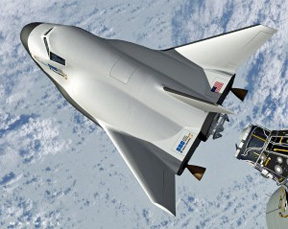
Artistic rendition of SNC’s Dream Chaser.
Meanwhile, on the east coast, several NASA astronauts will be at the agency’s Langley Research Center in Hampton, Virginia, this week to fly simulations of a Dream Chaser approach and landing to help evaluate the spacecraft’s subsonic handling. The test will measure how well the spacecraft would handle in a number of different atmospheric conditions and assess its guidance and navigation performance.
The Dream Chaser Space System is based on Langley’s Horizontal Lander HL-20 lifting body design concept. The design builds on years of analysis and wind tunnel testing by Langley engineers during the 1980s and 1990s. Langley and SNC joined forces six years ago to update the HL-20 design in the Dream Chaser orbital crew vehicle. In those years SNC has worked with to refine the spacecraft design. SNC will continue to test models in Langley wind tunnels. Langley researchers also helped develop a cockpit simulator at SNC’s facility in Louisville, Colorado, and the flight simulations being assessed at the center.
NASA is partnered with SNC, Space Exploration Technologies (SpaceX) and The Boeing Company to meet CCP milestones for integrated crew transportation systems under the Commercial Crew Integrated Capability (CCiCap) initiative. Advances made by these companies under their funded Space Act Agreements ultimately are intended to lead to the availability of commercial human spaceflight services for government and commercial companies.
While NASA works with U.S. industry partners to develop commercial spaceflight capabilities, the agency also is developing the Orion spacecraft and the Space Launch System (SLS), a crew capsule and heavy-lift rocket to provide an entirely new capability for human exploration. Designed to be flexible for launching spacecraft for crew and cargo missions, SLS and Orion will expand human presence beyond low-Earth orbit and enable new missions of exploration in the solar system.
