


• Skip to primary navigation
  • Skip to main content
  • Skip to primary sidebar
  • Skip to secondary sidebar
  • Skip to footer
  • NEWS:
  • SatNews
  • SatMagazine
  • MilSatMagazine
  • SmallSat News
  • |     EVENTS:
  • SmallSat Symposium
  • Satellite Innovation
  • MilSat Symposium
  • SmallSat Europe

SatNews

Satellite Industry Intelligence Since 1983

Subscribe
  • LATEST
  • SatNews Events
  • Magazines
  • Calendar
  • Subscribe
  • Missions & Constellations
    • Exploration & Science Missions
    • In-Orbit Servicing & Orbital Operations
    • LEO Constellations
    • Mission Autonomy & Onboard Systems
    • Mission Deployments & Manifests
    • Navigation & PNT
    • SmallSat
    • Spacecraft & Payload Technology
    View All in Missions & Constellations →
    The Silent Overhaul: How Software-Defined Routing and Cloud Ingestion Flattened the Aerospace Hardware StackThe Silent Overhaul: How Software-Defined Routing and Cloud Ingestion Flattened the Aerospace Hardware Stack
    Hybrid Earth Intelligence: NASA Expands Commercial Satellite Data Integration in $476M Cloud-Driven PushHybrid Earth Intelligence: NASA Expands Commercial Satellite Data Integration in $476M Cloud-Driven Push
    Hybrid Edge Mobility: Contrivian Launches “Horizon Plus” to Deliver Intelligent Multi-Orbit Field CommunicationsHybrid Edge Mobility: Contrivian Launches “Horizon Plus” to Deliver Intelligent Multi-Orbit Field Communications
    Space Tech vs. Biothreat: GMV Deploys Earth Observation and AI Core to Fight Invasive Pacific Seaweed in PortugalSpace Tech vs. Biothreat: GMV Deploys Earth Observation and AI Core to Fight Invasive Pacific Seaweed in Portugal
  • Business
    • Contracts & Commercial Deals
    • Earnings & Financial Reporting
    • Events & Conferences
    • Funding & Venture Capital
    • Market Forecasts
    • Mergers & Acquisitions
    • Personnel Moves & Appointments
    View All in Business & Finance →
    The Spatial Photonics Crunch: Inside the Invisible Supply Chain Threatening Orbital Laser NetworksThe Spatial Photonics Crunch: Inside the Invisible Supply Chain Threatening Orbital Laser Networks
    Sovereign Space Expansion: Spain’s FOSSA Systems Secures €9.25M to Scale Defense Constellation and SIGINT InfrastructureSovereign Space Expansion: Spain’s FOSSA Systems Secures €9.25M to Scale Defense Constellation and SIGINT Infrastructure
    Next-Gen Spatial Intelligence: BAE Systems Secures Agreement to Build High-Resolution Vantage Satellite Buses for VantorNext-Gen Spatial Intelligence: BAE Systems Secures Agreement to Build High-Resolution Vantage Satellite Buses for Vantor
    New Lobbying Force: Top NGSO Operators Unveil “SpaceConnect Association” in WashingtonNew Lobbying Force: Top NGSO Operators Unveil “SpaceConnect Association” in Washington
  • Defense
    • Counterspace & ASAT
    • Defense Budgets & Procurement
    • ISR & Reconnaissance
    • MILSATCOM
    • Missile Warning & Defense
    • National Security Programs
    • Space Domain Awareness
    View All in Military & Defense →
    Digital Twins for Space Command: Sedaro Tapped by Space Force to Build Federated Engineering PlatformDigital Twins for Space Command: Sedaro Tapped by Space Force to Build Federated Engineering Platform
    The Strategic Redistribution of Iranian Aerospace CapabilityThe Strategic Redistribution of Iranian Aerospace Capability
    Navigating Contested Battlespaces: Military GPS Receiver Market Approaches $3 Billion Amid Electronic Warfare SurgeNavigating Contested Battlespaces: Military GPS Receiver Market Approaches $3 Billion Amid Electronic Warfare Surge
    Preparing for Day One: DARPA Solicits Tech to Rebuild Destroyed Satellite Fleets Within HoursPreparing for Day One: DARPA Solicits Tech to Rebuild Destroyed Satellite Fleets Within Hours
  • Gov
    • Export Controls & Compliance
    • International Space Agreements
    • National Space Policy
    • Space Law & Treaties
    • Space Sustainability & Debris Policy
    • Space Traffic Management / Debris Removal
    View All in Government & Regulation →
    $3.57 Billion Milestone: FCC Advanced Wireless Services (AWS-3) Spectrum Auction Concludes$3.57 Billion Milestone: FCC Advanced Wireless Services (AWS-3) Spectrum Auction Concludes
    Who Has Authority to Intervene in a Space-Based Emergency?Who Has Authority to Intervene in a Space-Based Emergency?
    Staying in Their Lanes: SpaceX and Globalstar Join Forces to Defend Spectrum ExclusivityStaying in Their Lanes: SpaceX and Globalstar Join Forces to Defend Spectrum Exclusivity
    Orbital Paperwork War: China’s Spectrum Squatting Reserves 244,000 Satellite Slots to Combat SpaceX’s LEO MonopolyOrbital Paperwork War: China’s Spectrum Squatting Reserves 244,000 Satellite Slots to Combat SpaceX’s LEO Monopoly
  • Launch
    • Launch Providers
    • Launch Schedule & Calendars
    • Launch Sites & Infrastructure
    • Rocket Technology & Vehicles
    View All in Launch →
    Arianespace fights back – possibly!Arianespace fights back – possibly!
    Direct-to-Device Momentum: AST SpaceMobile Successfully Launches Giant Next-Gen BlueBird Satellites Atop SpaceX Falcon 9Direct-to-Device Momentum: AST SpaceMobile Successfully Launches Giant Next-Gen BlueBird Satellites Atop SpaceX Falcon 9
    SpaceX’s Secret ‘Starfall’ Capsule Wins FAA Approval for Pacific Reentry TestsSpaceX’s Secret ‘Starfall’ Capsule Wins FAA Approval for Pacific Reentry Tests
    Breaking the TRL Bottleneck: Space Phoenix Systems Debuts Cost-Effective Space Test-and-Return ServiceBreaking the TRL Bottleneck: Space Phoenix Systems Debuts Cost-Effective Space Test-and-Return Service
  • Software
    • Autonomous Ground Operations
    • Data Processing & AI/ML
    • Digital Twins & Modeling
    • Ground Segment & Teleports
    • Mission Planning & Simulation
    • Space Systems Software Engineering
    • Spectrum & Licensing
    View All in Software Automation & Ground Systems →
    Powering the Automated Floor: Intralogistics Operators Must Unify AGV Charging InfrastructurePowering the Automated Floor: Intralogistics Operators Must Unify AGV Charging Infrastructure
    Poland Sovereignty: GMV to Develop Core Ground Control Platform for CAMILA ConstellationPoland Sovereignty: GMV to Develop Core Ground Control Platform for CAMILA Constellation
    Software Over the Air: FatPipe Launches Acceleration Tool to Unclog Starlink and Amazon LEO LinksSoftware Over the Air: FatPipe Launches Acceleration Tool to Unclog Starlink and Amazon LEO Links
    Three LEO Operators Bet 2026 on a Supply Chain Built for 2027Three LEO Operators Bet 2026 on a Supply Chain Built for 2027
  • Services & Apps
    • Climate & Environmental Monitoring
    • Disaster Response & Security Mapping
    • Earth Observation & Imaging
    • Maritime & Aviation Satcom
    • Satellite Communications
    View All in Services & Applications →
    National SAR Defense: Norway Selects ICEYE for Nationwide Space-Based Flood and Hazard Monitoring SystemNational SAR Defense: Norway Selects ICEYE for Nationwide Space-Based Flood and Hazard Monitoring System
    Sovereign Milestone: OQ Technology Achieves Europe’s First Drone Video Transmission via 3GPP NTN LEO SatelliteSovereign Milestone: OQ Technology Achieves Europe’s First Drone Video Transmission via 3GPP NTN LEO Satellite
    Ghost Viewers trigger secondary ripple effect on Satellite Communications (SatCom)Ghost Viewers trigger secondary ripple effect on Satellite Communications (SatCom)
    Fleet-Wide Hybrid Networks: Marlink Integrates Starlink Across 80+ Oldendorff Carriers VesselsFleet-Wide Hybrid Networks: Marlink Integrates Starlink Across 80+ Oldendorff Carriers Vessels

NASA… A Sound-ing Decision To Bring More Information To Light (Launch)

February 7, 2013


Swirls of green and red appear in an aurora over Whitehorse, Yukon on the night of September 3, 2012. NASA’s VISIONS sounding rocket will study what makes the aurora, and how it affects Earth’s atmosphere.
Image Courtesy of David Cartier, Sr.
[SatNews] On a cold February night in Poker Flat, Alaska, a team of scientists will wait patiently for the…

…exotic red and green glow of an aurora to illuminate the sky. Instead of simply admiring the view, this group from NASA‘s Goddard Space Flight Center of Greenbelt, Maryland, and The Aerospace Corporation of El Segundo, California, will launch a sounding rocket up through the Northern Lights. The team has a two-week window in order to find the perfect launch conditions.

Armed with a series of instruments developed specifically for this mission, the VISIONS (VISualizing Ion Outflow via Neutral atom imaging during a Substorm) rocket will soar high through the arctic sky to study the auroral wind, which is a strong but intermittent stream of oxygen atoms from Earth’s atmosphere into outer space. Although the rocket will survive only 15 minutes before splashing down in the Arctic Ocean, the information it obtains will provide answers to some long-standing questions, said Doug Rowland, who is the VISIONS principal investigator at Goddard.

VISIONS will study how oxygen atoms leave Earth’s atmosphere under the influence of the aurora. Most of the atmosphere is bound by Earth’s gravity, but a small portion of it gets heated enough by the aurora that it can break free, flowing outwards until it reaches near-Earth space. The atoms that form this wind initially travel at about 300 miles per hour—only one percent of the speed needed to overcome gravity and leave Earth’s atmosphere.

“This oxygen would normally never gain enough energy to leave the atmosphere,” said Rowland. “On the other hand, at very high altitudes, satellite experiments have measured oxygen atoms moving faster than 50 miles per second. These experiments have shown that if oxygen can reach these high altitudes, there are plenty of ways for it to gain even more energy, in which case the oxygen atoms can escape near-Earth space entirely. What we don’t know is how the oxygen gets enough energy to fight against gravity and reach the higher altitudes where these slingshots are active.”

To find out what is doing the heavy lifting to kick start the oxygen, Rowland and his team are waiting to launch the rocket during the active phase of an aurora, which only lasts from 20 to 30 minutes. Auroras indicate a dramatic increase in the energy input to the upper atmosphere, creating a golden opportunity for the rocket to study the escaping oxygen, and learn more about what gives the oxygen the energy it needs to escape from Earth.

The VISIONS mission will highlight the advantages of using a sounding rocket instead of a satellite to gather the new information. In addition to being smaller and less expensive, sounding rockets provide vertical profiles of the auroral environment, on both the upleg and downleg portions of their parabolic trajectory, with speeds much less than those of orbiting satellites. Further, rockets can be launched from the right place at just the right time to study the aurora—unlike a satellite that can only encounter an aurora when it flies through it by chance.

To solve the mystery behind the auroral wind, the sounding rocket will use four unique instruments. The key instrument is Goddard’s MIniaturized Low-energy Energetic Neutral Atom imager, known as MILENA, which will directly observe the oxygen flowing out of the atmosphere.

In the past, scientists have only been able to study the up-flowing oxygen on a small scale—as the oxygen is electrically charged, it is confined by Earth’s magnetic field, and instruments can only measure the oxygen close to its source region. The revolutionary MILENA instrument, however, contains twin imagers that can observe the oxygen further along on its journey, after it has stolen an electron from a neutral gas atom in the atmosphere. This allows the oxygen to break free from its magnetic prison and travel a long distance, where it can be detected remotely. By mapping the oxygen, MILENA acts as a type of camera that builds up a picture of the auroral wind using oxygen atoms instead of light.
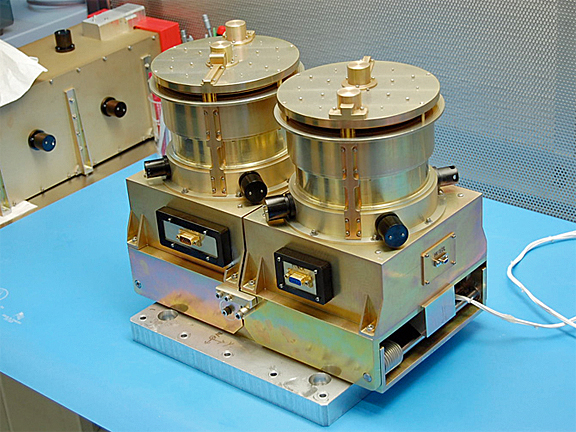

The MIniaturized Low-energy Energetic Neutral Atom imager, MILENA, was built at NASA’s Goddard Space Flight Center to fly on the VISIONS (VISualizing Ion Outflow via Neutral atom imaging during a Substorm) sounding rocket. MILENA will help track how oxygen moves through the atmosphere in response to aurora.
Photo credit: NASA

Although the MILENA instrument itself is new, it already has a successful history. The instrument was modeled after a similar imager known as MINI-ME (for Miniature Imager for Neutral Ionospheric Atoms and Magnetospheric Electrons) that flew on the NASA/U.S. Dept. of Defense FASTSAT (Fast Affordable Science and Technology Satellite) mission, which ended in November, 2012, after two years on-orbit.

The other instruments aboard VISIONS, including the Rocket-borne Auroral Imager (RAI), the Fields and Thermal Plasma (FTP) instrument, and the Energetic Electron Analyzer/Energetic Ion Analyzer (EEA/EIA), will work with MILENA to detect where the auroral activity occurs and measure the auroral energy that heats the oxygen. Goddard is providing MILENA and the FTP, while the RAI and EEA/EIA instruments are provided by The Aerospace Corporation of El Segundo, Calif.

NASA’s Wallops Flight Facility in Virginia, including the NASA Sounding Rocket Operations Contract (NSROC), is providing the rocket and payload support systems. The Poker Flat launch range is operated by the University of Alaska, Fairbanks, under contract to NASA. Although the VISIONS mission will last only 15 minutes, Michael Collier, a planetary scientist at Goddard who is the MILENA instrument lead, said the information gathered in its short trip will be crucial. “What we’re doing is launching into a specific period of intense geomagnetic activity,” Collier said. “With VISIONS, it may be the case we’re not getting a whole lot of data, but we get the data we want.” All they have to do is wait.

Story by Claire De Saravia, NASA’s Goddard Space Flight Center

Filed Under: Exploration & Science Missions

Primary Sidebar

Coverage

  • Missions & Constellations
  • Business & Finance
  • Military & Defense
  • Launch
  • Software Automation & Ground Systems
  • Government & Regulation
  • Services & Applications

Most Read Stories

  • SpaceX’s Secret ‘Starfall’ Capsule Wins FAA Approval for Pacific Reentry Tests
  • American military space closed around one company in seven days
  • Analyst Projects Massive Subscription Growth for Starlink Ahead of Imminent SpaceX IPO
  • Major opportunities for 2 GHz over Europe
  • Amazon Leo Constellation Surpasses 330 Satellites Following Latest Atlas V Launch

Secondary Sidebar

Footer


Satnews is a leading provider of satellite news, events, publications, research and other satellite industry information in both commercial and military enterprises worldwide.

Stories By Category

  • Business & Finance
  • Government & Regulation
  • Launch
  • Military & Defense
  • Missions & Constellations
  • Services & Applications
  • Software Automation & Ground Systems
  • Spectrum & Licensing
  • Startups & NewSpace Business

About Us

  • Leadership & Editorial Team
  • SatNews History
  • Free Satnews Subscription
  • SatNews Events
  • Magazines

Navigation

  • Latest Stories
  • Magazines
  • Events
  • Contact
  • Cookie & Privacy Policy for Satnews

We use cookies to ensure that we give you the best experience on our website. If you continue to use this site we will assume that you are happy with it.
x
Sign up Now (For Free)
Access daily or weekly satellite news updates covering all aspects of the commercial and military satellite industry.
Invalid email address
Notify Me Regarding ( At least one ):
We value your privacy and will not sell or share your email or other information with any other company. You may also unsubscribe at anytime.

Click Here to see our full privacy policy.
Thanks for subscribing!