

• Skip to primary navigation
  • Skip to main content
  • Skip to primary sidebar
  • Skip to secondary sidebar
  • Skip to footer
  • NEWS:
  • SatNews
  • SatMagazine
  • MilSatMagazine
  • SmallSat News
  • |     EVENTS:
  • SmallSat Symposium
  • Satellite Innovation
  • MilSat Symposium
  • SmallSat Europe

SatNews

Satellite Industry Intelligence Since 1983

Subscribe
  • LATEST
  • SatNews Events
  • Magazines
  • Calendar
  • Subscribe
  • Missions & Constellations
    • Exploration & Science Missions
    • In-Orbit Servicing & Orbital Operations
    • LEO Constellations
    • Mission Autonomy & Onboard Systems
    • Mission Deployments & Manifests
    • Navigation & PNT
    • SmallSat
    • Spacecraft & Payload Technology
    View All in Missions & Constellations →
    Resolve Optics Delivers Radiation-Resistant Star Tracker Lenses for Satellite Attitude ControlResolve Optics Delivers Radiation-Resistant Star Tracker Lenses for Satellite Attitude Control
    Novaspace Projects $3 Billion Cumulative In-Orbit Servicing Market Over the Next DecadeNovaspace Projects $3 Billion Cumulative In-Orbit Servicing Market Over the Next Decade
    VinSpace Signs SpaceX Launch Agreement to Deploy Vietnam’s First Private Satellite ConstellationVinSpace Signs SpaceX Launch Agreement to Deploy Vietnam’s First Private Satellite Constellation
    Lunar Station Corp Integrates NASA Datasets to Model Commercial Surface InfrastructureLunar Station Corp Integrates NASA Datasets to Model Commercial Surface Infrastructure
  • Business
    • Contracts & Commercial Deals
    • Earnings & Financial Reporting
    • Events & Conferences
    • Funding & Venture Capital
    • Market Forecasts
    • Mergers & Acquisitions
    • Personnel Moves & Appointments
    View All in Business & Finance →
    Norway’s Sovereign Wealth Fund Expands AST SpaceMobile Stake and Discloses $1.22 Billion SpaceX HoldingNorway’s Sovereign Wealth Fund Expands AST SpaceMobile Stake and Discloses $1.22 Billion SpaceX Holding
    Silicon Valley Space Week Speaker Focus: Joseph Yaffe, Cowboy Space CorporationSilicon Valley Space Week Speaker Focus: Joseph Yaffe, Cowboy Space Corporation
    Silicon Valley Space Week Speaker Focus: Robert Cardillo, Planet FederalSilicon Valley Space Week Speaker Focus: Robert Cardillo, Planet Federal
    Fortastra Appoints Former Space Systems Command Executive Scott Klempner as National Security Product DirectorFortastra Appoints Former Space Systems Command Executive Scott Klempner as National Security Product Director
  • Defense
    • Counterspace & ASAT
    • Defense Budgets & Procurement
    • ISR & Reconnaissance
    • MILSATCOM
    • Missile Warning & Defense
    • National Security Programs
    • Space Domain Awareness
    View All in Military & Defense →
    U.S. Space Force and Japan Complete QZSS Hosted-Payload Program with Launch of QZS-7U.S. Space Force and Japan Complete QZSS Hosted-Payload Program with Launch of QZS-7
    Impulse Space Secures $28 Million Space Force Contract Extension for VICTUS SALO MissionsImpulse Space Secures $28 Million Space Force Contract Extension for VICTUS SALO Missions
    BlackSky Awarded Multi-Year International Defense Contract Combining Gen-2 and Gen-3 Satellite IntelligenceBlackSky Awarded Multi-Year International Defense Contract Combining Gen-2 and Gen-3 Satellite Intelligence
    DamoTech Joins Space ISAC to Expand Space-Based Cyber Threat Intelligence and ResilienceDamoTech Joins Space ISAC to Expand Space-Based Cyber Threat Intelligence and Resilience
  • Gov
    • Export Controls & Compliance
    • International Space Agreements
    • National Space Policy
    • Space Law & Treaties
    • Space Sustainability & Debris Policy
    • Space Traffic Management / Debris Removal
    View All in Government & Regulation →
    DarkSky International Petitions Full FCC to Overturn Approval of Reflect Orbital’s Space-Mirror SatelliteDarkSky International Petitions Full FCC to Overturn Approval of Reflect Orbital’s Space-Mirror Satellite
    FCC Opens Proceeding to Unlock 200 MHz of Unlicensed Spectrum for Direct-to-Device Satellite LinksFCC Opens Proceeding to Unlock 200 MHz of Unlicensed Spectrum for Direct-to-Device Satellite Links
    SpaceX Regulatory Strategy at the FCC: Disruptive Expansion Meets Administrative OversightSpaceX Regulatory Strategy at the FCC: Disruptive Expansion Meets Administrative Oversight
    Greece Unveils €350 Million Hellas-Space 2.0 National Space ProgrammeGreece Unveils €350 Million Hellas-Space 2.0 National Space Programme
  • Launch
    • Launch Providers
    • Launch Schedule & Calendars
    • Launch Sites & Infrastructure
    • Rocket Technology & Vehicles
    View All in Launch →
    SpaceX Establishes 38-Minute Dual-Coast Launch Record as Industry Evaluates High-Cadence BenchmarksSpaceX Establishes 38-Minute Dual-Coast Launch Record as Industry Evaluates High-Cadence Benchmarks
    Arianespace Pauses ICARUS Carbon-Composite Upper Stage Upgrade to Focus on Ariane 6 Production RampArianespace Pauses ICARUS Carbon-Composite Upper Stage Upgrade to Focus on Ariane 6 Production Ramp
    Long March 7A Rocket Explodes During ChinaSat 4B Launch from WenchangLong March 7A Rocket Explodes During ChinaSat 4B Launch from Wenchang
    Projected Starship Cost Collapse Redefines Low Earth Orbit Infrastructure EconomicsProjected Starship Cost Collapse Redefines Low Earth Orbit Infrastructure Economics
  • Software
    • Autonomous Ground Operations
    • Data Processing & AI/ML
    • Digital Twins & Modeling
    • Ground Segment & Teleports
    • Mission Planning & Simulation
    • Space Systems Software Engineering
    • Spectrum & Licensing
    View All in Software Automation & Ground Systems →
    Astrolight Advances End-to-End Lasercom Network to Address Orbital Bandwidth and Spectrum BottlenecksAstrolight Advances End-to-End Lasercom Network to Address Orbital Bandwidth and Spectrum Bottlenecks
    Intellian Unveils CM100 GMDSS Terminal Built for Iridium Certus 100 Safety NetworkIntellian Unveils CM100 GMDSS Terminal Built for Iridium Certus 100 Safety Network
    NASA Joins Federal Genesis Mission Initiative to Process 150 Petabytes of Space Data via AI ArchitecturesNASA Joins Federal Genesis Mission Initiative to Process 150 Petabytes of Space Data via AI Architectures
    IHI Corporation and Kuva Space Partner to Evaluate Japanese Sovereign Hyperspectral ConstellationIHI Corporation and Kuva Space Partner to Evaluate Japanese Sovereign Hyperspectral Constellation
  • Services & Apps
    • Climate & Environmental Monitoring
    • Disaster Response & Security Mapping
    • Earth Observation & Imaging
    • Maritime & Aviation Satcom
    • Satellite Communications
    View All in Services & Applications →
    Planet Labs Secures Seven-Figure Agricultural Data Contract with Scottish GovernmentPlanet Labs Secures Seven-Figure Agricultural Data Contract with Scottish Government
    Nilesat Secures Tier 4 WTA Certification for Cairo Teleport InfrastructureNilesat Secures Tier 4 WTA Certification for Cairo Teleport Infrastructure
    Resecurity Joins Space ISAC to Expand Cyber Threat Intelligence Across Space AssetsResecurity Joins Space ISAC to Expand Cyber Threat Intelligence Across Space Assets
    Telespazio Deploys S/X-Band Antenna in the Azores to Expand Global Ground Station NetworkTelespazio Deploys S/X-Band Antenna in the Azores to Expand Global Ground Station Network

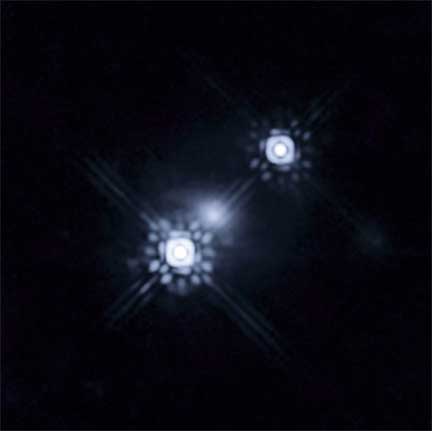
NASA/ESA Hubble Observes Slipped Disc Into Black Hole

November 4, 2011


Image credit: NASA, ESA, J.A. Muñoz (University of Valencia)
[SatNews] And you think you’ve had a bad day — how about being sucked into a black hole?

A team of scientists has used the NASA/ESA Hubble Space Telescope to observe a quasar accretion disc — a brightly glowing disc of matter that is slowly being sucked into its galaxy’s central black hole. Their study makes use of a novel technique that uses gravitational lensing to give an immense boost to the power of the telescope. The incredible precision of the method has allowed astronomers to directly measure the disc’s size and plot the temperature across different parts of the disc.

An international team of astronomers has used a new technique to study the bright disc of matter surrounding a faraway black hole. Using the NASA/ESA Hubble Space Telescope, combined with the gravitational lensing effect of stars in a distant galaxy [1], the team measured the disc’s size and studied the colors (and hence the temperatures) of different parts of the disc. These observations show a level of precision equivalent to spotting individual grains of sand on the surface of the Moon.

While black holes themselves are invisible, the forces they unleash cause some of the brightest phenomena in the Universe. Quasars — short for quasi-stellar objects — are glowing discs of matter that orbit supermassive black holes, heating up and emitting extremely bright radiation as they do so.

“A quasar accretion disc has a typical size of a few light-days, or around 100 billion kilometres across, but they lie billions of light-years away. This means their apparent size when viewed from Earth is so small that we will probably never have a telescope powerful enough to see their structure directly,” explains Jose Muñoz, the lead scientist in this study.

Until now, the minute apparent size of quasars has meant that most of our knowledge of their inner structure has been based on theoretical extrapolations, rather than direct observations.

The team therefore used an innovative method to study the quasar: Using the stars in an intervening galaxy as a scanning microscope to probe features in the quasar’s disc that would otherwise be far too small to see. As these stars move across the light from the quasar, gravitational effects amplify the light from different parts of the quasar, giving detailed color information for a line that crosses through the accretion disc.

The team observed a group of distant quasars that are gravitationally lensed by the chance alignment of other galaxies in the foreground, producing several images of the quasar.
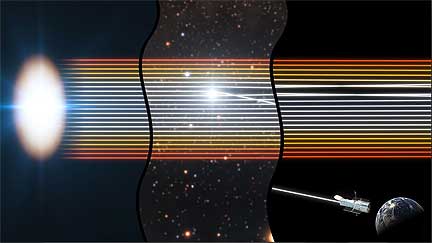

Using gravitational lensing to observe the disc around a black hole
They spotted subtle differences in color between the images, and changes in color over the time the observations were carried out. Part of these color differences are caused by the properties of dust in the intervening galaxies: The light coming from each one of the lensed images has followed a different path through the galaxy, so that the various colors encapsulate information about the material within the galaxy. Measuring the way and extent to which the dust within the galaxies blocks light (known to astronomers as the extinction law) at such distances is itself an important result in the study.

For one of the quasars they studied, though, there were clear signs that stars in the intervening galaxy were passing through the path of the light from the quasar [2]. Just as the gravitational effect due to the whole intervening galaxy can bend and amplify the quasar’s light, so can that of the stars within the intervening galaxy subtly bend and amplify the light from different parts of the accretion disc as they pass through the path of the quasar’s light.

By recording the variation in color, the team were able to reconstruct the color profile across the accretion disc. This is important because the temperature of an accretion disc increases the closer it is to the black hole, and the colors emitted by the hot matter get bluer the hotter they are. This allowed the team to measure the diameter of the disc of hot matter, and plot how hot it is at different distances from the centre.

They found that the disc is between four and eleven light-days across (approximately 100 to 300 billion kilometres). While this measurement shows large uncertainties, it is still a remarkably accurate measurement for a small object at such a great distance, and the method holds great potential for increased accuracy in the future. “This result is very relevant because it implies we are now able to obtain observational data on the structure of these systems, rather than relying on theory alone,” says Muñoz. “Quasars’ physical properties are not yet well understood. This new ability to obtain observational measurements is therefore opening a new window to help understand the nature of these objects.”

Notes
The Hubble Space Telescope is a project of international cooperation between ESA and NASA. The study, entitled “A study of gravitational lens chromaticity with the Hubble Space Telescope”, will appear in the December 1 issue of the Astrophysical Journal. The international team of astronomers consists of: J. A. Muñoz (University of Valencia, Spain), E. Mediavilla (Instituto de Astrofísica de Canarias, Spain), C. S. Kochanek (Ohio State University, USA), E. E. Falco (Harvard-Smithsonian Center for Astrophysics, USA) and A. M. Mosquera (University of Valencia and Ohio State University).

[1] Gravity bends the structure of spacetime, and hence deflects beams of light. When the alignment is right, with one object directly behind another, the foreground object’s gravity ‘bends’ the light like a lens, a process called gravitational lensing. Gravitational lenses typically produce multiple, distorted images of the distant object.

The most dramatic effects from gravitational lensing are the amplification and distortion of light from distant galaxies as it passes through massive galaxy clusters. This effect also takes place on smaller scales, with galaxies at an intermediate distance lensing the light of distant quasars, producing multiple images of them that are visible through the lens galaxy.

Individual stars can also lens light, although this effect, called gravitational microlensing, is much more subtle and can only be detected by measuring how the lensing effect increases the source’s brightness. This study makes use of gravitational microlensing by stars in a foreground galaxy to study the accretion disc of a quasar in the background. It also uses the interplay of quasar light and gravitational lensing to probe the gas and dust content of intermediate galaxies.

[2] The lens galaxy in which this phenomenon was observed is called [WKK93] G; the lensed quasar is called HE 1104-1805.

Filed Under: Exploration & Science Missions

Primary Sidebar

Coverage

  • Missions & Constellations
  • Business & Finance
  • Military & Defense
  • Launch
  • Software Automation & Ground Systems
  • Government & Regulation
  • Services & Applications

Most Read Stories

  • SpaceX Targets First Starship Upper Stage Tower Catch for Flight 14
  • SpaceX Limits Future Commercial Rideshare Bookings Past 2028 Amid Severe Manifest Saturation
  • EchoStar Faces Mounting Financial Pressure on Hughes Satellite Unit Amid Corporate Reorganization
  • NASA and ISISPACE Deploy GRITSS CubeSat to Advance Orbital Reference Frame Precision
  • FCC Proposes Opening Unlicensed Bluetooth and Wi-Fi Bands for Space-Based Communications

Secondary Sidebar

Footer


Satnews is a leading provider of satellite news, events, publications, research and other satellite industry information in both commercial and military enterprises worldwide.

Stories By Category

  • Business & Finance
  • Government & Regulation
  • Launch
  • Military & Defense
  • Missions & Constellations
  • Services & Applications
  • Software Automation & Ground Systems
  • Spectrum & Licensing
  • Startups & NewSpace Business

About Us

  • Leadership & Editorial Team
  • SatNews History
  • Free Satnews Subscription
  • SatNews Events
  • Magazines

Navigation

  • Latest Stories
  • Magazines
  • Events
  • Contact
  • Cookie & Privacy Policy for Satnews

We use cookies to ensure that we give you the best experience on our website. If you continue to use this site we will assume that you are happy with it.
x
Sign up Now (For Free)
Access daily or weekly satellite news updates covering all aspects of the commercial and military satellite industry.
Invalid email address
Notify Me Regarding ( At least one ):
We value your privacy and will not sell or share your email or other information with any other company. You may also unsubscribe at anytime.

Click Here to see our full privacy policy.
Thanks for subscribing!