

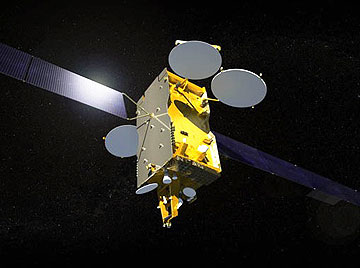
Artistic rendition of the Express AM4 satellite, courtesy of Astrium
The Express AM4 satellite, designed and manufactured by Astrium teaming with Khrunichev for RSCC, has left Astrium’s facility in Toulouse, where it had undergone its final integration and test campaign. Express AM4 will now be transported by a Russian Antonov aircraft to Baikonur, Kazakhstan, in preparation for its launch by a Khrunichev Proton Breeze M vehicle in August 2011. Express AM4, to be positioned at 80 degrees East, is the largest Express satellite ever ordered by national Russian operator RSCC. This telecommunications satellite is built in the frame of a partnership between the European spacecraft manufacturer Astrium and the Russian company Khrunichev Space Center.
RSCC is focused primarily on the development of satellite communications for fixed and broadcast services in the Russian Federation to secure the common information network across the country. RSCC currently operates 11 satellites from 14 degrees West to 140 degrees East in geostationary orbit, and is currently looking for high power satellites to complement its existing fleet and fulfil growing needs for satellite capacity. Express AM4 is the first and major milestone in this ambitious program. Express AM4 is based on the highly successful Astrium’s Eurostar E3000 satellite design. The satellite will be delivered in orbit by Khrunichev Space Center using the Proton launch vehicle. Launch and Early Orbit Phase operations will be conducted from the Astrium spacecraft control centre in Toulouse. Express AM4 has a 63 active transponders communications payload operating in -L, C-, Ku- and Ka-bands for its planned 15-year service life in orbit. Its 12 antennas will provide high performance coverage over the Russian Federation and the CIS countries and its steerable antennas can be used to provide communication to any point within the satellite’s visibility. With an electrical power of more than 16 kW, Express AM4 is the most powerful satellite ever built in Europe. Express AM4 will become the 50th Eurostar satellite to reach geostationary orbit, with Astrium’s Eurostar series having accumulated more than 400 years of successful in-orbit operations.
