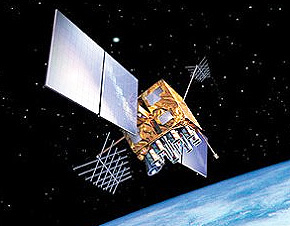
[SatNews] The seventh Global Positioning System Block IIR (GPS IIR-7/SVN-54) satellite, designed and built by Lockheed Martin [NYSE: LMT], has reached 10 years of successful on-orbit operations, and continues to deliver critical position, navigation and timing (PNT) signals to nearly one billion GPS users worldwide.
The satellite, launched on January 30, 2001, and declared operational on February 15, 2001, is one of 31 GPS spacecraft currently on-orbit providing vital situational awareness and precision weapon guidance for the military, and supporting a wide range of civil, scientific and commercial functions. The GPS constellation is increasing productivity in areas as diverse as farming, mining, construction, surveying, package delivery and supply chain management, while also enhancing public safety by reducing response times for emergency services. U.S. Air Force Space Command‘s 2nd Space Operations Squadron, based at Schriever Air Force Base, Colo., manages and operates the GPS constellation for both civil and military users.
As the prime contractor for the GPS IIR program, Lockheed Martin Space Systems Company designed and built 21 IIR spacecraft for the Global Positioning Systems Directorate of the U.S. Air Force Space and Missile Systems Center. The final eight spacecraft, designated Block IIR-M, were modernized to enhance operations and navigation signal performance. The current fleet of Block IIR and IIR-M satellites within the overall GPS constellation has reached over 120 cumulative operational years on-orbit with a reliability record of better than 99.9 percent. To meet the increasing user demands for GPS services, a Lockheed Martin-led team is building the U.S. Air Force’s next generation GPS spacecraft, known as GPS III. Following a successful and ahead of schedule critical design review in August 2010, the GPS III team is now progressing steadily in the manufacturing phase of the program – and has completed more than half of its 59 Manufacturing Readiness Reviews (MRR).
- Skip to primary navigation
- Skip to main content
- Skip to primary sidebar
- Skip to secondary sidebar
- Skip to footer


Satellite Industry Intelligence Since 1983
Footer

Satnews is a leading provider of satellite news, events, publications, research and other satellite industry information in both commercial and military enterprises worldwide.