

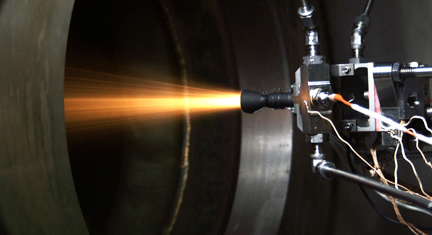
During tests of the five-pound thruster, the Divert Attitude Control System thruster fired under vacuum conditions to simulate operation in a space environment. The tests mimicked the lander mission profile and operation scenarios. Image Credit: NASA/MSFC
The test program accomplished its objectives, including evaluation of combustion stability, engine efficiency, and the ability of the thruster to perform the mission profile and a long-duration, steady-state burn at full power. The test results will allow the Robotic Lander Project to move forward with robotic lander designs using advanced propulsion technology. The test articles are part of the Divert Attitude Control System, or DACS, developed by the U.S. Missile Defense Agency of the Department of Defense. The control system provides two kinds of propulsion: one for control and the other for maneuvering. The Attitude Control System thrusters provide roll, pitch, and yaw control. These small thruster types were chosen to meet the golf-cart-size lander’s requirement for light-weight, compact propulsion components to aid in reducing overall spacecraft mass and mission cost by leveraging an existing government resource.
