

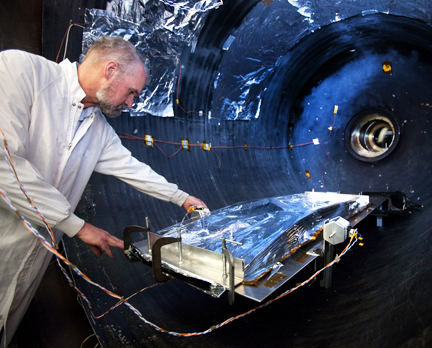
 Northrop Grumman Corporation (NYSE:NOC) is leading Webb‘s design and development effort for the space agency’s Goddard Space Flight Center. Tests were conducted the last week of August in vacuum chambers at Northrop Grumman Aerospace Systems’ Redondo Beach facility. Using flight-like sunshield membranes, the tests are designed to mimic the rapid change in air pressure the folded sunshield will experience the first minutes of launch. Several different folding configurations each underwent a series of 90-second depressurization tests and proved that the stowed sunshield will retain its shape during launch and allow trapped air to escape safely, both critical to sunshield deployment and performance.
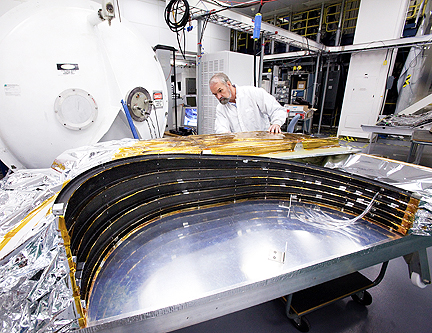 Three critical full-scale sections of the sunshield were tested: the section on top of the spacecraft around the tower that supports the telescope; the vertical pallet structure that contains the folded sunshield membranes, and the intervening four-bar linkage area that is folded in an inverted V-shape. The flow paths are complex and the sunshield material, a tough plastic film, Kapton® E, is only one- to two-thousandths of an inch thick and covers a surface area the size of a tennis court. Another series of complementary tests slated for October will inject air into the stowed sunshield test article and provide more detailed data used in evaluating analytical models. The Webb Telescope’s sunshield is a five-layer structure the size of a tennis court. Each of the five membrane layers is about as thick as a human hair (one to two-thousands of an inch thick). The layers are separated from each other and held in place by spreader bars and deployable booms. The sunshield will absorb and deflect solar light to keep the telescope operating at cryogenic temperatures so infrared sensors can see into the most distant galaxies.
