


The pilot program, named UKube 1, will use a spacecraft platform that is currently under development by the company Clyde Space Ltd and will involve a competition among companies and academic groups to derive the most innovative ideas for payloads. The winning payloads will be launched on the satellite in mid 2011. Companies and academics who are interested in designing a payload can contact the UK Space Agency for more information. The small size, low complexity and largely off-the-shelf nature of Cubesats make them inexpensive and allow them to be launched on a rapid timescale, enabling a high number of launches, more science and more terrestrial applications.
The Minister for Universities and Science, David Willetts, said, “Britain’s first CubeSat will bring major benefits to the UK space industry. Firms will now have a cheap and quick way to test their latest prototypes. Running a competition to see which experiments will go up with UKube1 is an inventive way to ensure it is fitted with the most creative and innovative payload ideas.”
Dr. David Williams, Chief executive (Acting) of the UK Space Agency, added, “A CubeSat programme will allow us to fast-track and test some of the UK’s new and cutting-edge space technology and perform unique science at a relatively low cost. These satellites may be smaller than your home computer, but, with the payloads that our skilled scientists will add to them, they are sure to make up in innovation what they lack in size.”
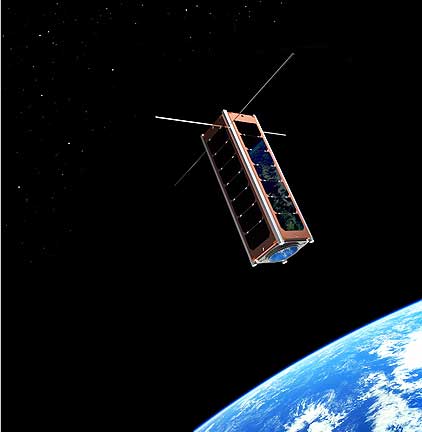
Artist’s impression of 3u CubeSat in space Credit: Clyde Space
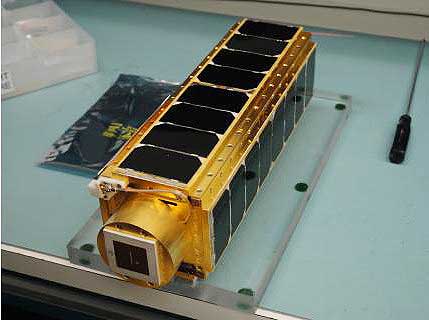
NASA’s Pharmasat Credit: NASA
