

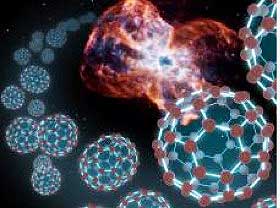
Astronomers using NASA’s Spitzer Space Telescope have discovered carbon molecules, known as “buckyballs,” in space for the first time. Image courtesy of NASA.
They are named for their resemblance to architect Buckminster Fuller‘s geodesic domes, which have interlocking circles on the surface of a partial sphere. Buckyballs were thought to float around in space, but had escaped detection until now. Buckyballs are composed of 60 carbon atoms arranged in three-dimensional, spherical structures. Their alternating patterns of hexagons and pentagons match a typical black-and-white soccer ball. The research team also found the more elongated relative of buckyballs, known as C70, for the first time in space. These molecules consist of 70 carbon atoms and are shaped more like an oval rugby ball. Both types of molecules belong to a class known officially as buckminsterfullerenes, or fullerenes. In 1970, Japanese professor Eiji Osawa predicted the existence of buckyballs, but they were not observed until lab experiments in 1985. Researchers simulated conditions in the atmospheres of aging, carbon-rich giant stars, in which chains of carbon had been detected. Surprisingly, these experiments resulted in the formation of large quantities of buckminsterfullerenes. The molecules have since been found on Earth in candle soot, layers of rock and meteorites. The study of fullerenes and their relatives has grown into a busy field of research because of the molecules’ unique strength and exceptional chemical and physical properties. Among the potential applications are armor, drug delivery and superconducting technologies.
