

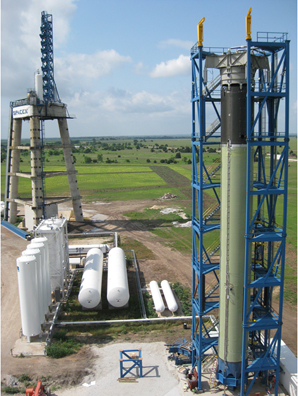
 A Falcon 9 first stage (green) and interstage (black) during structural qualification testing at SpaceX’s Texas Test Site.
The regime consisted of the first stage tank and interstage hardware subjected to a proof test of 1.1 times the maximum expected operating pressure (MEOP), and a burst pressure proof test of 1.4 MEOP; qualifying both articles with a 1.4 factor of safety. The 1.4 factor of safety designation means that the first stage tank and the interstage can withstand 140 percent the maximum internal pressure expected during flight, and qualifies both pieces of hardware to meet human rating safety requirements, as defined by NASA.
The first stage also passed this human rating milestone when subjected to structural bending tests.The testing regimen included over 150 pressurization cycles, exceeding the number of required life cycles by more than 100. In addition, the first stage and interstage were subjected to stiffness tests, maximum dynamic pressure loading and main engine cutoff conditions; all at expected values, as well as ultimate loads.
“Falcon 9 continues to pass qualification testing in preparation for its first flight, scheduled for 2009,” said Elon Musk, CEO and CTO of SpaceX. “All hardware was designed to be man-rated, and these tests confirm that SpaceX is one step closer to flying humans on the Falcon 9/Dragon system.” Falcon 9’s first stage and interstage also passed ground wind qualification tests, critical for when the vehicle is vertical on the launch pad at Cape Canaveral Air Force Station in Florida. Both components were designed, built and tested by SpaceX.
