

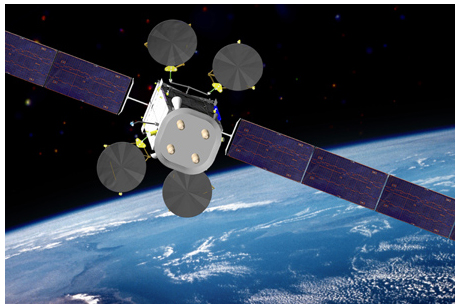
 The 702B, an evolution of the Boeing 702 satellite, offers satellite operators a spacecraft that operates in the medium-level power ranges, with six to 12 kilowatts of onboard power and a more flexible, modular design that maintains the spacecraft’s advanced technologies. Under the contract, the four Boeing-built geostationary satellites, Intelsat 21, Intelsat 22, and two spacecraft yet to be named, will offer C- and Ku-band capacity optimized to distribute video, network and voice services from Asia and Africa to the Americas and Europe. In April, Intelsat announced its IS 22 satellite will include an Ultra-High Frequency government-hosted payload that will serve the Australian Defence Force. This is the 37th satellite ordered by Intelsat from Boeing, and this new contract is the extension of a long term relationship.
“We’ve been developing this variant of our Boeing 702 satellite for more than four years, incorporating low-risk, proven technologies that differentiate the Boeing 702B from our competitors’ spacecraft, while providing the flexibility needed to accommodate a large variety of commercial and government satellite requirements,” said Craig Cooning, vice president and general manager of Boeing Space and Intelligence Systems. “We’re extremely proud of the increased value this design can offer our customers. Using our Lean manufacturing processes, this new addition to the Boeing 702 family is also easier to manufacture and assemble, resulting in a high-quality, affordable product.”
Intelsat has stringent specifications for satellite procurements. When choosing manufacturers, we examine spacecraft reliability, the use of flight-proven technologies and ability to deliver on time under our proven system test requirements,” said Ken Lee, Intelsat senior vice president, Space Systems. “During our nearly five decades of space heritage, Boeing has delivered 33 satellites to Intelsat. We are pleased to continue our relationship with the addition of these four spacecraft.”
During the conference call with Boeing and Intelsat, additional information gleaned from the various conversations revealed the 702B is very price competitive, and that the $1B price tag quoted in the Los Angeles Times this morning is NOT correct — Intelsat would not specify the price point, nor would Boeing. The 702B price is also highly dependent upon the number of transponders ordered, so there is no fixed Bus price. Boeing has been working on this project for approximately four years and the good news is that the Company’s El Segundo plant will certainly stabilize the employment factor in that area with this new product line. The 702B certainly seems to offer much needed capacity for U.S. and international government use and is also highly attractive to the commercial FSS and BSS marketplace.
