

 Surrey Satellite Technology Ltd (SSTL) is preparing two satellites for
launch on July 25th. The Earth observation missions, UK-DMC2 and
Deimos-1, will be launched onboard a Dnepr rocket from the Baikonur Cosmodrome on Saturday, July 25th, 2009 at 18:46 UTC, 19:46 BST.
Surrey Satellite Technology Ltd (SSTL) is preparing two satellites for
launch on July 25th. The Earth observation missions, UK-DMC2 and
Deimos-1, will be launched onboard a Dnepr rocket from the Baikonur Cosmodrome on Saturday, July 25th, 2009 at 18:46 UTC, 19:46 BST.
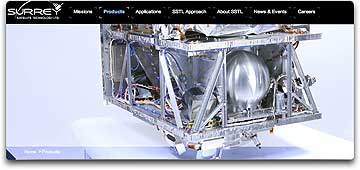
The spacecraft, which are both based on the 100kg class SSTL-100 micro satellite platform, will join the international Disaster Monitoring Constellation (DMC), expanding the constellation to six operational satellites. The new satellites will enhance DMC satellite daily imaging capacity for applications such as deforestation mapping, urban planning, natural resource management, security, agriculture and disaster relief operations.
 Disaster relief
DMC satellites can image large areas in a short period of time to help guide relief agencies to problem areas. Satellites revisit an area every day to detect changes in land cover making them ideal for assessing the impact of events such as floods and fires.
Disaster relief
DMC satellites can image large areas in a short period of time to help guide relief agencies to problem areas. Satellites revisit an area every day to detect changes in land cover making them ideal for assessing the impact of events such as floods and fires.
“The DMC brings unique and important benefits to the individual partners in the constellation through daily revisit, enabling a broad range of Earth observation applications”, said Dr. Matt Perkins, SSTL’s CEO. “The new technology applied to UK-DMC2 and funded by SSTL highlights the importance of the DMC, and its growth and continuity, to SSTL.”
SSTL’s Executive Chairman, Sir Martin Sweeting, added: “The DMC has pioneered a new international partnership approach to Earth observation, providing unique data with high temporal resolution: the success of the first DMC is now leading to the next generation of more advanced satellites in the constellation.”
Deimos-1, which is owned by Spanish company Deimos Space, and SSTL’s own UK-DMC2 satellite, will use the latest SSTL technologies that have been developed by adapting and improving space-proven technologies from the Company’s previous 21 Earth observation missions. As well as being the debut for its new 22-meter multispectral wide-swath imaging subsystem, SSTL’s UK-DMC2 satellite will play an important role as a test bed for new technologies for use in future missions.
UK-DMC2 offers enhancements over its predecessor, UK-DMC, which was launched in 2003 and continues to contribute valuable imagery beyond its 5-year design life. The new satellite will provide data continuity for the many organizations worldwide that make use of DMC data.
SSTL’s launch services team is currently at the Baikonur Cosmodrome, where a second week of pre-launch checkout tests is progressing well. The six-man team has been joined by two engineers from Deimos Space as they prepare for the Spanish company’s first satellite launch.
SSTL has a proven track record in launch management, interface and integration activities, which began with the launch of UoSAT-1 onboard a Thor Delta rocket in 1981. SSTL have been responsible for the successful launch services of 34 small satellites on nine different launch vehicles from Kourou, Plesetsk, Baikonur, Vandenburg and Kodiak Island, including the first commercial launch onboard Dnepr (UoSAT-12) in 1999.
