

• Skip to primary navigation
  • Skip to main content
  • Skip to primary sidebar
  • Skip to secondary sidebar
  • Skip to footer
  • NEWS:
  • SatNews
  • SatMagazine
  • MilSatMagazine
  • SmallSat News
  • |     EVENTS:
  • SmallSat Symposium
  • Satellite Innovation
  • MilSat Symposium
  • SmallSat Europe

SatNews

Satellite Industry Intelligence Since 1983

Subscribe
  • LATEST
  • SatNews Events
  • Magazines
  • Calendar
  • Subscribe
  • Missions & Constellations
    • Exploration & Science Missions
    • In-Orbit Servicing & Orbital Operations
    • LEO Constellations
    • Mission Autonomy & Onboard Systems
    • Mission Deployments & Manifests
    • Navigation & PNT
    • SmallSat
    • Spacecraft & Payload Technology
    View All in Missions & Constellations →
    SmallSat Europe Speaker Focus: Moritz Novak, GATE SpaceSmallSat Europe Speaker Focus: Moritz Novak, GATE Space
    Exotrail Confirms Successful Deployment of NASA-Funded AEPEX CubeSat via Spacevan 002Exotrail Confirms Successful Deployment of NASA-Funded AEPEX CubeSat via Spacevan 002
    Global Space Economy Reaches 429 Billion Dollars as Commercial Satellite Sector DominatesGlobal Space Economy Reaches 429 Billion Dollars as Commercial Satellite Sector Dominates
    SmallSat Europe Speaker Focus: Dr. Oguz Karasu, Oxford Saïd Business SchoolSmallSat Europe Speaker Focus: Dr. Oguz Karasu, Oxford Saïd Business School
  • Business
    • Contracts & Commercial Deals
    • Earnings & Financial Reporting
    • Events & Conferences
    • Funding & Venture Capital
    • Market Forecasts
    • Mergers & Acquisitions
    • Personnel Moves & Appointments
    View All in Business & Finance →
    Intuitive Machines to Acquire Goonhilly Earth Station and COMSAT to Scale Deep Space NetworkIntuitive Machines to Acquire Goonhilly Earth Station and COMSAT to Scale Deep Space Network
    Energy Efficient E-Paper Displays Redefine Professional Digital SignageEnergy Efficient E-Paper Displays Redefine Professional Digital Signage
    Gilat Wins Big Military Contracts, Expands India FootprintGilat Wins Big Military Contracts, Expands India Footprint
    Gen Z Influence on AI-Driven Audio MarketGen Z Influence on AI-Driven Audio Market
  • Defense
    • Counterspace & ASAT
    • Defense Budgets & Procurement
    • ISR & Reconnaissance
    • MILSATCOM
    • Missile Warning & Defense
    • National Security Programs
    • Space Domain Awareness
    View All in Military & Defense →
    iDirect Government Launches 450 Rackmount Software-Defined Modem for Multi-Orbit DefenseiDirect Government Launches 450 Rackmount Software-Defined Modem for Multi-Orbit Defense
    US Air Force Taps L3Harris to Bolster ABMS Digital InfrastructureUS Air Force Taps L3Harris to Bolster ABMS Digital Infrastructure
    U.S. and Australia Expand Space Surveillance Network to Counter Emerging ASAT ThreatsU.S. and Australia Expand Space Surveillance Network to Counter Emerging ASAT Threats
    U.S. Space Force Awards $3.2 Billion for Space-Based Interceptor LayerU.S. Space Force Awards $3.2 Billion for Space-Based Interceptor Layer
  • Gov
    • Export Controls & Compliance
    • International Space Agreements
    • National Space Policy
    • Space Law & Treaties
    • Space Sustainability & Debris Policy
    • Space Traffic Management / Debris Removal
    View All in Government & Regulation →
    SES Extends IRIS² Review as Consortium Reaches Initial Project MilestoneSES Extends IRIS² Review as Consortium Reaches Initial Project Milestone
    FCC Approves Landmark Spectrum Sharing and Direct-to-Device FrameworksFCC Approves Landmark Spectrum Sharing and Direct-to-Device Frameworks
    Satellite and the Upcoming Spectrum AuctionSatellite and the Upcoming Spectrum Auction
    ATVA Urges FCC to Close “Affiliation-Swap” Loopholes Impacting Satellite OperatorsATVA Urges FCC to Close “Affiliation-Swap” Loopholes Impacting Satellite Operators
  • Launch
    • Launch Providers
    • Launch Schedule & Calendars
    • Launch Sites & Infrastructure
    • Rocket Technology & Vehicles
    View All in Launch →
    SpaceX Debuts Starship V3: Redefining Heavy-Lift Launch CapabilitySpaceX Debuts Starship V3: Redefining Heavy-Lift Launch Capability
    AST SpaceMobile Pivots to SpaceX for Mid-June Launch of Three BlueBird SatellitesAST SpaceMobile Pivots to SpaceX for Mid-June Launch of Three BlueBird Satellites
    SpaceX Accelerates Transition from Falcon 9 to Next-Generation Starship FleetSpaceX Accelerates Transition from Falcon 9 to Next-Generation Starship Fleet
    NanoAvionics Satellites Reach Orbit on SpaceX CAS500-2 MissionNanoAvionics Satellites Reach Orbit on SpaceX CAS500-2 Mission
  • Software
    • Autonomous Ground Operations
    • Data Processing & AI/ML
    • Digital Twins & Modeling
    • Ground Segment & Teleports
    • Mission Planning & Simulation
    • Space Systems Software Engineering
    • Spectrum & Licensing
    View All in Software Automation & Ground Systems →
    SpinLaunch Partners with Aalyria for Meridian Constellation Network OrchestrationSpinLaunch Partners with Aalyria for Meridian Constellation Network Orchestration
    Your anomaly detection isn’t the problemYour anomaly detection isn’t the problem
    SmallSat Europe Speaker Focus: Olaf Eckart, BMW GroupSmallSat Europe Speaker Focus: Olaf Eckart, BMW Group
    SES Accelerates Multi-Orbit IFC Strategy with meoSphere and Next-Gen ESA DevelopmentSES Accelerates Multi-Orbit IFC Strategy with meoSphere and Next-Gen ESA Development
  • Services & Apps
    • Climate & Environmental Monitoring
    • Disaster Response & Security Mapping
    • Earth Observation & Imaging
    • Maritime & Aviation Satcom
    • Satellite Communications
    View All in Services & Applications →
    Consumer NPU Boom Accelerates Autonomous Satellite ProcessingConsumer NPU Boom Accelerates Autonomous Satellite Processing
    Ted Turner: “Shake with Terror”Ted Turner: “Shake with Terror”
    Satellite Technology and the Legacy of the Media PioneerSatellite Technology and the Legacy of the Media Pioneer
    SmallSat Europe Speaker Focus: Massimo Comparini, Leonardo Space DivisionSmallSat Europe Speaker Focus: Massimo Comparini, Leonardo Space Division

ESA’s Planck Is Truly Too Cool

July 6, 2009

The extremely low operational temperature of just a tenth of a degree above absolute zero (0.1 K) has been reached on the detectors of Planck‘s High Frequency Instrument (HFI).

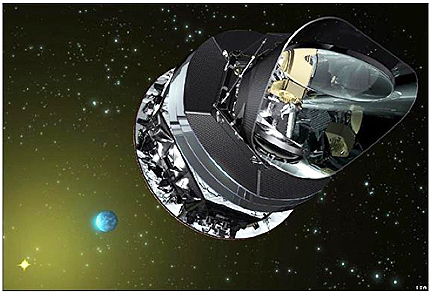
Planck satellite (ESA) This makes the HFI detectors the coldest known objects in outer space. The achievement, seven weeks after launch, marks a key milestone for the Planck mission. The spacecraft’s active cooling system has now reached its final operational conditions and the two instruments onboard Planck (HFI and the Low Frequency Instrument, LFI) are now both at their cryogenic operational temperatures.

The design of the Planck spacecraft allows it to cool down passively to about 45 K (-228 °C) by radiating heat towards the cold space environment. However, to reach the required operational temperatures for the two instruments (20K for LFI and down to 0.1 K for HFI), Planck is equipped with a sophisticated active cooling system. This system comprises three different coolers that act on different stages of the two Planck instruments, respectively down to 20K, 4K and 0.1K above absolute zero. The passive cool down of the spacecraft in the space environment started immediately after launch on May 14th. The two coldest coolers (0.1K dilution cooler and 4K Joules-Thompson cooler) were switched on very shortly after launch, but at a low level. This was done to allow the gas that these stages use for cooling to flow through the system’s pipes, to prevent any potential clogging of these pipes that might be caused by the rapid passive cool-down.

Two days after launch the coldest of the spacecraft’s three V-grooves — panels that isolate thermally the payload from the hot spacecraft and help to cool the spacecraft by passively radiating excess heat — was already at 75 K. However, the Focal Plane Units (FPUs) of the HFI and LFI as well as the telescope were actively kept at a higher temperature of about 170 K (-103 °C) for two weeks, using dedicated heaters. This was to prevent any contamination, from the spacecraft that is outgassing early in the mission, to freeze onto the surface of these elements.

On June 1st, the anti-contamination heaters were switched off and the focal plane and telescope were allowed to resume the passive cool down. Three days later, on June 4th, when the LFI FPU had passively cooled to 100K, the sorption cooler (20 K stage) was switched on. The sorption cooler is responsible for actively cooling the LFI Focal Plane Unit to its operational temperature of 20K and pre-cools the HFI Focal Plane Unit to 18K. Its coldest operational level was reached after nine days, on 13 June, with a temperature of ~17.5K. As the next steps in activating the cooling system, the remaining two coolers (4K and 0.1K coolers), which had been switched on at a low level shortly after launch, were set to full power one after the other on June 28th. With all coolers of the active cooling chain in operation, the detectors in the HFI Focal Plane Unit finally reached the 0.1K level on July 3rd. For the two instruments HFI and LFI, the next and last phase of their commissioning before the start of nominal science operations is the Calibration and Performance Verification (CPV) phase. This phase will now last until mid-August, during which they will carry out specific activities targeted to calibrate both the HFI and LFI. Upon completion of the CPV phase, Planck will start its scientific mission, surveying the whole sky twice over within about one year.

Filed Under: Exploration & Science Missions

Primary Sidebar

Coverage

  • Missions & Constellations
  • Business & Finance
  • Military & Defense
  • Launch
  • Software Automation & Ground Systems
  • Government & Regulation
  • Services & Applications

Most Read Stories

  • NASA Shuts Off Instrument on Voyager 1 to Extend Interstellar Mission
  • Bad news, but good news followed
  • AST SpaceMobile Pivots to SpaceX for Mid-June Launch of Three BlueBird Satellites
  • SmallSat Europe Speaker Focus: Merek Chertkow, The Radiation Team
  • Blue Origin Achieves First Booster Reuse but Satellite Enters Off-Nominal Orbit

Secondary Sidebar

Footer


Satnews is a leading provider of satellite news, events, publications, research and other satellite industry information in both commercial and military enterprises worldwide.

Stories By Category

  • Business & Finance
  • Government & Regulation
  • Launch
  • Military & Defense
  • Missions & Constellations
  • Services & Applications
  • Software Automation & Ground Systems
  • Spectrum & Licensing
  • Startups & NewSpace Business

About Us

  • Leadership & Editorial Team
  • SatNews History
  • Free Satnews Subscription
  • SatNews Events
  • Magazines

Navigation

  • Latest Stories
  • Magazines
  • Events
  • Contact
  • Cookie & Privacy Policy for Satnews

We use cookies to ensure that we give you the best experience on our website. If you continue to use this site we will assume that you are happy with it.
x
Sign up Now (For Free)
Access daily or weekly satellite news updates covering all aspects of the commercial and military satellite industry.
Invalid email address
Notify Me Regarding ( At least one ):
We value your privacy and will not sell or share your email or other information with any other company. You may also unsubscribe at anytime.

Click Here to see our full privacy policy.
Thanks for subscribing!