

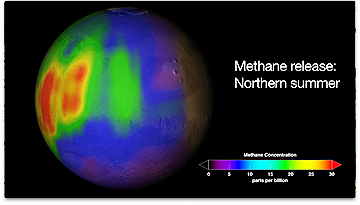
 Mars today is a world of cold and lonely deserts, apparently without life of any kind, at least on the surface. Worse still, it looks like Mars has been cold and dry for billions of years, with an atmosphere so thin, any liquid water on the surface quickly boils away while the sun’s ultraviolet radiation scorches the ground. This image shows concentrations of Methane discovered on Mars. Credit: NASA
But there is evidence of a warmer and wetter past — features resembling dry riverbeds and minerals that form in the presence of water indicate water once flowed through Martian sands. Since liquid water is required for all known forms of life, scientists wonder if life could have risen on Mars, and if it did, what became of it as the Martian climate changed.
New research reveals there is hope for Mars yet. The first definitive detection of methane in the atmosphere of Mars indicates the planet is still alive, in either a biologic or geologic sense, according to a team of NASA and university scientists.
“Methane is quickly destroyed in the Martian atmosphere in a variety of ways, so our discovery of substantial plumes of methane in the northern hemisphere of Mars in 2003 indicates some ongoing process is releasing the gas,” said Dr. Michael Mumma of NASA’s Goddard Space Flight Center in Greenbelt, Md. “At northern mid-summer, methane is released at a rate comparable to that of the massive hydrocarbon seep at Coal Oil Point in Santa Barbara, California.”
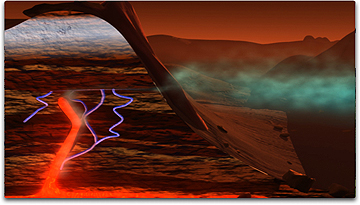 Methane consists of four atoms of hydrogen bound to a carbon atom, and is the main component of natural gas on Earth. It’s of interest to astrobiologists because organisms release much of Earth’s methane as they digest nutrients. However, other purely geological processes, like oxidation of iron, also release methane. “Right now, we don’t have enough information to tell if biology or geology — or both — is producing the methane on Mars,” said Mumma. “But it does tell us that the planet is still alive, at least in a geologic sense. It’s as if Mars is challenging us, saying, hey, find out what this means.” Mumma is lead author of a paper on this research appearing in Science Express January 15. Scientists don’t yet know enough to say with certainty what the source of the Martian methane is, but this artist’s concept depicts a possibility. In this illustration, subsurface water, carbon dioxide and the planet’s internal heat combine to release methane. Although we don’t have evidence on Mars of active volcanoes today, ancient methane trapped in ice “cages” might now be released. Credit: NASA/Susan Twardy
If microscopic Martian life is producing the methane, it likely resides far below the surface, where it’s still warm enough for liquid water to exist. Liquid water, as well as energy sources and a supply of carbon, are necessary for all known forms of life.
“On Earth, microorganisms thrive 2 to 3 kilometers (about 1.2 to 1.9 miles) beneath the Witwatersrand basin of South Africa, where natural radioactivity splits water molecules into molecular hydrogen (H2) and oxygen. The organisms use the hydrogen for energy. It might be possible for similar organisms to survive for billions of years below the permafrost layer on Mars, where water is liquid, radiation supplies energy, and carbon dioxide provides carbon,” said Mumma.
“Gases, like methane, accumulated in such underground zones might be released into the atmosphere if pores or fissures open during the warm seasons, connecting the deep zones to the atmosphere at crater walls or canyons,” said Mumma.
“Microbes that produced methane from hydrogen and carbon dioxide were one of the earliest forms of life on Earth,” noted Dr. Carl Pilcher, Director of the NASA Astrobiology Institute which partially supported the research. “If life ever existed on Mars, it’s reasonable to think that its metabolism might have involved making methane from Martian atmospheric carbon dioxide.”
However, it is possible a geologic process produced the Martian methane, either now or eons ago. On Earth, the conversion of iron oxide (rust) into the serpentine group of minerals creates methane, and on Mars this process could proceed using water, carbon dioxide, and the planet’s internal heat. Although we don’t have evidence on Mars of active volcanoes today, ancient methane trapped in ice “cages” called clathrates might now be released.
The team found methane in the atmosphere of Mars by carefully observing the planet over several Mars years (and all Martian seasons) with NASA’s Infrared Telescope Facility, run by the University of Hawaii, and the W. M. Keck telescope, both at Mauna Kea, Hawaii.
The team used spectrometer instruments attached to the telescopes to make the detection. Spectrometers spread light into its component colors, like a prism separates white light into a rainbow. The team looked for dark areas in specific places along the rainbow (light spectrum) where methane was absorbing sunlight reflected from the Martian surface. They found three such areas, called absorption lines, which together are a definitive signature of methane, according to the team. They were able to distinguish lines from Martian methane from the methane in Earth’s atmosphere because the motion of the Red Planet shifted the position of the Martian lines, much as a speeding ambulance causes its siren to change pitch as it passes by.
“We observed and mapped multiple plumes of methane on Mars, one of which released about 19,000 metric tons of methane,” said Dr. Geronimo Villanueva of the Catholic University of America, Washington, D.C. Villanueva is stationed at NASA Goddard and is co-author of the paper. “The plumes were emitted during the warmer seasons — spring and summer — perhaps because the permafrost blocking cracks and fissures vaporized, allowing methane to seep into the Martian air. Curiously, some plumes had water vapor while others did not,” said Villanueva.
According to the team, the plumes were seen over areas that show evidence of ancient ground ice or flowing water. For example, plumes appeared over northern hemisphere regions such as east of Arabia Terra, the Nili Fossae region, and the south-east quadrant of Syrtis Major, an ancient volcano 1,200 kilometers (about 745 miles) across.
It will take future missions, like NASA’s Mars Science Laboratory, to discover the origin of the Martian methane. One way to tell if life is the source of the gas is by measuring isotope ratios. Isotopes are heavier versions of an element; for example, deuterium is a heavier version of hydrogen. In molecules that contain hydrogen, like water and methane, the rare deuterium occasionally replaces a hydrogen atom. Since life prefers to use the lighter isotopes, if the methane has less deuterium than the water released with it on Mars, it’s a sign that life is producing the methane. The research was funded by NASA’s Planetary Astronomy Program and the NASA Astrobiology Institute.
