


• Skip to primary navigation
  • Skip to main content
  • Skip to primary sidebar
  • Skip to secondary sidebar
  • Skip to footer
  • NEWS:
  • SatNews
  • SatMagazine
  • MilSatMagazine
  • SmallSat News
  • |     EVENTS:
  • SmallSat Symposium
  • Satellite Innovation
  • MilSat Symposium
  • SmallSat Europe

SatNews

Satellite Industry Intelligence Since 1983

Subscribe
  • LATEST
  • SatNews Events
  • Magazines
  • Calendar
  • Subscribe
  • Missions & Constellations
    • Exploration & Science Missions
    • In-Orbit Servicing & Orbital Operations
    • LEO Constellations
    • Mission Autonomy & Onboard Systems
    • Mission Deployments & Manifests
    • Navigation & PNT
    • SmallSat
    • Spacecraft & Payload Technology
    View All in Missions & Constellations →
    Radiation-Resistant Lens Designs Adapt to Accelerate Space Payload ProductionRadiation-Resistant Lens Designs Adapt to Accelerate Space Payload Production
    Seibersdorf Laboratories and Tumbleweed Partner on Microgravity R&D Service for Pharma and BiotechSeibersdorf Laboratories and Tumbleweed Partner on Microgravity R&D Service for Pharma and Biotech
    Build, Buy or Merge: Satellite Companies Move to Own Their LaunchBuild, Buy or Merge: Satellite Companies Move to Own Their Launch
    SpacePNT Selected to Supply Spaceborne GNSS Receiver Subsystem for SWISSto12 HummingSat PlatformSpacePNT Selected to Supply Spaceborne GNSS Receiver Subsystem for SWISSto12 HummingSat Platform
  • Business
    • Contracts & Commercial Deals
    • Earnings & Financial Reporting
    • Events & Conferences
    • Funding & Venture Capital
    • Market Forecasts
    • Mergers & Acquisitions
    • Personnel Moves & Appointments
    View All in Business & Finance →
    Early Signals, 2016: SpaceX’s First Backer Opened the First SmallSat SymposiumEarly Signals, 2016: SpaceX’s First Backer Opened the First SmallSat Symposium
    EnSilica Reaches Initial Agreement for $80 Million Resilient GNSS ASIC ProgramEnSilica Reaches Initial Agreement for $80 Million Resilient GNSS ASIC Program
    Thales Alenia Space Signs €240 Million Contract With OHB for Sentinel-3NG Topography AltimetersThales Alenia Space Signs €240 Million Contract With OHB for Sentinel-3NG Topography Altimeters
    A Second LEO Network Has Paying Customers and a Launch ProblemA Second LEO Network Has Paying Customers and a Launch Problem
  • Defense
    • Counterspace & ASAT
    • Defense Budgets & Procurement
    • ISR & Reconnaissance
    • MILSATCOM
    • Missile Warning & Defense
    • National Security Programs
    • Space Domain Awareness
    View All in Military & Defense →
    ARES Shield AI Completes First In-Orbit Object Detection Test Aboard D-Orbit SpacecraftARES Shield AI Completes First In-Orbit Object Detection Test Aboard D-Orbit Spacecraft
    GAO Finds Pentagon Lacks Coordinated View of Military Space Supply Chain RisksGAO Finds Pentagon Lacks Coordinated View of Military Space Supply Chain Risks
    Orbital Proximity Incidents Mask Broader Satellite Jamming ThreatOrbital Proximity Incidents Mask Broader Satellite Jamming Threat
    Lite Coms Secures Over $100 Million in Q3 2026 Defense SATCOM OrdersLite Coms Secures Over $100 Million in Q3 2026 Defense SATCOM Orders
  • Gov
    • Export Controls & Compliance
    • International Space Agreements
    • National Space Policy
    • Space Law & Treaties
    • Space Sustainability & Debris Policy
    • Space Traffic Management / Debris Removal
    View All in Government & Regulation →
    United States Finalizes 20 Agenda Item Positions Ahead of WRC-27 Spectrum NegotiationsUnited States Finalizes 20 Agenda Item Positions Ahead of WRC-27 Spectrum Negotiations
    FCC Upper C-Band Auction 115 Creates Indirect Spectrum and Market Shifts for SmallSat and LEO OperatorsFCC Upper C-Band Auction 115 Creates Indirect Spectrum and Market Shifts for SmallSat and LEO Operators
    FCC Sets April 27, 2027 Start Date for Upper C-Band Auction, Pressuring BroadcastersFCC Sets April 27, 2027 Start Date for Upper C-Band Auction, Pressuring Broadcasters
    Senate Appropriators Move to Bar Sole-Source Awards Over $100 Million for Space Data Network and SB-AMTISenate Appropriators Move to Bar Sole-Source Awards Over $100 Million for Space Data Network and SB-AMTI
  • Launch
    • Launch Providers
    • Launch Schedule & Calendars
    • Launch Sites & Infrastructure
    • Rocket Technology & Vehicles
    View All in Launch →
    NATO Stands Up Starlift Launch Brokerage to Connect Alliance Demand With Allied SpaceportsNATO Stands Up Starlift Launch Brokerage to Connect Alliance Demand With Allied Spaceports
    ULA Clears Blue Origin BE-4 Engines, Focuses Vulcan Failure Probe on Core Stage Fuel SupplyULA Clears Blue Origin BE-4 Engines, Focuses Vulcan Failure Probe on Core Stage Fuel Supply
    Google Selects Blue Origin’s New Glenn Rocket for 2029 AI Satellite LaunchGoogle Selects Blue Origin’s New Glenn Rocket for 2029 AI Satellite Launch
    NASA’s Voyager 1 Reaches One Light-Day From Earth at 16.1 Billion MilesNASA’s Voyager 1 Reaches One Light-Day From Earth at 16.1 Billion Miles
  • Software
    • Autonomous Ground Operations
    • Data Processing & AI/ML
    • Digital Twins & Modeling
    • Ground Segment & Teleports
    • Mission Planning & Simulation
    • Space Systems Software Engineering
    • Spectrum & Licensing
    View All in Software Automation & Ground Systems →
    RBC Signals Secures $10 Million Strategic Growth Investment Led by Washington Harbour PartnersRBC Signals Secures $10 Million Strategic Growth Investment Led by Washington Harbour Partners
    Ramon.Space Raises $124 Million Series B to Scale Orbital Computing InfrastructureRamon.Space Raises $124 Million Series B to Scale Orbital Computing Infrastructure
    Gilat Cuts 2026 Growth Forecast to 3% Amid Launch and IFC DelaysGilat Cuts 2026 Growth Forecast to 3% Amid Launch and IFC Delays
    U.S. Navy Expands ALL.SPACE Terminal Fleet to 108 with Follow-On Hydra MAX 2 OrderU.S. Navy Expands ALL.SPACE Terminal Fleet to 108 with Follow-On Hydra MAX 2 Order
  • Services & Apps
    • Climate & Environmental Monitoring
    • Disaster Response & Security Mapping
    • Earth Observation & Imaging
    • Maritime & Aviation Satcom
    • Satellite Communications
    View All in Services & Applications →
    Smart and Elveo Mobile Complete Direct-to-Device Satellite Trials on Philippine Sea RouteSmart and Elveo Mobile Complete Direct-to-Device Satellite Trials on Philippine Sea Route
    Thales Alenia Space Awarded DGA Contract for French IRIS Military Optical ConstellationThales Alenia Space Awarded DGA Contract for French IRIS Military Optical Constellation
    Ubotica Demonstrates Autonomous Onboard Satellite Scheduling for Maritime SurveillanceUbotica Demonstrates Autonomous Onboard Satellite Scheduling for Maritime Surveillance
    UniSQ Demonstrates Tomographic Spectrometer During KREPE-3 Re-Entry CampaignUniSQ Demonstrates Tomographic Spectrometer During KREPE-3 Re-Entry Campaign

Hubble Discovers Planet While Dusting — Fomalhaut The Gift That Keeps On Giving

November 15, 2008

Formalhaut b Say hello to the new kid on the block, as NASA’s Hubble Space Telescope has taken the first visible-light snapshot of a planet circling another star. Estimated to be no more than three times Jupiter’s mass, the planet, called Fomalhaut b, orbits the bright southern star Fomalhaut, located 25 light-years away in the constellation Piscis Australis, or the “Southern Fish.” For the first time ever, astronomers have confirmed the existence of a planet orbiting another star. The planet, called Fomalhaut b, orbits the bright southern star Fomalhaut and is located 25 light-years away from Earth. Hubble’s Advanced Camera for Surveys captured visible-light images 21 months apart that show that the planet is moving along a path around the star. Credit: NASA, ESA, and G. Bacon (STScI)

Fomalhaut has been a candidate for planet hunting ever since an excess of dust was discovered around the star in the early 1980s by NASA’s Infrared Astronomy Satellite, IRAS. In 2004, the coronagraph in the High Resolution Camera on Hubble’s Advanced Camera for Surveys produced the first-ever resolved visible-light image of the region around Fomalhaut. It clearly showed a ring of protoplanetary debris approximately 21.5 billion miles across and having a sharp inner edge.

This large debris disk is similar to the Kuiper Belt, which encircles the solar system and contains a range of icy bodies from dust grains to objects the size of dwarf planets, such as Pluto. Hubble astronomer Paul Kalas, of the University of California at Berkeley, and team members proposed in 2005 that the ring was being gravitationally modified by a planet lying between the star and the ring’s inner edge.

Circumstantial evidence came from Hubble’s confirmation that the ring is offset from the center of the star. The sharp inner edge of the ring is also consistent with the presence of a planet that gravitationally “shepherds” ring particles. Independent researchers have subsequently reached similar conclusions.

Now, Hubble has actually photographed a point source of light lying 1.8 billion miles inside the ring’s inner edge. The results are being reported in the November 14 issue of Science magazine.

“Fomalhaut is the gift that keeps on giving. Following the unexpected discovery of its dust ring, we have now found an exoplanet at a location suggested by analysis of the dust ring’s shape. The lesson for exoplanet hunters is ‘follow the dust,'” said team member Mark Clampin of NASA’s Goddard Space Flight Center in Greenbelt, Maryland.
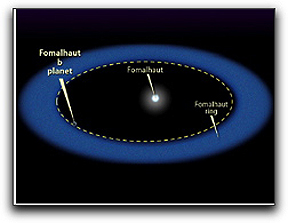
Fomalhaut compared Observations taken 21 months apart by Hubble’s Advanced Camera for Surveys’ coronagraph show that the object is moving along a path around the star, and is therefore gravitationally bound to it. The planet is 10.7 billion miles from the star, or about 10 times the distance of the planet Saturn from our sun. This PDF compares the size of the Fomalhaut system to our own solar system. Credit: NASA, ESA, and A. Feild (STScI)

The planet is brighter than expected for an object of three Jupiter masses. One possibility is that it has a Saturn-like ring of ice and dust reflecting starlight. The ring might eventually coalesce to form moons. The ring’s estimated size is comparable to the region around Jupiter and its four largest orbiting satellites.

Kalas and his team first used Hubble to photograph Fomalhaut in 2004, and made the unexpected discovery of its debris disk, which scatters Fomalhaut’s starlight. At the time they noted a few bright sources in the image as planet candidates. A follow-up image in 2006 showed that one of the objects is moving through space with Fomalhaut but changed position relative to the ring since the 2004 exposure. The amount of displacement between the two exposures corresponds to an 872-year-long orbit as calculated from Kepler’s laws of planetary motion.

Future observations will attempt to see the planet in infrared light and will look for evidence of water vapor clouds in the atmosphere. This would yield clues to the evolution of a comparatively newborn 100-million-year-old planet. Astrometric measurements of the planet’s orbit will provide enough precision to yield an accurate mass.

NASA’s James Webb Space Telescope, scheduled to launch in 2013 will be able to make coronagraphic observations of Fomalhaut in the near- and mid-infrared. Webb will be able to hunt for other planets in the system and probe the region interior to the dust ring for structures such as an inner asteroid belt. For more information about the Hubble Space Telescope, visit:

Filed Under: Exploration & Science Missions

Primary Sidebar

Coverage

  • Missions & Constellations
  • Business & Finance
  • Military & Defense
  • Launch
  • Software Automation & Ground Systems
  • Government & Regulation
  • Services & Applications

Most Read Stories

  • Blue Origin Reconstructs Launch Complex 36 Tower, Targets November Return to Flight for New Glenn
  • Amazon Navigates Launch Delays with Under 400 Satellites in Orbit Ahead of Nov. 13 Vulcan Return
  • Northwood Space Secures $375M Series C at $2B Valuation to Expand Shared Ground Station Network
  • NASA Outlines Artemis IV Starship Refueling Architecture as Launch Estimates Vary
  • SpaceX Explores Boost Mobile Acquisition in Push to Build Hybrid Terrestrial-Satellite Network

Secondary Sidebar

Footer


Satnews is a leading provider of satellite news, events, publications, research and other satellite industry information in both commercial and military enterprises worldwide.

Stories By Category

  • Business & Finance
  • Government & Regulation
  • Launch
  • Military & Defense
  • Missions & Constellations
  • Services & Applications
  • Software Automation & Ground Systems
  • Spectrum & Licensing
  • Startups & NewSpace Business

About Us

  • Leadership & Editorial Team
  • SatNews History
  • Free Satnews Subscription
  • SatNews Events
  • Magazines

Navigation

  • Latest Stories
  • Magazines
  • Events
  • Contact
  • Cookie & Privacy Policy for Satnews

We use cookies to ensure that we give you the best experience on our website. If you continue to use this site we will assume that you are happy with it.
x
Sign up Now (For Free)
Access daily or weekly satellite news updates covering all aspects of the commercial and military satellite industry.
Invalid email address
Notify Me Regarding ( At least one ):
We value your privacy and will not sell or share your email or other information with any other company. You may also unsubscribe at anytime.

Click Here to see our full privacy policy.
Thanks for subscribing!