

• Skip to primary navigation
  • Skip to main content
  • Skip to primary sidebar
  • Skip to secondary sidebar
  • Skip to footer
  • NEWS:
  • SatNews
  • SatMagazine
  • MilSatMagazine
  • SmallSat News
  • |     EVENTS:
  • SmallSat Symposium
  • Satellite Innovation
  • MilSat Symposium
  • SmallSat Europe

SatNews

Satellite Industry Intelligence Since 1983

Subscribe
  • LATEST
  • SatNews Events
  • Magazines
  • Calendar
  • Subscribe
  • Missions & Constellations
    • Exploration & Science Missions
    • In-Orbit Servicing & Orbital Operations
    • LEO Constellations
    • Mission Autonomy & Onboard Systems
    • Mission Deployments & Manifests
    • Navigation & PNT
    • SmallSat
    • Spacecraft & Payload Technology
    View All in Missions & Constellations →
    SES Space & Defense and Starlab Partner on O3b mPOWER Space-to-Space Relay ArchitectureSES Space & Defense and Starlab Partner on O3b mPOWER Space-to-Space Relay Architecture
    Artemis II Pilot Advocates Stepwise Return to Moon via Equatorial LandingsArtemis II Pilot Advocates Stepwise Return to Moon via Equatorial Landings
    Thales CEO Confirms Progression on EU’s Multi-Billion Euro IRIS² Sovereign Satellite ConstellationThales CEO Confirms Progression on EU’s Multi-Billion Euro IRIS² Sovereign Satellite Constellation
    Viasat Deploys Reflector and Boom Assembly on ViaSat-3 F3 Ahead of In-Orbit TestingViasat Deploys Reflector and Boom Assembly on ViaSat-3 F3 Ahead of In-Orbit Testing
  • Business
    • Contracts & Commercial Deals
    • Earnings & Financial Reporting
    • Events & Conferences
    • Funding & Venture Capital
    • Market Forecasts
    • Mergers & Acquisitions
    • Personnel Moves & Appointments
    View All in Business & Finance →
    EchoStar Faces Mounting Financial Pressure on Hughes Satellite Unit Amid Corporate ReorganizationEchoStar Faces Mounting Financial Pressure on Hughes Satellite Unit Amid Corporate Reorganization
    Optical Zonu Debuts Miniature Ku-Band RF-over-Fiber Transmitter for Space-Constrained Defense PlatformsOptical Zonu Debuts Miniature Ku-Band RF-over-Fiber Transmitter for Space-Constrained Defense Platforms
    STMicroelectronics Reports Q2 2026 Earnings Growth Driven by AI Data Centers and Satellite DemandSTMicroelectronics Reports Q2 2026 Earnings Growth Driven by AI Data Centers and Satellite Demand
    AT&T CEO Reaffirms Support for AST SpaceMobile, Dismisses Satellite Revenue RiskAT&T CEO Reaffirms Support for AST SpaceMobile, Dismisses Satellite Revenue Risk
  • Defense
    • Counterspace & ASAT
    • Defense Budgets & Procurement
    • ISR & Reconnaissance
    • MILSATCOM
    • Missile Warning & Defense
    • National Security Programs
    • Space Domain Awareness
    View All in Military & Defense →
    Space Force Awards $287 Million Software Contract to Sphinx Defense for Strategic SATCOM Ground SegmentSpace Force Awards $287 Million Software Contract to Sphinx Defense for Strategic SATCOM Ground Segment
    L3Harris Signs Multi-Year Framework Agreement to Quadruple THAAD Propulsion ProductionL3Harris Signs Multi-Year Framework Agreement to Quadruple THAAD Propulsion Production
    GAO Report Warns Space Force Must Improve Personnel Metrics to Support Fleet ExpansionGAO Report Warns Space Force Must Improve Personnel Metrics to Support Fleet Expansion
    NNSA Delivers Fifth Next-Generation Global Burst Detector Payload to U.S. Space Force for GPS IntegrationNNSA Delivers Fifth Next-Generation Global Burst Detector Payload to U.S. Space Force for GPS Integration
  • Gov
    • Export Controls & Compliance
    • International Space Agreements
    • National Space Policy
    • Space Law & Treaties
    • Space Sustainability & Debris Policy
    • Space Traffic Management / Debris Removal
    View All in Government & Regulation →
    FCC Approves Upper C-Band Order, Allocating $5.6 Billion to SES and $504 Million to EutelsatFCC Approves Upper C-Band Order, Allocating $5.6 Billion to SES and $504 Million to Eutelsat
    GSMA Endorses Abuja Declaration to Advance Satellite Spectrum Reform and Launch ATLAS UmojaGSMA Endorses Abuja Declaration to Advance Satellite Spectrum Reform and Launch ATLAS Umoja
    UK Space Agency Unveils £62 Million Domestic Space Fund and Strategic Partnership with Space FloridaUK Space Agency Unveils £62 Million Domestic Space Fund and Strategic Partnership with Space Florida
    NewOrbit Urges Targeted UK Sovereign Allocation Toward Very Low Earth Orbit Capabilities Following £62M Government Space FundingNewOrbit Urges Targeted UK Sovereign Allocation Toward Very Low Earth Orbit Capabilities Following £62M Government Space Funding
  • Launch
    • Launch Providers
    • Launch Schedule & Calendars
    • Launch Sites & Infrastructure
    • Rocket Technology & Vehicles
    View All in Launch →
    SpaceX Targets First Starship Upper Stage Tower Catch for Flight 14SpaceX Targets First Starship Upper Stage Tower Catch for Flight 14
    L3Harris Delivers Four RS-25 Core Stage Engines to NASA for Crewed Artemis III Lunar MissionL3Harris Delivers Four RS-25 Core Stage Engines to NASA for Crewed Artemis III Lunar Mission
    Commercial Launch Providers Advance Next-Generation Heavy and Medium-Lift Vehicle Milestones Ahead of 2026 DebutsCommercial Launch Providers Advance Next-Generation Heavy and Medium-Lift Vehicle Milestones Ahead of 2026 Debuts
    SpaceX Limits Future Commercial Rideshare Bookings Past 2028 Amid Severe Manifest SaturationSpaceX Limits Future Commercial Rideshare Bookings Past 2028 Amid Severe Manifest Saturation
  • Software
    • Autonomous Ground Operations
    • Data Processing & AI/ML
    • Digital Twins & Modeling
    • Ground Segment & Teleports
    • Mission Planning & Simulation
    • Space Systems Software Engineering
    • Spectrum & Licensing
    View All in Software Automation & Ground Systems →
    Astrolight Advances End-to-End Lasercom Network to Address Orbital Bandwidth and Spectrum BottlenecksAstrolight Advances End-to-End Lasercom Network to Address Orbital Bandwidth and Spectrum Bottlenecks
    Intellian Unveils CM100 GMDSS Terminal Built for Iridium Certus 100 Safety NetworkIntellian Unveils CM100 GMDSS Terminal Built for Iridium Certus 100 Safety Network
    NASA Joins Federal Genesis Mission Initiative to Process 150 Petabytes of Space Data via AI ArchitecturesNASA Joins Federal Genesis Mission Initiative to Process 150 Petabytes of Space Data via AI Architectures
    IHI Corporation and Kuva Space Partner to Evaluate Japanese Sovereign Hyperspectral ConstellationIHI Corporation and Kuva Space Partner to Evaluate Japanese Sovereign Hyperspectral Constellation
  • Services & Apps
    • Climate & Environmental Monitoring
    • Disaster Response & Security Mapping
    • Earth Observation & Imaging
    • Maritime & Aviation Satcom
    • Satellite Communications
    View All in Services & Applications →
    Resecurity Joins Space ISAC to Expand Cyber Threat Intelligence Across Space AssetsResecurity Joins Space ISAC to Expand Cyber Threat Intelligence Across Space Assets
    Telespazio Deploys S/X-Band Antenna in the Azores to Expand Global Ground Station NetworkTelespazio Deploys S/X-Band Antenna in the Azores to Expand Global Ground Station Network
    Amazon Files FCC Application for 5,105-Satellite Constellation to Enable Direct-to-Device Mobile ServicesAmazon Files FCC Application for 5,105-Satellite Constellation to Enable Direct-to-Device Mobile Services
    FCC Proposes Opening Unlicensed Bluetooth and Wi-Fi Bands for Space-Based CommunicationsFCC Proposes Opening Unlicensed Bluetooth and Wi-Fi Bands for Space-Based Communications

NASA’s Shock With Dusty Stars

November 12, 2008

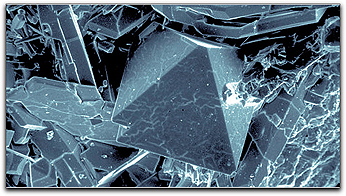
dusty shock wave Not necessarily what you might think when you imagine stars, and the creation of planets, according to new observations from NASA’s Spitzer Space Telescope. Shock waves around dusty, young stars might be creating the raw materials for planets; the evidence comes in the form of tiny crystals. Spitzer detected crystals similar in make-up to quartz around young stars just beginning to form planets. The crystals, called cristobalite and tridymite, are known to reside in comets, in volcanic lava flows on Earth, and in some meteorites that land on Earth. NASA’s Spitzer Space Telescope detected quartz-like crystals called cristobalite in young planetary systems. Cristobalite, which is shown here in this magnified view, is found on Earth in volcanic lava flows. Photo courtesy of George Rossman of Caltech.

Planets are born out of swirling pancake-like disks of dust and gas that surround young stars. They start out as mere grains of dust swimming around in a disk of gas and dust, before lumping together to form full-fledged planets. During the early stages of planet development, the dust grains crystallize and adhere together, while the disk itself starts to settle and flatten. This occurs in the first millions of years of a star’s life.

Astronomers already knew that crystallized dust grains stick together to form larger particles, which later lump together to form planets. But they were surprised to find cristobalite and tridymite. What’s so special about these particular crystals? They require flash heating events, such as shock waves, to form. The findings suggest that the same kinds of shock waves that cause sonic booms from speeding jets are responsible for creating the stuff of planets throughout the universe.

“By studying these other star systems, we can learn about the very beginnings of our own planets 4.6 billion years ago,” said William Forrest of the University of Rochester, New York. “Spitzer has given us a better idea of how the raw materials of planets are produced very early on.” Forrest and University of Rochester graduate student Ben Sargent led the research, to appear in the Astrophysical Journal.

When Forrest and his colleagues used Spitzer to examine five young planet-forming disks about 400 light-years away, they detected the signature of silica crystals. Silica is made of only silicon and oxygen and is the main ingredient in glass. When melted and crystallized, it can make the large hexagonal quartz crystals often sold as mystical tokens. When heated to even higher temperatures, it can also form small crystals like those commonly found around volcanoes.
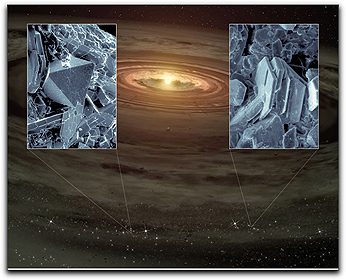
Planetary disks The crystals require temperatures as high as 1,220 Kelvin (about 1,740 degrees Fahrenheit) to form. But young planet-forming disks are only about 100 to 1,000 Kelvin (about minus 280 degrees Fahrenheit to 1,340 Fahrenheit), too cold to make the crystals. Because the crystals require heating followed by rapid cooling to form, astronomers theorized that shock waves could be the cause. Shock waves, or supersonic waves of pressure, are thought to be created in planet-forming disks when clouds of gas swirling around at high speeds collide. Some theorists think that shock waves might also accompany the formation of giant planets. NASA’s Spitzer Space Telescope has, for the first time, detected tiny quartz-like crystals sprinkled in young planetary systems. The crystals, which are types of silica minerals called cristobalite and tridymite, can be seen close-up in the black-and-white insets (cristobalite is on the left, and tridymite on the right). The main picture is an artist’s concept of a young star and its swirling disk of planet-forming materials. Image credit: NASA/JPL-Caltech

The findings are in agreement with local evidence from our own solar system. Spherical pebbles, called chondrules, found in ancient meteorites that fell to Earth are also thought to have been crystallized by shock waves in our solar system’s young planet-forming disk. In addition, NASA’s Stardust mission found tridymite minerals in comet Wild 2.

Other authors of the paper include C. Tayrien, M.K. McClure, A.R. Basu, P. Mano, Dan Watson, C.J. Bohac, K.H. Kim and J.D. Green of the University of Rochester; A Li of the University of Missouri, Columbia; E. Furlan of NASA’s Jet Propulsion Laboratory, Pasadena, California, and G.C. Sloan of Cornell University, Ithaca, New York.

JPL manages the Spitzer Space Telescope mission for NASA’s Science Mission Directorate, Washington. Science operations are conducted at the Spitzer Science Center at the California Institute of Technology, also in Pasadena. Caltech manages JPL for NASA. Spitzer’s infrared spectrograph, which made the observations, was built by Cornell University, Ithaca, New York. Its development was led by Jim Houck of Cornell. You can learn more at this site.

Filed Under: Exploration & Science Missions

Primary Sidebar

Coverage

  • Missions & Constellations
  • Business & Finance
  • Military & Defense
  • Launch
  • Software Automation & Ground Systems
  • Government & Regulation
  • Services & Applications

Most Read Stories

  • AST SpaceMobile Finalizes Assembly of Next-Generation BlueBirds for August SpaceX Launch
  • SpaceX Controlled-Deorbit Report Discloses Decommissioning of 260 Starlink Satellites Over Six Months
  • SpaceX Files FCC Application for 100,000 Third-Generation Starlink Satellites
  • EchoStar’s Dish DBS Initiates Prepackaged Chapter 11 Restructuring to Resolve Impending Senior Note Maturities
  • BNP Paribas Outlines Steep Regulatory Obstacles in SpaceX Mobile Integration Strategy

Secondary Sidebar

Footer


Satnews is a leading provider of satellite news, events, publications, research and other satellite industry information in both commercial and military enterprises worldwide.

Stories By Category

  • Business & Finance
  • Government & Regulation
  • Launch
  • Military & Defense
  • Missions & Constellations
  • Services & Applications
  • Software Automation & Ground Systems
  • Spectrum & Licensing
  • Startups & NewSpace Business

About Us

  • Leadership & Editorial Team
  • SatNews History
  • Free Satnews Subscription
  • SatNews Events
  • Magazines

Navigation

  • Latest Stories
  • Magazines
  • Events
  • Contact
  • Cookie & Privacy Policy for Satnews

We use cookies to ensure that we give you the best experience on our website. If you continue to use this site we will assume that you are happy with it.
x
Sign up Now (For Free)
Access daily or weekly satellite news updates covering all aspects of the commercial and military satellite industry.
Invalid email address
Notify Me Regarding ( At least one ):
We value your privacy and will not sell or share your email or other information with any other company. You may also unsubscribe at anytime.

Click Here to see our full privacy policy.
Thanks for subscribing!