

During safe mode, the lander halts non-critical activities and awaits further instructions from the mission team. Within hours of receiving information of the safing event, mission engineers at NASA‘s Jet Propulsion Laboratory, Pasadena, Calif., and at Lockheed Martin in Denver, were able to send commands to restart battery charging with the result being unlikely any energy was lost.
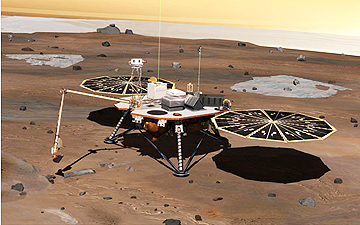 Weather conditions at the landing site in the north polar region of Mars have deteriorated in recent days. Overnight temperatures have fallen to -141F (-96C), and daytime high temperatures have reached only -50F (-45C), the lowest temperatures experienced so far in the mission. A mild dust storm blowing through the area, along with water-ice clouds, further complicated the situation by reducing the amount of sunlight reaching the lander’s solar arrays, thereby reducing the amount of power the craft could generate. Low temperatures caused the lander’s battery heaters to turn on Tuesday for the first time, creating another drain on precious power supplies. Science activities will remain on hold for the next several days to allow the spacecraft to recharge and conserve power. Attempts to resume normal operations will not take place before the coming weekend. (IMAGE: NASA’s Phoenix Mars Lander monitors the atmosphere overhead and reaches out to the soil below in this artist’s depiction of the spacecraft fully deployed on the surface of Mars. Courtesy of NASA)
