

• Skip to primary navigation
  • Skip to main content
  • Skip to primary sidebar
  • Skip to secondary sidebar
  • Skip to footer
  • NEWS:
  • SatNews
  • SatMagazine
  • MilSatMagazine
  • SmallSat News
  • |     EVENTS:
  • SmallSat Symposium
  • Satellite Innovation
  • MilSat Symposium
  • SmallSat Europe

SatNews

Satellite Industry Intelligence Since 1983

Subscribe
  • LATEST
  • SatNews Events
  • Magazines
  • Calendar
  • Subscribe
  • Missions & Constellations
    • Exploration & Science Missions
    • In-Orbit Servicing & Orbital Operations
    • LEO Constellations
    • Mission Autonomy & Onboard Systems
    • Mission Deployments & Manifests
    • Navigation & PNT
    • SmallSat
    • Spacecraft & Payload Technology
    View All in Missions & Constellations →
    NASA Shuts Off Instrument on Voyager 1 to Extend Interstellar MissionNASA Shuts Off Instrument on Voyager 1 to Extend Interstellar Mission
    Starlink Outages Disrupt Navy Drone Tests as Pentagon Dependency GrowsStarlink Outages Disrupt Navy Drone Tests as Pentagon Dependency Grows
    Iridium Unveils Core Role in Artemis II and Next-Gen PNT at Space Symposium 2026Iridium Unveils Core Role in Artemis II and Next-Gen PNT at Space Symposium 2026
    Boeing and Millennium Unveil Resolute Mid-Class Satellite PlatformBoeing and Millennium Unveil Resolute Mid-Class Satellite Platform
  • Business
    • Contracts & Commercial Deals
    • Earnings & Financial Reporting
    • Events & Conferences
    • Funding & Venture Capital
    • Market Forecasts
    • Mergers & Acquisitions
    • Personnel Moves & Appointments
    View All in Business & Finance →
    Geographic Hotspots: Where Demand Is AcceleratingGeographic Hotspots: Where Demand Is Accelerating
    Amazon+Globalstar. Turbocharging the industryAmazon+Globalstar. Turbocharging the industry
    SmallSat Europe Speaker Focus: Martin Langer, OroraTechSmallSat Europe Speaker Focus: Martin Langer, OroraTech
    SmallSat Europe Speaker Focus: Jaume Sanpera, SateliotSmallSat Europe Speaker Focus: Jaume Sanpera, Sateliot
  • Defense
    • Counterspace & ASAT
    • Defense Budgets & Procurement
    • ISR & Reconnaissance
    • MILSATCOM
    • Missile Warning & Defense
    • National Security Programs
    • Space Domain Awareness
    View All in Military & Defense →
    Saltzman Unveils 2040 Blueprint to Scale Space Force for Great Power CompetitionSaltzman Unveils 2040 Blueprint to Scale Space Force for Great Power Competition
    The Rise of Grey Zone Satellites: Ambiguity as a Tactical AdvantageThe Rise of Grey Zone Satellites: Ambiguity as a Tactical Advantage
    SmallSat Europe Speaker Focus: Col. Marcin Mazur, Polish Space AgencySmallSat Europe Speaker Focus: Col. Marcin Mazur, Polish Space Agency
    US Space Force Awards $68.6M Modification to Lockheed Martin for Next-Gen OPIRUS Space Force Awards $68.6M Modification to Lockheed Martin for Next-Gen OPIR
  • Gov
    • Export Controls & Compliance
    • International Space Agreements
    • National Space Policy
    • Space Law & Treaties
    • Space Sustainability & Debris Policy
    • Space Traffic Management / Debris Removal
    View All in Government & Regulation →
    SmallSat Europe Speaker Focus: Chris Quilty, Quilty SpaceSmallSat Europe Speaker Focus: Chris Quilty, Quilty Space
    NRL to Showcase Sovereign Space Capabilities at 41st Space SymposiumNRL to Showcase Sovereign Space Capabilities at 41st Space Symposium
    FCC Modernizes Satellite Spectrum Rules to Unleash Next-Generation BroadbandFCC Modernizes Satellite Spectrum Rules to Unleash Next-Generation Broadband
    SmallSat Europe Speaker Focus: Daniel Bock, Morpheus SpaceSmallSat Europe Speaker Focus: Daniel Bock, Morpheus Space
  • Launch
    • Launch Providers
    • Launch Schedule & Calendars
    • Launch Sites & Infrastructure
    • Rocket Technology & Vehicles
    View All in Launch →
    Blue Origin Achieves First Booster Reuse but Satellite Enters Off-Nominal OrbitBlue Origin Achieves First Booster Reuse but Satellite Enters Off-Nominal Orbit
    Ensign-Bickford Hardware Supports Successful Artemis II Lunar MissionEnsign-Bickford Hardware Supports Successful Artemis II Lunar Mission
    China Accelerates Orbital Internet Deployment with Successful Smart Dragon-3 Sea LaunchChina Accelerates Orbital Internet Deployment with Successful Smart Dragon-3 Sea Launch
    What the SpaceX IPO Changes for Every Satellite OperatorWhat the SpaceX IPO Changes for Every Satellite Operator
  • Software
    • Autonomous Ground Operations
    • Data Processing & AI/ML
    • Digital Twins & Modeling
    • Ground Segment & Teleports
    • Mission Planning & Simulation
    • Space Systems Software Engineering
    • Spectrum & Licensing
    View All in Software Automation & Ground Systems →
    Blue Origin Unveils Project Quartz Global Ground Station NetworkBlue Origin Unveils Project Quartz Global Ground Station Network
    Cloudcomputing Targets 1.5M Identities in Spain and Finalizes Innovate IT AcquisitionCloudcomputing Targets 1.5M Identities in Spain and Finalizes Innovate IT Acquisition
    Archangel Lightworks Secures £10M Series A to Scale Optical Ground InfrastructureArchangel Lightworks Secures £10M Series A to Scale Optical Ground Infrastructure
    Keysight and Sateliot Win ESA and GSMA Foundry Challenge for 6G InnovationKeysight and Sateliot Win ESA and GSMA Foundry Challenge for 6G Innovation
  • Services & Apps
    • Climate & Environmental Monitoring
    • Disaster Response & Security Mapping
    • Earth Observation & Imaging
    • Maritime & Aviation Satcom
    • Satellite Communications
    View All in Services & Applications →
    NASA Targets Commercial Relays to Replace Aging TDRSS InfrastructureNASA Targets Commercial Relays to Replace Aging TDRSS Infrastructure
    OQ Technology Awarded ESA Contract to Adapt 5G Beamforming for SpaceOQ Technology Awarded ESA Contract to Adapt 5G Beamforming for Space
    Kraken Robotics Integrates KATFISH Sonar on SEFINE RD-22 USV Following Multi-Naval DemonstrationsKraken Robotics Integrates KATFISH Sonar on SEFINE RD-22 USV Following Multi-Naval Demonstrations
    Astroscale Plans World-First Multi-Orbit Satellite Inspection MissionAstroscale Plans World-First Multi-Orbit Satellite Inspection Mission

Mars, NASA’s MESSENGER Discovers Rare Real Estate With a View

October 30, 2008

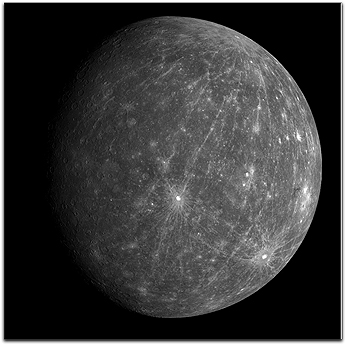
Mercury While Mercury may appear as a battered surface, a NASA spacecraft gliding over its surface for the second time this year has revealed more previously unseen real estate on the innermost planet. The probe also has produced several science firsts and is returning hundreds of new photos and measurements of the planet‘s surface, atmosphere and magnetic field. Image of Mercury captured by MESSENGER on the probe’s second approach. Credit: NASA/Johns Hopkins University Applied Physics Laboratory/Carnegie Institution of Washington

“Now that MESSENGER’s cameras have imaged more than 80 percent of Mercury, it is clear that, unlike the moon and Mars, Mercury’s surface is more homogeneously ancient and heavily cratered, with large extents of younger volcanic plains lying within and between giant impact basins,” said co-investigator Mark Robinson of Arizona State University in Tempe. Spacecraft images also are revealing for the first time vast geologic differences on the surface.

The MErcury Surface, Space ENvironment, GEochemistry, and Ranging, or MESSENGER, spacecraft flew by Mercury shortly after 4:40 a.m. EDT, on October 6. It completed a critical gravity assist to keep it on course to orbit Mercury in 2011 and unveiled 30 percent of Mercury’s surface never before seen by a spacecraft.

This is no small task. Point your spacecraft in the right direction to pass by the planet as it orbits the Sun, and get whatever information you can during the high-speed rendezvous. That was NASA’s strategy during the early days of Solar System exploration, and it provided them with an incredible amount of insight into the universe. The difficulty level gets turned up a notch when talking about “orbital insertion”. You’re not just flying by the planet; you’re getting there and then slowing down to the point where the world that you want to explore pulls your spacecraft into orbit around it. Too slow and your probe will drop into the planet’s atmosphere and burn up. Too fast and you’ll fly off into space, stuck helpless in a solar orbit for billions of years.
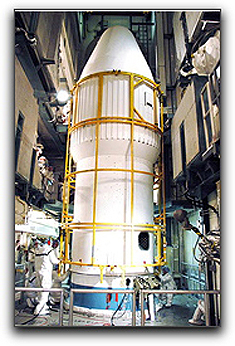
MESSENGER NASA’s MESSENGER will head into space with all the energy and speed it had when it left the Earth, and then have to slow down to meet up with Mercury. This means MESSENGER has to burn off a lot of energy during its journey. One way is to carry a large amount of fuel and perform braking maneuvers during the trip. But fuel already accounts for more than half of MESSENGER’s total launch weight; adding more would weigh down the spacecraft to the point where it wouldn’t be practical to launch at all. Image to left: Workers at Pad 17-B prepare the Delta II payload fairing for installation around MESSENGER. On August 2, 2004, as the spacecraft prepared for a 7-year trek to Mercury. Credit: NASA.

“The region of Mercury’s surface that we viewed at close range for the first time this month is bigger than the land area of South America,” said Sean Solomon, principal investigator and director of the Department of Terrestrial Magnetism at the Carnegie Institution of Washington. “When combined with data from our first flyby and from Mariner 10, our latest coverage means that we have now seen about 95 percent of the planet.”

The spacecraft’s science instruments operated throughout the flyby. Cameras snapped more than 1,200 pictures of the surface, while topography beneath the spacecraft was profiled with a laser altimeter. The comparison of magnetosphere observations from the spacecraft’s first flyby in January with data from the probe’s second pass has provided key new insight into the nature of Mercury’s internal magnetic field and revealed new features of its magnetosphere. The magnetosphere is the volume surrounding Mercury that is controlled by the planet’s magnetic field.

“The previous flybys by MESSENGER and Mariner 10 provided data only about Mercury’s eastern hemisphere,” explains Brian Anderson of the Johns Hopkins University Applied Physics Laboratory, known as APL, in Laurel, Md. “The most recent flyby gave us our first measurements on Mercury’s western hemisphere, and with them we discovered that the planet’s magnetic field is highly symmetric.”

The Mercury Atmospheric and Surface Composition Spectrometer observed Mercury’s thin atmosphere, known as an exosphere. The instrument searched for emissions from sodium, calcium, magnesium, and hydrogen atoms. Observations of magnesium are the first detection of this chemical in Mercury’s exosphere. Preliminary analysis suggests that the spatial distributions of sodium, calcium, and magnesium are different. Simultaneous observations of these spatial distributions, also a first for the spacecraft, have opened an unprecedented window into the interaction of Mercury’s surface and exosphere.

The project is the seventh in NASA’s Discovery Program of lower-cost, scientifically focused missions. APL designed, built and operates the spacecraft and manages the mission for NASA’s Science Mission Directorate in Washington. Science instruments were built by APL; NASA’s Goddard Space Flight Center in Greenbelt, Maryland; the University of Michigan, Ann Arbor; and the University of Colorado, Boulder. GenCorp Aerojet of Sacramento, California, and Composite Optics Inc. of San Diego, provided the propulsion system and composite structure.

Filed Under: Exploration & Science Missions

Primary Sidebar

Coverage

  • Missions & Constellations
  • Business & Finance
  • Military & Defense
  • Launch
  • Software Automation & Ground Systems
  • Government & Regulation
  • Services & Applications

Most Read Stories

  • SpaceX Loses Contact With Starlink Satellite
  • Rocket Lab Emerging as Potential Bus Provider for 2,800-Satellite Equatys Constellation
  • SpaceX Accelerates Record-Breaking IPO Following Trillion-Dollar xAI Merger
  • Planet Labs Imposes Indefinite Blackout on Iran Satellite Imagery at U.S. Request
  • Amazon in Reported Talks to Acquire Globalstar in $9 Billion Move to Challenge Starlink

Secondary Sidebar

Footer


Satnews is a leading provider of satellite news, events, publications, research and other satellite industry information in both commercial and military enterprises worldwide.

Stories By Category

  • Business & Finance
  • Government & Regulation
  • Launch
  • Military & Defense
  • Missions & Constellations
  • Services & Applications
  • Software Automation & Ground Systems
  • Spectrum & Licensing
  • Startups & NewSpace Business

About Us

  • Leadership & Editorial Team
  • SatNews History
  • Free Satnews Subscription
  • SatNews Events
  • Magazines

Navigation

  • Latest Stories
  • Magazines
  • Events
  • Contact
  • Cookie & Privacy Policy for Satnews

We use cookies to ensure that we give you the best experience on our website. If you continue to use this site we will assume that you are happy with it.
x
Sign up Now (For Free)
Access daily or weekly satellite news updates covering all aspects of the commercial and military satellite industry.
Invalid email address
Notify Me Regarding ( At least one ):
We value your privacy and will not sell or share your email or other information with any other company. You may also unsubscribe at anytime.

Click Here to see our full privacy policy.
Thanks for subscribing!