

 Big news came with the latest observations from NASA’s Spitzer Space Telescope which reveals that the nearest planetary system to our own has two asteroid belts — our own solar system has just one. The star at the center of the nearby system, called Epsilon Eridani, is a younger, slightly cooler and fainter version of the sun. Previously, astronomers had uncovered evidence for two possible planets in the system, and for a broad, outer ring of icy comets similar to our own Kuiper Belt. Right: NASA’s Spitzer Space Telescope captured this picture of comet Holmes in February 2008, four months after the comet suddenly erupted and brightened a millionfold overnight. Image credit: NASA/JPL-Caltech
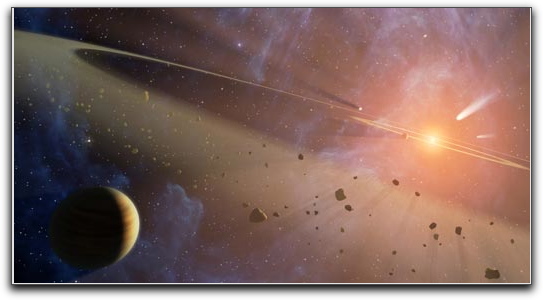 Now, Spitzer has discovered that the system also has dual asteroid belts. One sits at approximately the same position as the one in our solar system. The second, denser belt, most likely also populated by asteroids, lies between the first belt and the comet ring. The presence of the asteroid belts implies additional planets in the Epsilon Eridani system. Left: This artist’s conception shows the closest known planetary system to our own, called Epsilon Eridani. Observations from NASA’s Spitzer Space Telescope show that the system hosts two asteroid belts, in addition to previously identified candidate planets and an outer comet ring.
Astronomers have detected stars with signs of multiple belts of material before, but Epsilon Eridani is closer to Earth and more like our sun overall. It is 10 light-years away, slightly less massive than the sun, and roughly 800 million years old, or one-fifth the age of the sun.
Because the star is so close and similar to the sun, it is a popular locale in science fiction. The television series Star Trek and Babylon 5 referenced Epsilon Eridani, and it has been featured in novels by Issac Asimov and Frank Herbert, among others.
The popular star was also one of the first to be searched for signs of advanced alien civilizations using radio telescopes in 1960. At that time, astronomers did not know of the star’s young age.
“This system probably looks a lot like ours did when life first took root on Earth,” said Dana Backman, an astronomer at the SETI Institute, in Mountain View, California, and outreach director for NASA’s Sofia mission. “The main difference we know of so far is that it has an additional ring of leftover planet construction material.” Backman is lead author of a paper about the findings to appear January 10 in the Astrophysical Journal.
Asteroid belts are rocky and metallic debris left over from the early stages of planet formation. Their presence around other stars signals that rocky planets like Earth could be orbiting in the system’s inner regions, with massive gas planets circling near the belts’ rims. In our own solar system, for example, there is evidence that Jupiter, which lies just beyond our asteroid belt, caused the asteroid belt to form long ago by stirring up material that would have otherwise coalesced into a planet. Nowadays, Jupiter helps keep our asteroid belt confined to a ring.
Spitzer observed Epsilon Eridani with both of its infrared cameras and its infrared spectrometer. When asteroid and comets collide or evaporate, they release tiny particles of dust that give off heat, which Spitzer can see. “Because the system is so close to us, Spitzer can really pick out details in the dust, giving us a good look at the system’s architecture,” said co-author Karl Stapelfeldt of NASA’s Jet Propulsion Laboratory, Pasadena, California.
The asteroid belts detected by Spitzer orbit at distances of approximately 3 and 20 astronomical units from the star (an astronomical unit is the average distance between Earth and the sun). For reference, our own asteroid belt lies at about 3 astronomical units from the sun, and Uranus is roughly 19 astronomical units away.
One of the two possible planets previously identified around Epsilon Eridani, called Epsilon Eridani b, was discovered in 2000. The planet is thought to orbit at an average distance of 3.4 astronomical units from the star, just outside the innermost asteroid belt identified by Spitzer. This is the first time that an asteroid belt and a planet beyond our solar system have been found in a similar arrangement as our asteroid belt and Jupiter.
Some researchers had reported that Epsilon Eridani b orbits in an exaggerated ellipse ranging between 1 and 5 astronomical units, but this means the planet would cross, and quickly disrupt, the newfound asteroid belt. Instead, Backman and colleagues argue that this planet must have a more circular orbit that keeps it just outside the belt.
The other candidate planet was first proposed in 1998 to explain lumpiness observed in the star’s outer comet ring. It is thought to lie near the inner edge of the ring, which orbits between 35 and 90 astronomical units from Epsilon Eridani.
The intermediate belt detected by Spitzer suggests that a third planet could be responsible for creating and shepherding its material. This planet would orbit at approximately 20 astronomical units and lie between the other two planets. “Detailed studies of the dust belts in other planetary systems are telling us a great deal about their complex structure,” said Michael Werner, co-author of the study and project scientist for Spitzer at JPL. “It seems that no two planetary systems are alike.”
Astronomers think that each of Epsilon Eridani’s asteroid belts could have a planet orbiting just outside it, shepherding its rocky debris into a ring in the same way that Jupiter helps keep our asteroid belt confined. The planet near the inner belt was previously identified in 2000 via the radial velocity, or “star wobble,” technique, while the planet near the outer belt was inferred when Spitzer discovered the belt.
The inner belt orbits at a distance of about 3 astronomical units from its star, or about the same position as the asteroid belt in our own solar system (an astronomical unit is the distance between Earth and our sun). The second asteroid belt lies at about 20 astronomical units from the star, or a position comparable to Uranus in our solar system. The outer comet ring orbits from 35 to 90 astronomical units from the star; our solar system’s analogous Kuiper Belt extends from about 30 to 50 astronomical units from the sun.
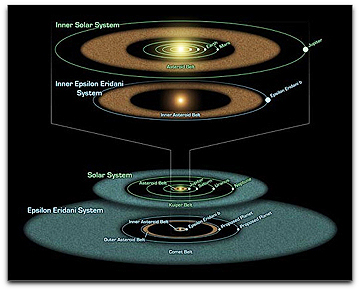 Epsilon Eridani is our closest known planetary system, located about 10 light-years away in the constellation Eridanus. Its central star is a younger, fainter version of our sun, and is about 800 million years old, about the same age of our solar system when life first took root on Earth. Right: This artist’s diagram compares the Epsilon Eridani system to our own solar system. The two systems are structured similarly, and both host asteroids (brown), comets (blue) and planets (white dots).
Observations from NASA’s Spitzer Space Telescope show that the system hosts two asteroid belts, in addition to previously identified candidate planets and an outer comet ring. Epsilon Eridani’s inner asteroid belt is located at about the same position as ours, approximately three astronomical units from its star (an astronomical unit is the distance between Earth and the sun.). The system’s second, denser belt lies at about the same place where Uranus orbits in our solar system, or 20 astronomical units from the star.
In the same way that Jupiter lies just outside our asteroid belt, shepherding its rocky debris into a ring, Epsilon Eridani is thought to have planets orbiting near the rims of its two belts. The first of these planets was identified in 2000 via the radial velocity technique. Called Epsilon Eridani b, it orbits at an average distance of 3.4 astronomical units, placing it just outside the system’s inner asteroid belt.
The second planet orbiting near the rim of the outer asteroid belt at 20 astronomical units was inferred when Spitzer discovered the belt.
A third planet might orbit in Epsilon Eridani at the inner edge of its outermost comet ring, which lies between 35 and 90 astronomical units. This planet was first hinted at in 1998 due to observed lumpiness in the comet ring.
The outer comet ring around Epsilon Eridani is denser than our comet ring, called the Kuiper belt, because the system is younger. Over time, Epsilon Eridani’s ring will become wispier like the Kuiper Belt. Its comets will collide with each other and break up, or get pushed out of the ring by the gravitational influences of planets.
