

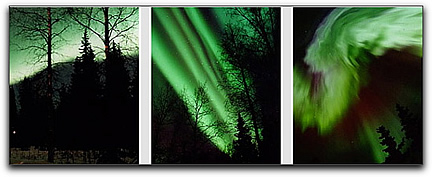
 Those beautiful and complicated Northern Lights, or aurora borealis — what makes them move and brighten? NASA will tell all at a media teleconference on Thursday, July 24, at 1 p.m. EDT, to announce the first results from a fleet of five satellites.
The satellites comprise NASA’s Time History of Events and Macroscale Interactions during Substorms (THEMIS) mission. Originally launched in February 2007, the satellite constellation is helping resolve the mystery of what triggers geomagnetic substorms, or atmospheric events visible in the Northern Hemisphere. Data from the mission may help protect commercial satellites and humans living in space from the adverse effects of particle radiation.
The briefing participants include: Vassilis Angelopoulos, THEMIS principal investigator, University of California, Los Angeles, California; David Sibeck, THEMIS project scientist, NASA’s Goddard Space Flight Center, Greenbelt, Maryland; Chuck Goodrich, THEMIS program scientist, NASA Headquarters, Washington D.C.; Nicola Fox, scientist, Johns Hopkins University Applied Physics Laboratory, Laurel, Maryland.
