

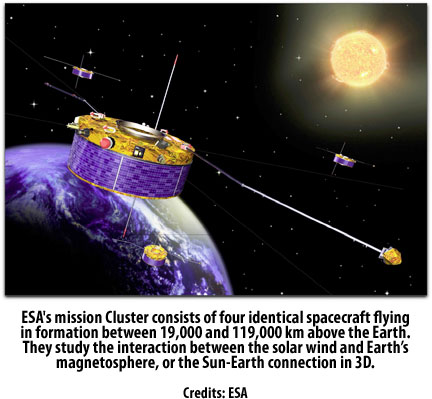
 The first sound an alien race is likely to hear from Earth are chirps and whistles. These are the sounds that accompany the brilliant aurora in our northern skies. ESA’s Cluster mission is showing scientists how to understand this emission and, in the future, search for alien worlds by listening for their sounds. Scientists call this radio emission the Auroral Kilometric Radiation (AKR), which is generated high above the Earth, by the same shaft of solar particles that then causes an aurora to light the sky beneath. For decades, astronomers had assumed that these radio waves travelled out into space in an ever-widening cone, rather like light emitted from a torch. Thanks to Cluster, astronomers now know this is not true. By analyzing 12,000 separate bursts of AKR, a team of astronomers have determined that the AKR is beamed into space in a narrow plane. This is like placing a mask over the torch with just a small slit in the middle for light to escape.
AKR was discovered by satellites in the early 1970s. AKR is blocked from reaching the ground by our planet’s ionosphere. This is just as well—otherwise, AKR would overwhelm the transmissions from all our radio stations. AKR is 10,000 times more intense than even the strongest military radar signal. Not only will this new understanding of how the AKR is beamed into space help astronomers understand the magnetic environment of those gas worlds, it will also help them search for similar planets around other stars.
