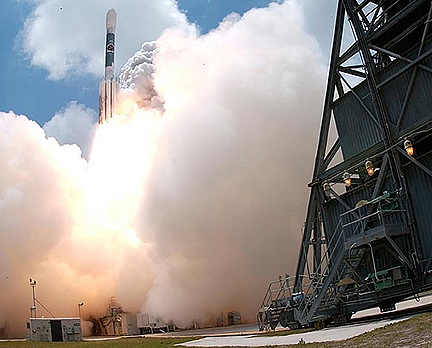
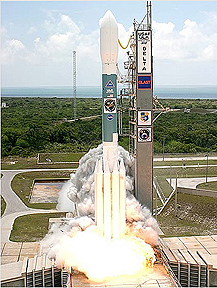
 High-fives and a loud WooHoo! After a number of delays, finally, NASA’s Gamma-ray Large Area Space Telescope, or GLAST, successfully launched aboard a Delta II rocket from Cape Canaveral Air Force Station in Florida at 12:05 p.m. EDT, June 11th. The GLAST observatory separated from the second stage of the Delta II at 1:20 p.m. and the flight computer immediately began powering up the components necessary to control the satellite. Twelve minutes after separating from the launch vehicle, both GLAST solar arrays were deployed. The arrays immediately began producing the power necessary to maintain the satellite and instruments, while the operations team continues to check out the spacecraft subsystems. With high sensitivity GLAST is the first imaging gamma-ray observatory to survey the entire sky every day. It will give scientists a unique opportunity to learn about the ever-changing universe at extreme energies.
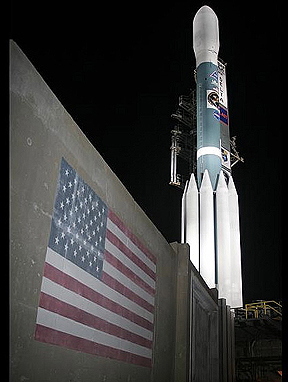 After a 75-minute flight, the GLAST spacecraft was deployed into low
Earth orbit 350 miles above the Earth. It will begin to transmit initial instrument data after about three weeks. The telescope will explore the most extreme environments in the universe, searching for signs of new laws of
physics and investigating what composes mysterious dark matter. It
will seek explanations for how black holes accelerate immense jets of
material to nearly light speed, and look for clues to crack the
mysteries behind powerful explosions known as gamma-ray bursts.
NASA’s GLAST mission is an astrophysics and particle physics
partnership, developed in collaboration with the U.S. Department of
Energy, along with important contributions from academic institutions
and partners in France, Germany, Italy, Japan, Sweden and the U.S.
After a 75-minute flight, the GLAST spacecraft was deployed into low
Earth orbit 350 miles above the Earth. It will begin to transmit initial instrument data after about three weeks. The telescope will explore the most extreme environments in the universe, searching for signs of new laws of
physics and investigating what composes mysterious dark matter. It
will seek explanations for how black holes accelerate immense jets of
material to nearly light speed, and look for clues to crack the
mysteries behind powerful explosions known as gamma-ray bursts.
NASA’s GLAST mission is an astrophysics and particle physics
partnership, developed in collaboration with the U.S. Department of
Energy, along with important contributions from academic institutions
and partners in France, Germany, Italy, Japan, Sweden and the U.S.
“The entire GLAST Team is elated the observatory is now on-orbit and all systems continue to operate as planned,” said GLAST program manager Kevin Grady of NASA’s Goddard Space Flight Center in Greenbelt, Maryland.
“After a 60-day checkout and initial calibration period, we’ll begin science operations,” said Steve Ritz, GLAST project scientist at Goddard. “GLAST soon will be telling scientists about many new objects to study, and this information will be available on the Internet for the world to see.” —Cape Canaveral Air Force Station, Florida