

By Nick David, Editorial Lead, SatNews
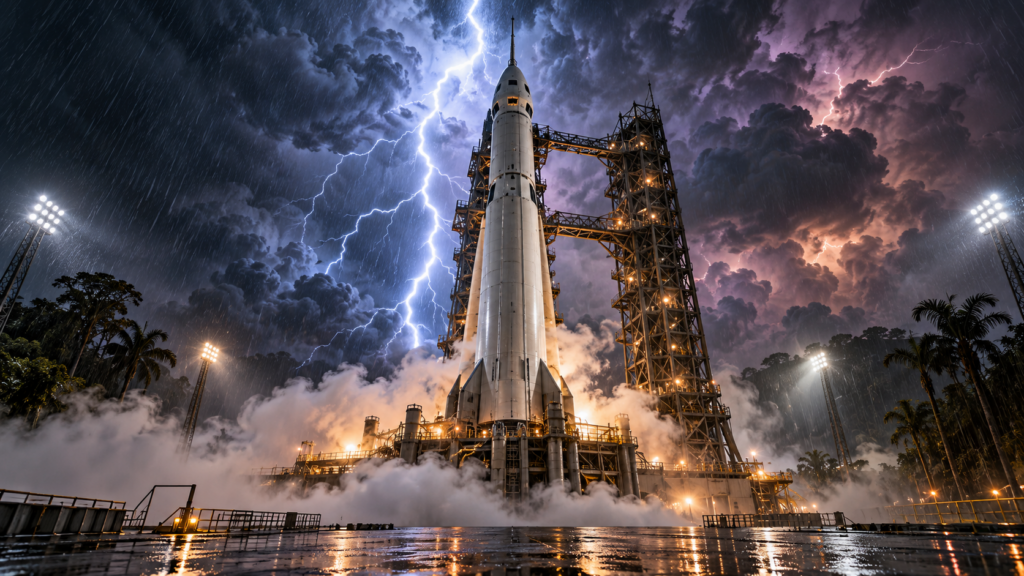
European ministers meeting in Rome on Dec. 15 will be asked whether Europe should build its own crew transportation capability, and the question put to them runs well past a capsule.
Josef Aschbacher, director general of the European Space Agency, set out the scope on the opening morning of World Space Business Week in Paris on Sept. 14, in a fireside chat with Novaspace’s Carla Filotico, the first session after the opening remarks on the event’s Summit for Satellite Financing track. Ministers will be asked, he said, “whether Europe would like to invest also in crew transportation. That means more autonomy also in human transportation, astronaut transportation. And that means an end-to-end chain from the rocket to the crew vehicle, launch abort system, the science, the operations in orbit, crew recovery, and everything that is needed with control centers and so on, whether we would like to engage in this or not.”
He was direct about the weight of it. “If it happens, and I’ll say if it happens, that means if the member states decide so, that would be quite historic.”
A political decision, with the bill to follow
The Intermediate Ministerial Meeting sits between ESA’s November 2025 ministerial in Bremen and the next full Council at ministerial level in 2028, which Italy will host. Aschbacher was explicit that December should not be read as a spending event.
“It is not a funding moment,” he said. “It’s not a funding summit, but it’s a political decision.” He likened it to the 2023 Seville summit, where ministers decided on launchers and on the LEO Cargo Return Service. He briefly called that a crew vehicle before correcting himself: “Sorry, a cargo vehicle, almost a Freudian slip.” Of Rome, he said: “The decision I hope will be made in December. And then obviously the funding will come through our usual mechanism.”
It is not a funding moment. It’s not a funding summit, but it’s a political decision.
That mechanism is ESA’s subscription process: once the political direction is set, member states commit money program by program.
A price is already in circulation
ESA has published no cost estimate for an end-to-end European crew capability, but Aschbacher has offered one. On Sept. 10, AFP reported that he put it at around €1 billion a year for the next decade. Continuing to buy seats for European astronauts from foreign providers would cost about €5 billion over the same period. He has been making the case since at least May, when he titled an Agence Europe op-ed “Are we pilots or passengers?”
President Emmanuel Macron, who hosted the International Space Summit in Paris on Sept. 9 and 10, used the second day to attach dates to the ambition. He called for a European cargo capsule docking with the International Space Station within two years, a European lunar lander within five, and a crewed European capsule launching from Kourou within ten.
Parts of the chain are already under contract
The cargo service agreed at Seville was designed with an upgrade path. ESA said at the time that the service vehicle “could evolve to a crew vehicle and eventually serve other destinations.” The program’s second phase has since been renamed ALADDIN, for Autonomous LEO Accelerated Demo Docking to ISS Node.
On Sept. 10, during the Paris summit, ESA awarded The Exploration Company €760 million under ALADDIN for its Nyx capsule. The award breaks down as €310 million for a demonstration mission that must dock with the ISS no later than the second quarter of 2029, plus €450 million in options for two follow-on flights. It came two days after the company closed a $450 million Series C. Thales Alenia Space, which held the other Phase 1 contract, remains in the running: ESA said it is continuing a second-stage tendering process with the company to keep competition in the market.
The abort system has a starting point too. In April ESA opened a call for a Crew Launch Abort Demonstrator, a €1 million system-level definition study of up to 12 months. ESA describes it as the first step toward derisking a launch abort system for a crew vehicle.
At the launch end, three companies signed European Launcher Challenge contracts in August worth €543.6 million in total: Isar Aerospace (€197.8 million), Rocket Factory Augsburg (€186.9 million) and PLD Space (€158.9 million). A fourth award, to MaiaSpace, is still in process. Orbex, the fifth company preselected in 2025, entered administration in February. On Sept. 5, Isar’s Spectrum reached orbit from Andøya in Norway on its second flight; the first ended about 30 seconds after liftoff in March 2025. Aschbacher congratulated the company from the stage.
Europe’s Crew Chain · By the Numbers
760M
Euros: ALADDIN award to The Exploration Company for Nyx
543.6M
Euros: Launcher Challenge contracts signed in August
22.1B
Euros subscribed at the Bremen ministerial, November 2025
1B
Euros a year for a decade: Aschbacher’s crew estimate
He was careful not to let crew transport stand for the whole proposition. “I mentioned the human transport, but I should really say this is only one element,” he said. “It’s the tip of the iceberg. It’s the visible part.”
Paris produced a mandate
Asked what came out of the summit, Aschbacher described a mandate. “We got a call from the ministers to ESA to prepare the next decisions, to step up,” he said. “That means to lift the autonomy of Europe in space, in particular in exploration, but not only exploration, it’s really space in general.” He added that “nothing was decided, but it was a very clear political guideline.”
ESA member states endorsed a Call to Boost European Space Exploration on Sept. 9. It names three priorities: securing Europe’s access to and presence in low Earth orbit after the ISS, strengthening its position on and around the Moon, and using both as stepping stones toward Mars. ESA says it is preparing concrete options for Rome on that basis.
From Paris to Rome and Beyond
SEPT. 5, 2026
Isar’s Spectrum reaches orbit
Second flight, from Andøya
SEPT. 10, 2026
€760M ALADDIN award
The Exploration Company, for Nyx
DEC. 15, 2026
Rome ministerial meeting
Ministers decide on an end-to-end crew chain
2028
Next full ESA ministerial, in Italy
Subscriptions settle the funding
Q2 2029
Nyx demo docking deadline
No later than the second quarter of 2029
In his telling, autonomy is meant to make Europe a stronger partner. The aim is “not to isolate ourselves, but to be a very good partner internationally,” he said, naming the United States, Japan, the UAE, Australia and South Korea. “We need to be a stronger, good partner in order to be also able to establish strong international cooperation partnerships.”
The money behind the ambition
Member states subscribed €22.1 billion at Bremen in November 2025. ESA called it the largest commitment in its history: a 32% nominal increase on 2022, or 17% after inflation. Aschbacher said on stage that more than 40% of the Bremen funding went to programs ESA runs with the European Commission, among them Galileo, Copernicus and IRIS².
The next large European funding decision sits in Brussels, with the European Competitiveness Fund in the EU’s 2028–2034 budget framework. On June 16 the Council agreed a partial position on the fund that set aside financial and horizontal questions for the wider budget negotiation. Aschbacher was plain about where ESA stands: “I’d like to be very clear, we really need that.” That decision and ESA’s own 2028 ministerial will arrive around the same time. As he put it, there are “two big funding decisions in Europe to come.” He left the door open to crew there too: the EU program “might include eventually more ambitious access to space, programming around that, potentially human. We shall see.”
Speaking in a financing track, he also pointed to money from outside the institutions. ESA is putting more emphasis on private co-funding from venture capital, funding institutions and companies in other sectors, he said, citing European carmakers that are “discovering more and more space as one of the domains where they would like to also step in, invest.” His view: “we have to go outside our classical space sector and space community into new domains.”
Inside the agency, he offered reform as the case for trusting ESA with more. Since Bremen ESA has added a directorate for resilience, covering security and defense, and a CFO directorate to push contracts to industry faster. Time to contract is down 50%, and ESA is hiring about 500 people this year. Missions now sit in four categories, Alpha, Beta, Gamma and Delta, which range from fully reviewed science missions to commercial ones where ESA acts as an anchor customer and is “much more hands-off.”
His closing message was aimed at the room. “Sometimes it is said that Europe is too slow, too fragmented, too complicated,” he said. “But I can assure you, Europe is very strong, is very active, is very dynamic… Trust in us, work with us.”
The rest of the week kept returning to it
Later sessions came back to the crew question. On Sept. 15 the moderator of the global launch providers panel pointed back to the DG’s “teaser” on crew and asked Mitsubishi Heavy Industries for the Japanese view. MHI’s answer centered on cargo: it plans an HTV-X flight to the ISS once a year and a commercial version for post-ISS destinations.
The sharpest reply came from the commercial station builders on Sept. 16. Max Haot, chief executive of Vast, said the ISS “has to be retired at the end of 2030” and that his company’s “business model does not close if we don’t have Europe as a partner.” He welcomed ESA’s cargo award to The Exploration Company and the talk of a European crew capsule: “sovereignty is really bringing more assets to the table.” He also said what he wants from Europe: a commitment “to use the science and the crew capability of the space station, you know, something like sending an astronaut twice a year.” Europe’s side of any such deal would need budget, which puts the question back with ministers in Rome and, after them, with the 2028 subscriptions and the EU’s next budget.
Key Takeaway
On Dec. 15, ministers decide whether Europe commits to the full chain that would put a European astronaut in orbit on a European rocket. The cost will be settled afterward, through subscriptions at or ahead of the 2028 ministerial.
About the Author
A storyteller at heart, Nick David covers space policy, satellite markets, defense, and the technologies reshaping how humanity operates beyond Earth. With a background in creative direction, brand strategy, and editorial storytelling, he brings a modern lens to complex subjects and a relentless curiosity about what comes next.
