

On May 18, 2026, defense satellite communications provider iDirect Government announced the release of WCore, a virtualized waveform core and hardware abstraction layer designed for military satellite communications (MILSATCOM).
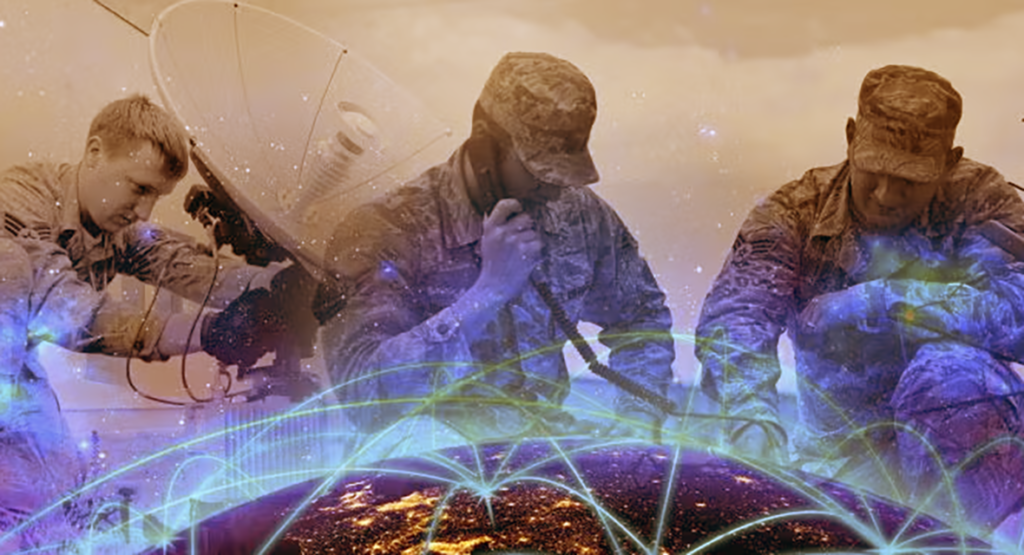
The software tool transforms traditional, single-purpose hardware appliances into multi-waveform software-defined modems (SDMs) that can operate across multiple satellite constellations and orbital planes.
Software-Defined Agility and Hardware Abstraction
The introduction of WCore addresses a long-standing bottleneck in military communications: the rigidity of hardware-dependent satellite modems. Historically, switching between different communication networks or waveforms required field operators to swap out physical line-replaceable units or maintain multiple parallel hardware stacks inside tactical vehicles and command posts.
WCore eliminates this complexity by virtualizing the underlying hardware interface. By creating a standardized abstraction layer between the physical processing circuits and the operational software, WCore allows different satellite waveforms to run as software applications on a unified compute platform. This approach enables defense developers to rapidly deploy, scale, and update communication protocols without needing to redesign or replace the physical modem hardware.
Multi-Waveform Support Across 16 Networks
The software layer is natively integrated into iDirectGov’s 4-Series hardware line, but it is engineered to be vendor-agnostic and deployable across high-density hub baseband appliances or standardized cloud-based software-defined modems.
The WCore framework provides tactical flexibility by supporting approximately 16 distinct military and commercial waveforms simultaneously, including:
- Evolution Defense and Sovereign platforms
- Viasat Global Xpress (GX) and SES Flex commercial networks
- Standard DVB-S2X high-throughput protocols
- The Enhanced Bandwidth Efficient Modem (EBEM) architecture
This diverse protocol support allows frontline personnel to maintain continuous command and control connectivity by rapidly switching between different satellite systems as they move through a theater of operations or encounter localized electronic jamming.
Centrally Managed Shared Security Services
Beyond providing interoperability, WCore functions as a shared-services engine, making critical security and anti-jamming capabilities uniformly accessible to every waveform running on the platform. Rather than requiring developers to program security features into each individual waveform, WCore applies them universally at the system layer.
These shared tactical capabilities include Federal Information Processing Standards (FIPS) compliance and robust transmission security (TRANSEC) protocols to prevent adversaries from intercepting or analyzing communication metadata. It also integrates Open AMIP and BMIP antenna-to-modem interface protocols alongside iDirectGov’s proprietary Communication Signal Interference Removal (CSIR) technology, which dynamically identifies and excises interfering signal spikes to maintain link stability during active electronic warfare attacks.
Multi-Orbit Resiliency for Modern Warfare
The rollout of WCore aligns directly with the U.S. Department of Defense’s shift toward multi-orbit, resilient satellite architectures. Modern defense missions increasingly require a single terminal to seamlessly route data across an integrated network of Geostationary (GEO), Highly Elliptical (HEO), Medium Earth Orbit (MEO), and Low Earth Orbit (LEO) constellations.
Tim Winter, President of iDirect Government, emphasized that today’s defense landscape demands seamless interoperability. He noted that WCore enables continuous command and control communications coverage throughout a theater by abstracting hardware complexity and accelerating third-party application integration.
By simplifying the inclusion of third-party software onto a single compute platform, WCore aims to provide a unified toolset for the next generation of highly contested, multi-orbit military communications.
