

Why Tactical SATCOM’s Future Is Integrated
By: Lite Coms (sponsored)
From Parts Bin to Platform: The Tactical SATCOM Shift
Tactical VSAT systems—spanning both parabolic and electronically steerable architectures—remain foundational to military and expeditionary communications. But as these systems evolve, the real challenge is no longer the terminal itself.
- Tactical VSAT terminals are evolving from discrete component stacks into unified system architectures, and the operators still evaluating terminals as standalone hardware are asking the wrong question
- The choice between parabolic and electronically steerable antennas is real, but it is a mission-dependent trade-off within a larger integration framework, not a technology war
- The decisive capability gap in tactical SATCOM is no longer the antenna. It is the seam between the antenna, the modem, and the operator interface, and closing that seam defines the next generation of deployable systems
For decades, deploying a tactical VSAT meant assembling a system from parts: an antenna from one vendor, an indoor modem from another, cabling between them, and a separate interface for each component. The operator, often working in austere conditions with limited training time, became the integration layer. Setup was slow. Troubleshooting was slower. The weakest link in the architecture was not the hardware. It was the space between the hardware.
That model is breaking down. Modern tactical SATCOM is converging toward integrated architectures where the terminal, modem platform, and control interface are designed as a single system rather than bolted together in the field. The shift is not cosmetic. It changes how quickly a system deploys, how reliably it operates, and how few personnel it requires to sustain.
Parabolic or ESA: A Mission Decision, Not a Technology Contest
The tactical VSAT market has split into two primary terminal architectures, and understanding when to use each is the first integration decision a program manager faces.
Parabolic VSAT terminals remain the workhorse for high-throughput, multi-band operations. Their advantages are well established: superior gain and link margin, proven multi-band capability across X, Ku, and Ka frequencies, and decades of operational heritage in expeditionary and fixed-site deployments. For backhaul missions requiring maximum throughput from a GEO, MEO, or HEO constellation, parabolic terminals deliver performance that flat-panel alternatives have not yet matched.
Electronically steerable antenna (ESA) terminals occupy a different operational niche. Low-profile, flat-panel designs with no mechanical acquisition eliminate the setup delay inherent in motorized dishes. Electronic beam steering enables communications-on-the-move (COTM), a capability parabolic systems cannot provide. ESA terminals are increasingly fielded on tactical vehicles, mobile command centers, and rapid-deployment kits where minutes matter and antenna profiles must stay low.
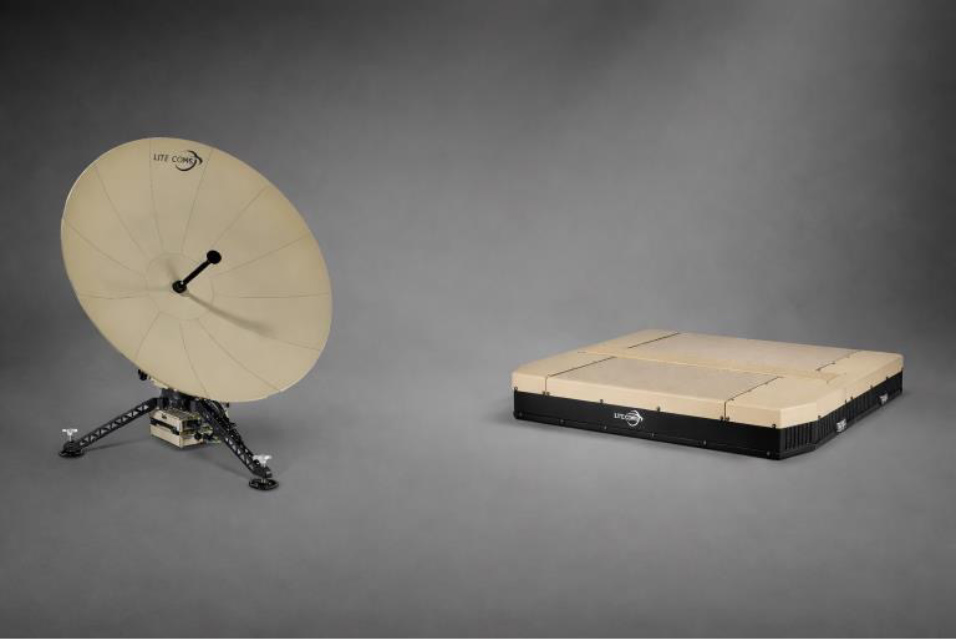
| Feature | Parabolic VSAT | ESA VSAT |
| Signal acquisition | Motorized auto-acquire | Electronic beam steering |
| Deployment time | Minutes | Near-instant |
| Mobility | Quick halt (COTP) | Full COTM capable |
| Constellation support | GEO, MEO, HEO | LEO, GEO, MEO |
| Throughput | High | Moderate to high |
| Best suited for | Expeditionary backhaul, fixed-site C2 | Tactical vehicles, mobile command, rapid deployment |
Neither architecture is obsolete. Neither is universally superior. The decision depends on the mission: a forward operating base requiring sustained high-bandwidth connectivity calls for parabolic. A convoy requiring uninterrupted SATCOM at speed calls for ESA. Increasingly, operational units deploy both, and the integration challenge multiplies.
Where the Real Complexity Lives: Below the Antenna
Look past the terminal itself. The harder integration problem is what sits between the antenna and the operator.
Traditional deployments housed the modem indoors, connected to the antenna by long cable runs that added weight, failure points, and setup time. Every cable connector was a potential fault in the rain. Every meter of coax was signal loss. The modem and antenna existed as separate kingdoms, each with its own power requirements, its own thermal envelope, its own interface.
The industry response has been to collapse the modem into the outdoor architecture. Tactical Modem Assemblies (TMAs), ruggedized outdoor modem platforms designed specifically for field deployment, eliminate the indoor rack, the cable runs, and the environmental protection overhead. Lite Coms’ AN/TSC-248 family of terminals illustrates the approach: a 1.3-meter auto-acquire antenna paired with a TMA housing an integrated iDirect 950mp satellite modem, wide-band custom Ku LNB, and Mission Microwave SSPAs in a single ruggedized enclosure. The TMA supports multi-waveform operation across FDMA, TDMA, and MF-TDMA access schemes, with passive fanless thermal management that eliminates moving parts in the cooling chain. The cabling shrinks. The footprint shrinks. The failure modes shrink.
Explore Lite Coms Tactical Modem Assemblies: https://www.litecoms.com/tactical-satellite-modems/
But integration does not stop at the modem. The third layer, the operator interface, determines whether a technically capable system is actually usable under pressure. Historically, operators managed separate interfaces for antennas, modems, and RF components. Three screens. Three login procedures. Three mental models. The training burden alone created operational friction that no amount of antenna performance could overcome.
Unified control interfaces collapse those three screens into one. Lite Coms’ Lite Link® GUI, a browser-based platform accessible from any connected device, provides a single pane of glass for satellite acquisition, real-time system health monitoring, modem configuration, and RF parameter management. The operator initiates the link, monitors performance, and troubleshoots faults from one environment without toggling between vendor-specific tools. The cognitive load drops. The time-to-operational drops faster.
Explore the Lite Link® GUI: https://www.litecoms.com/litelink-gui/
The Counterargument: Integration Has Trade-Offs
The case against tightly integrated systems is not trivial. Best-of-breed procurement, selecting the optimal antenna, the optimal modem, and the optimal interface independently, gives acquisition officers maximum flexibility and avoids vendor lock-in. If a superior modem enters the market, a modular architecture allows a swap without replacing the entire system. Integration, by definition, constrains that flexibility.
The counterargument holds in environments where technology refresh cycles are short and interoperability standards are mature. It weakens in tactical environments where setup speed, operator simplicity, and field reliability matter more than component-level optimization. When a team has 15 minutes to establish a SATCOM link in contested conditions, the performance gap between the best modem on the market and the second-best modem is irrelevant. The gap between a system that deploys in one step and a system that deploys in five is not.
The Integration Stack as Competitive Differentiator
Map these layers together and the architecture becomes clear:
Terminal (parabolic or ESA) → Ruggedized Modem Platform (TMA) → Network Control → Unified Interface
The effectiveness of a VSAT system depends not on any single layer but on how well the layers work together. An exceptional antenna paired with a mediocre modem interface delivers a mediocre operational experience. A well-integrated system with solid components at every layer delivers faster deployment, fewer failure modes, and lower training overhead.
This is where the tactical SATCOM market is heading. Recent DoD terminal procurements increasingly evaluate systems as integrated architectures rather than individual components, and modem vendors are designing products for specific antenna families rather than selling standalone boxes. The procurement language is shifting from “which antenna” to “which architecture.” Lite Coms has built its terminal portfolio around this philosophy from the start, with nearly 1,000 VSAT systems deployed across U.S. military operations and a multi-orbit, constellation-agnostic design approach that treats integration as the baseline, not the upgrade.
For operators and program managers evaluating their next tactical SATCOM deployment, the question is no longer which terminal has the highest gain or the fastest beam steering. It is which system, from terminal to modem to interface, deploys as one, operates as one, and fails gracefully as one. The parts bin era is closing. The integration era has arrived.
Learn More About Lite Coms
Tactical Satellite Modems: https://www.litecoms.com/tactical-satellite-modems/
Lite Link® GUI: https://www.litecoms.com/litelink-gui/
Lite Coms Homepage: https://www.litecoms.com/
