

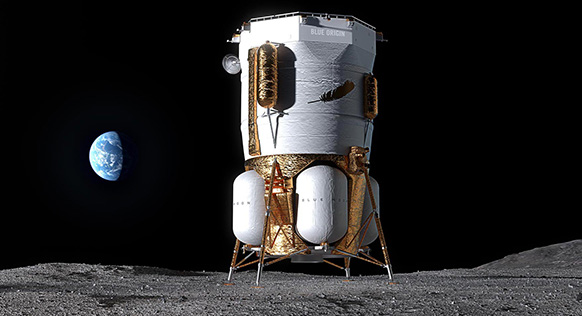
As NASA’s Artemis program faces mounting scrutiny over the delays and technical complexities of the Starship Human Landing System (HLS), a new strategic analysis suggests that Blue Origin’s Blue Moon Mark 1 (MK1) lander may provide the “innovative, affordable, and expedited” path necessary to maintain U.S. leadership in the lunar race against China.
The Blue Moon MK1 is a single-launch cargo lander designed to deliver up to 3 metric tons of payload to any location on the lunar surface.
The MK1 Advantage: Simplicity and Speed
While the human-rated Starship requires upwards of a dozen refueling launches to reach the Moon, the Blue Moon MK1 is a single-launch cargo lander optimized for the New Glenn launch vehicle. This architecture offers a significantly reduced risk profile for early-stage lunar infrastructure.
Key features of the MK1 platform include:
- Payload Capacity: Delivering 3 metric tons of cargo to the lunar surface in a single mission.
- LOX-LH2 Propulsion: Utilizing the high-performance BE-7 engine, which provides the efficiency needed for precision landings in the challenging terrain of the lunar South Pole.
- Expedited Timeline: Blue Origin’s first pathfinder mission, MK1-SN001, is currently manifesting for a late 2026 launch, potentially providing NASA with a “dry run” of lunar landing technologies ahead of human missions.
Strategic Context: The U.S.-China Space Race
The analysis from The Space Review posits that if the human-rated HLS variants (from both SpaceX and Blue Origin) continue to slip past 2028, the MK1 could serve as a critical bridge. By landing heavy cargo—such as habitats, rovers, and power systems—autonomously, NASA can build out a “lunar basecamp” even if the crewed landings are delayed.
This “cargo-first” strategy mirrors China’s Chang’e program, which has successfully landed multiple robotic missions to build operational experience before attempting crewed sorties.
Commercial Lunar Economy and CLPS
The MK1 is also a major contender for future Commercial Lunar Payload Services (CLPS) task orders. Unlike the smaller landers currently in use, the MK1’s massive payload bay allows it to carry large-scale international scientific instruments and commercial mining equipment, accelerating the maturation of a sustainable lunar economy.
Looking Ahead
Blue Origin is expected to conduct a full-duration hot-fire test of the BE-7 engine integrated with the MK1 flight tanks in Q2 2026 at its test facility in Huntsville, Alabama.
