

• Skip to primary navigation
  • Skip to main content
  • Skip to primary sidebar
  • Skip to secondary sidebar
  • Skip to footer
  • NEWS:
  • SatNews
  • SatMagazine
  • MilSatMagazine
  • SmallSat News
  • |     EVENTS:
  • SmallSat Symposium
  • Satellite Innovation
  • MilSat Symposium
  • SmallSat Europe

SatNews

Satellite Industry Intelligence Since 1983

Subscribe
  • LATEST
  • SatNews Events
  • Magazines
  • Calendar
  • Subscribe
  • Missions & Constellations
    • Exploration & Science Missions
    • In-Orbit Servicing & Orbital Operations
    • LEO Constellations
    • Mission Autonomy & Onboard Systems
    • Mission Deployments & Manifests
    • Navigation & PNT
    • SmallSat
    • Spacecraft & Payload Technology
    View All in Missions & Constellations →
    Exotrail Confirms Successful Deployment of NASA-Funded AEPEX CubeSat via Spacevan 002Exotrail Confirms Successful Deployment of NASA-Funded AEPEX CubeSat via Spacevan 002
    Global Space Economy Reaches 429 Billion Dollars as Commercial Satellite Sector DominatesGlobal Space Economy Reaches 429 Billion Dollars as Commercial Satellite Sector Dominates
    SmallSat Europe Speaker Focus: Dr. Oguz Karasu, Oxford Saïd Business SchoolSmallSat Europe Speaker Focus: Dr. Oguz Karasu, Oxford Saïd Business School
    Gen Z Influence on AI-Driven Audio MarketGen Z Influence on AI-Driven Audio Market
  • Business
    • Contracts & Commercial Deals
    • Earnings & Financial Reporting
    • Events & Conferences
    • Funding & Venture Capital
    • Market Forecasts
    • Mergers & Acquisitions
    • Personnel Moves & Appointments
    View All in Business & Finance →
    Intuitive Machines to Acquire Goonhilly Earth Station and COMSAT to Scale Deep Space NetworkIntuitive Machines to Acquire Goonhilly Earth Station and COMSAT to Scale Deep Space Network
    Energy Efficient E-Paper Displays Redefine Professional Digital SignageEnergy Efficient E-Paper Displays Redefine Professional Digital Signage
    Gilat Wins Big Military Contracts, Expands India FootprintGilat Wins Big Military Contracts, Expands India Footprint
    SmallSat Europe Speaker Focus: Stefano Antonetti, D-OrbitSmallSat Europe Speaker Focus: Stefano Antonetti, D-Orbit
  • Defense
    • Counterspace & ASAT
    • Defense Budgets & Procurement
    • ISR & Reconnaissance
    • MILSATCOM
    • Missile Warning & Defense
    • National Security Programs
    • Space Domain Awareness
    View All in Military & Defense →
    iDirect Government Launches 450 Rackmount Software-Defined Modem for Multi-Orbit DefenseiDirect Government Launches 450 Rackmount Software-Defined Modem for Multi-Orbit Defense
    US Air Force Taps L3Harris to Bolster ABMS Digital InfrastructureUS Air Force Taps L3Harris to Bolster ABMS Digital Infrastructure
    U.S. and Australia Expand Space Surveillance Network to Counter Emerging ASAT ThreatsU.S. and Australia Expand Space Surveillance Network to Counter Emerging ASAT Threats
    U.S. Space Force Awards $3.2 Billion for Space-Based Interceptor LayerU.S. Space Force Awards $3.2 Billion for Space-Based Interceptor Layer
  • Gov
    • Export Controls & Compliance
    • International Space Agreements
    • National Space Policy
    • Space Law & Treaties
    • Space Sustainability & Debris Policy
    • Space Traffic Management / Debris Removal
    View All in Government & Regulation →
    SES Extends IRIS² Review as Consortium Reaches Initial Project MilestoneSES Extends IRIS² Review as Consortium Reaches Initial Project Milestone
    FCC Approves Landmark Spectrum Sharing and Direct-to-Device FrameworksFCC Approves Landmark Spectrum Sharing and Direct-to-Device Frameworks
    Satellite and the Upcoming Spectrum AuctionSatellite and the Upcoming Spectrum Auction
    ATVA Urges FCC to Close “Affiliation-Swap” Loopholes Impacting Satellite OperatorsATVA Urges FCC to Close “Affiliation-Swap” Loopholes Impacting Satellite Operators
  • Launch
    • Launch Providers
    • Launch Schedule & Calendars
    • Launch Sites & Infrastructure
    • Rocket Technology & Vehicles
    View All in Launch →
    SpaceX Debuts Starship V3: Redefining Heavy-Lift Launch CapabilitySpaceX Debuts Starship V3: Redefining Heavy-Lift Launch Capability
    AST SpaceMobile Pivots to SpaceX for Mid-June Launch of Three BlueBird SatellitesAST SpaceMobile Pivots to SpaceX for Mid-June Launch of Three BlueBird Satellites
    SpaceX Accelerates Transition from Falcon 9 to Next-Generation Starship FleetSpaceX Accelerates Transition from Falcon 9 to Next-Generation Starship Fleet
    NanoAvionics Satellites Reach Orbit on SpaceX CAS500-2 MissionNanoAvionics Satellites Reach Orbit on SpaceX CAS500-2 Mission
  • Software
    • Autonomous Ground Operations
    • Data Processing & AI/ML
    • Digital Twins & Modeling
    • Ground Segment & Teleports
    • Mission Planning & Simulation
    • Space Systems Software Engineering
    • Spectrum & Licensing
    View All in Software Automation & Ground Systems →
    SpinLaunch Partners with Aalyria for Meridian Constellation Network OrchestrationSpinLaunch Partners with Aalyria for Meridian Constellation Network Orchestration
    Your anomaly detection isn’t the problemYour anomaly detection isn’t the problem
    SmallSat Europe Speaker Focus: Olaf Eckart, BMW GroupSmallSat Europe Speaker Focus: Olaf Eckart, BMW Group
    SES Accelerates Multi-Orbit IFC Strategy with meoSphere and Next-Gen ESA DevelopmentSES Accelerates Multi-Orbit IFC Strategy with meoSphere and Next-Gen ESA Development
  • Services & Apps
    • Climate & Environmental Monitoring
    • Disaster Response & Security Mapping
    • Earth Observation & Imaging
    • Maritime & Aviation Satcom
    • Satellite Communications
    View All in Services & Applications →
    Consumer NPU Boom Accelerates Autonomous Satellite ProcessingConsumer NPU Boom Accelerates Autonomous Satellite Processing
    Ted Turner: “Shake with Terror”Ted Turner: “Shake with Terror”
    Satellite Technology and the Legacy of the Media PioneerSatellite Technology and the Legacy of the Media Pioneer
    SmallSat Europe Speaker Focus: Massimo Comparini, Leonardo Space DivisionSmallSat Europe Speaker Focus: Massimo Comparini, Leonardo Space Division

Low Orbit Can Be Such a Drag

December 19, 2025

The edge of space is not a sharp line, but rather a fading gradient where the Earth’s atmosphere becomes progressively thinner until it eventually merges with the vacuum of the interplanetary medium.

While the official boundary of space is often cited at the Kármán line—100 kilometers above sea level—satellites operating in Low Earth Orbit (LEO) remain deeply immersed in the outermost layers of our planet’s gaseous envelope. Between altitudes of 200 and 600 kilometers, the air is billions of times thinner than at sea level, yet it remains dense enough to exert a relentless force known as atmospheric drag. This residual atmosphere, primarily composed of atomic oxygen and molecular nitrogen, acts as a subtle but inescapable brake on any object traveling at the orbital velocities required to stay aloft.

For a satellite to maintain its orbit, it must travel at approximately 7.8 kilometers per second. At these extreme speeds, even the most infrequent collisions with sparse air molecules create a cumulative resistance. This drag converts the kinetic energy of the spacecraft into heat, causing the satellite to lose velocity. As the satellite slows, Earth’s gravity pulls it into a lower, tighter orbit. The paradox of orbital mechanics dictates that as the satellite drops, it actually speeds up due to the conservation of angular momentum, but this descent also moves the craft into denser regions of the atmosphere. This creates a feedback loop: lower altitudes contain more molecules, which generate more drag, which further lowers the altitude. Without active propulsion to “re-boost” its position, the satellite enters a terminal spiral.

The density of this residual atmosphere is not constant; it is highly volatile and influenced heavily by solar activity. During periods of high solar flux, the Sun emits intense ultraviolet and X-ray radiation that heats the thermosphere, causing it to expand outward like a balloon. This expansion pushes denser air into higher altitudes where it previously did not exist.

A satellite that was relatively safe during a solar minimum may suddenly find itself “plowing” through a much thicker medium during a solar maximum. Such events can increase drag by a factor of ten or more in a matter of hours, leading to the premature and rapid deorbiting of entire constellations if they lack the fuel to fight back.

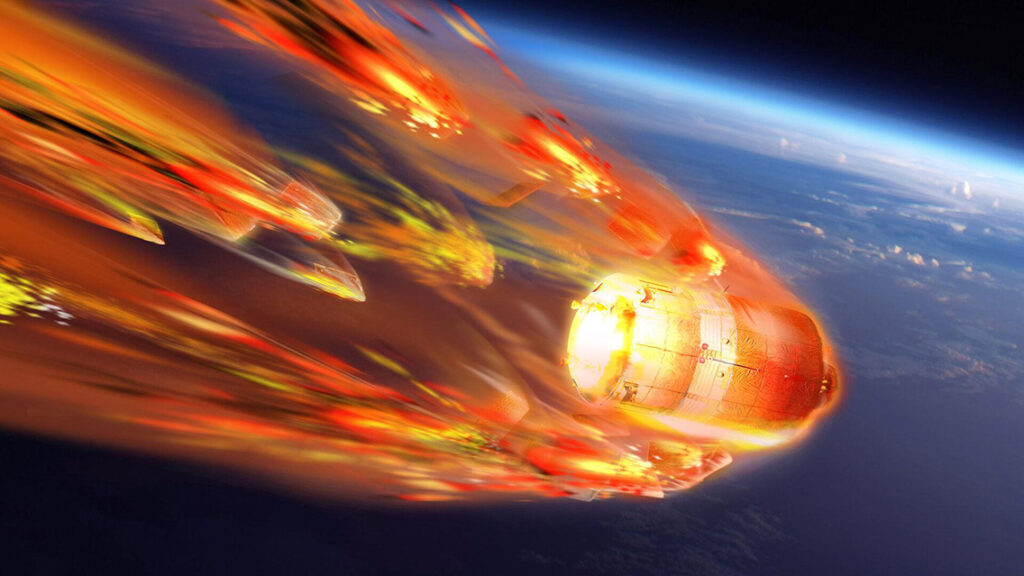
Once the satellite descends below the 200-kilometer threshold, the atmosphere becomes thick enough that the drag force becomes overwhelming. The structural integrity of the spacecraft is challenged by both mechanical stress and the intense thermal energy generated by friction. At this stage, the process of orbital decay transitions into a fiery reentry.

The satellite, having lost the battle against the lingering molecules of Earth’s atmosphere, eventually disintegrates and burns up, highlighting the fact that the “void” of space is, in reality, a very crowded and resisting medium. This phenomenon remains the primary challenge for long-term mission planning in LEO, necessitating a constant balance between orbital height, fuel reserves, and solar cycle predictions.

Satellite Orbital Lifespan: Solar Minimum vs. Solar Maximum

AltitudeSolar Minimum LifetimeSolar Maximum LifetimeImpact of Solar Activity
200 km1–2 days< 1 dayExtremely rapid decay; terminal reentry.
300 km1–2 years1–3 monthsLifespan reduced by up to 90% during solar max.
400 km10–20 years~1 yearThe ISS altitude; requires frequent re-boosting.
500 km50+ years5–10 yearsCritical threshold for “natural” debris mitigation.
600 km~100+ years25–50 yearsAtmosphere is thin but still exerts long-term drag.
800 kmMany centuries100+ yearsDrag is minimal; orbits are stable for generations.

Filed Under: In-Orbit Servicing & Orbital Operations

Primary Sidebar

Coverage

  • Missions & Constellations
  • Business & Finance
  • Military & Defense
  • Launch
  • Software Automation & Ground Systems
  • Government & Regulation
  • Services & Applications

Most Read Stories

  • NASA Shuts Off Instrument on Voyager 1 to Extend Interstellar Mission
  • Bad news, but good news followed
  • Blue Origin Achieves First Booster Reuse but Satellite Enters Off-Nominal Orbit
  • AST SpaceMobile Pivots to SpaceX for Mid-June Launch of Three BlueBird Satellites
  • The Smartest Money in the Room Is Looking Up

Secondary Sidebar

Footer


Satnews is a leading provider of satellite news, events, publications, research and other satellite industry information in both commercial and military enterprises worldwide.

Stories By Category

  • Business & Finance
  • Government & Regulation
  • Launch
  • Military & Defense
  • Missions & Constellations
  • Services & Applications
  • Software Automation & Ground Systems
  • Spectrum & Licensing
  • Startups & NewSpace Business

About Us

  • Leadership & Editorial Team
  • SatNews History
  • Free Satnews Subscription
  • SatNews Events
  • Magazines

Navigation

  • Latest Stories
  • Magazines
  • Events
  • Contact
  • Cookie & Privacy Policy for Satnews

We use cookies to ensure that we give you the best experience on our website. If you continue to use this site we will assume that you are happy with it.
x
Sign up Now (For Free)
Access daily or weekly satellite news updates covering all aspects of the commercial and military satellite industry.
Invalid email address
Notify Me Regarding ( At least one ):
We value your privacy and will not sell or share your email or other information with any other company. You may also unsubscribe at anytime.

Click Here to see our full privacy policy.
Thanks for subscribing!
