



A report by ESA indicates that they are responsible for better in-flight streaming and video-calling due to a project supported by the European Space Agency (ESA) that involved an experiment for a new type of antenna terminal together with ESA, Viasat. The plans are to commercialize the antenna’s new in-flight connectivity solution called Viasat Amara.
Viasat Amara has a dual-beam phased array antenna that provides both better access to video calling (a latency-sensitive use), as well as video streaming such as watching a football match (a bandwidth-sensitive use). The antenna makes it possible to connect to satellites both in low Earth orbit and in geostationary orbit, determined on which is needed. Links using satellites in low Earth orbit have lower latency with minimal communication delays, whereas those with satellites in geostationary orbit have a high bandwidth and so can transmit much more data.
“Phased array antennas are an evolutionary and much needed step towards more energy and space efficient in-flight connectivity solutions, and we are proud to have contributed to Project Aidan – a key milestone that led Viasat to developing Amara. We’re looking forward to next opportunities for cooperation with Viasat, and many other industry partners – for the benefit of all ESA Member States,” said Massimiliano Simeoni, Aidan’s Project Implementation Manager at ESA Connectivity and Secure Communications.

The antenna terminal was developed, designed and tested within an ESA partnership, under ESA’s program of Advanced Research in Telecommunications Systems (ARTES). The experiment, conducted in 2021, consisted of a demonstration flight from Rotterdam in the Netherlands to Payerne in Switzerland. The antenna provided a reliable satellite connection en route, enabling passengers to stream content on Youtube and Netflix, and video call with colleagues on the ground.
“The Viasat Aera terminal is a key part of Viasat Amara, our next generation in-flight connectivity solution going far beyond fast and free high-speed Wi-Fi,” said Viasat on its Viasat Amara announcement. “Our pioneering mission remains to help our airline customers maximize connectivity’s enormous potential for brand, loyalty, and growth. It’s been great to work with ESA as one of our key partners to help bring it to fruition.”

The antenna uses an innovative design, an electronically steered phased array. Rather than relying on a single large antenna that physically moves to track satellites, the antenna uses many small components. These individual elements coordinate the timing of their signals to have a unified connection, as an example it is similar to attendees participating in a stadium ‘wave’ that forms as each person stands up. This mirrors movement and provides not only a faster way to connect, but also the possibility of connecting to two satellites simultaneously.
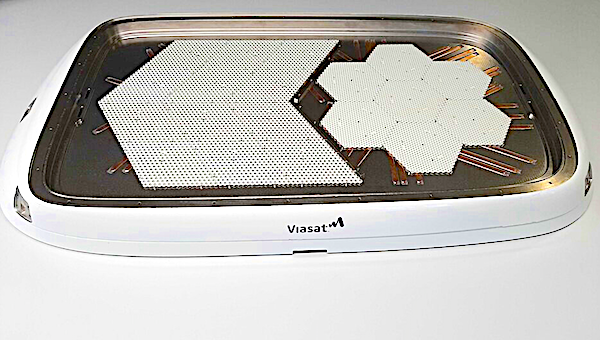
Viasat’s in-flight solution’s commercial service is expected to begin in 2028. As a result of the antenna’s modular technology, the product can be easily incorporated into existing antennas, making it cheaper and easier to incorporate in passenger airlines.
This antenna development marks the beginning of exciting opportunities for the future of onboard connectivity.
